Showing posts with label euro crisis. Show all posts

Monday, January 27, 2025

Loyalty > Competence

 Whenever I hear criticisms of Donald Trump -- or anybody else, for that matter -- valuing loyalty over competence I can only shake my head and say, well, duh!

Of COURSE loyalty is more important than competence.  To anyone who doubts it consider.  Suppose someone is disloyal and out to get you.  Would you rather they were supremely competent or a total idiot?  The answer is so obvious as to make the question rhetorical. When someone is disloyal, greater competence means greater danger.

So the real issue is not whether loyalty is more important than competence (it is), but whether the fear of disloyalty is rampant.  In other words, to say that someone values loyalty over competence really means that they are beset by fears of disloyalty.

These fears are usually justified.  In other words, when the fear of disloyalty is rampant, it usually means that disloyalty really IS rampant. 

There are a number of things that can make disloyalty widespread.  One is being surrounded by real enemies, offering numerous opportunities for betrayal. That is the situation, for instance, in a collection of city-states, or mafia gangs.  It could be a sleazy, underhanded leader asking people to do sleazy, underhanded things that undermine their morals, including their sense of loyalty.  That seems a fair description of Trump.  And it is also true, as some wise person remarked, that by regarding everyone around you as an enemy and treating everyone as an enemy you will, in fact, end up with a lot of enemies.  Note also that when disloyalty is rampant, it becomes self-perpetuating.  If everyone else is trying to stab each other in the back, only a fool and a sucker would refrain.*

Only a society in which loyalty is simply assumed can promotions be based on competence.  We have had that up until now.  Trump is undermining it.

So how does one guard against disloyalty?

It may seem terribly naive and utopian, but one important way to fight disloyalty is through moral authority.  That is, so far as I can tell, the real message in A Team of Rivals.  Instead of looking for loyalists, Lincoln chose the top talent in the Republican Party for is cabinet and won their loyalty.  It took no particular insight for Lincoln to recognize that his cabinet consisted of the top talent in the Republican Party.  His real genius was in persuading them to take orders from Mr. Nobody from Hicktown, Illinois.  Our whole system functions because our government has moral authority that people respect.  That is why Trump and MAGA's attacks on its moral authority are so dangerous.

Of course, this is not to suggest that moral authority alone can can prevent treachery.  Another way to prevent disloyalty is to make it difficult.  Treachery is easier in a small city-state surrounded by hostile neighbors than in a giant country with ocean to the east and west and friendly neighbors to the north and south.**  A favorite fantasy of mine is to imagine myself teaching civics in high school or political science in college and assigning my class to write a paper on what they could do to commit treason.*** The point would be that committing treason in our society today would be extremely difficult.**** It is easy to be loyal when there are almost no opportunities to be disloyal.

Another way is to lower the stakes for disloyalty.  This is the approach taken in most commercial capitalist ventures.  In a commercial/capitalist context, disloyalty is seen as a minor offense, if an offense at all.  Loyalty is valued to an extent, but too much loyalty is regarded as corrupt -- "crony capitalism."  In other words, it is not seen as dishonorably for an employee to leave a job when a better offer presents itself, or for an employer to lay off an employee it cannot afford to pay, or a customer to switch to a supplier who offers a better deal.  In another context, this would be seen a disloyal, but disloyalty of this type is tolerated because the stakes are not high -- it costs some money, that is all, and money is fungible and can be replaced.

What is valued is integrity -- honest dealings with strangers and associates alike.  This would mean not embezzling from an employer or selling trade secrets, but these things are condemned not so much as a betrayal, but as dishonest -- no worse, really than ripping off a stranger or deceit in arm's length transactions.  

Donald Trump famously commented that he valued loyalty more than integrity, but that is contrary to the ethos of a commercial/capitalist enterprise, which sees integrity as as foundational and loyalty is a mere extra -- nice to have, but not all that important.  For Trump to prize loyalty over integrity in business dealings is another way of saying he values honor among thieves.  But honor among thieves is not to be trusted.  People with no integrity can hardly be counted on to be loyal.  Another reason Trump is beset by fear of disloyalty.  

Of course, in the end moral authority, limited opportunity, and low stakes and only make disloyalty infrequent.  They cannot eliminate it altogether.  That is why we still have security clearances for people doing top secret work that really does offer opportunities for disloyalty with high stakes.

_________________________________________________
*That is why I do not believe people who think that Machiavelli's The Prince should be understood as satire, or as a warning to the common people.  It is a realistic assessment of how to survive when treachery is rampant.
**Trump can't do anything about the oceans, but he is working hard on alienating our friendly neighbors.
***Of course I would never actually do that.  It would be way to easy to misconstrue.
****I live in New Mexico.  It has Los Alamos Labs and Sandia Labs, both of which offer access to classified information.  So the first step would be to get a job there and somehow get access to classified information.  The next step is to visit the nearest Russian consulate, which is located in Houston, Texas -- 884 miles from Albuquerque and 904 miles from Los Alamos.  Presumably the Russians have spies around both Los Alamos and Sandia Labs, so you would not have to go to Houston every time you wanted to give them information.  But the point stands.

Sunday, August 11, 2019

One More Comment on the Brexit

Polls show that Brexit supporters feel very strongly that their sovereignty is on the line.  For the sake of Brexit, they are willing to see North Ireland, Scotland, and even Wales withdraw from the United Kingdom, and willing to see the economy crash.

This is widely being portrayed as irrational and hysterical, but I am not so sure.  After all many countries have made great sacrifices for the sake of protecting their sovereignty.

So maybe the real question is not whether withdrawal from the EU would entail some hardships -- we all agree that it would.  The real question should be whether Britain is withdrawing from the frying pan only to take refuge in the fire.

Donald Trump is eager to see a no-deal Brexit.  The reason he wants the Brits to leave without a deal is that if Britain leaves the EU regulatory zone, he can hope to bring Britain into the US regulatory zone.  And make no mistake, if Britain joins the US regulatory zone, it will not be as an equal partner, but has subordinate dependency.

Likewise, Vladimir Putin is eager to see Britain crash out of the EU without a deal, and his motives are obvious. What he wants is for the British economy to tank and Russia to come forward as the rescuer.  This will, of course, mean reducing Britain to a subordinate dependency -- of Russia.

So maybe the real question to ask Brexit supporters is not whether they are prepared to accept the loss of non-English Britain and the tanking of the economy for the sake of restoring England's sovereignty.  The question should be whether ending up as a subordinate dependency of either the US or Russia rates as sovereignty and, if not, whether it is a preferable infringement on sovereignty to the EU.

Sunday, August 4, 2019

Brexit is Going About How I Expected

When Salon used the purported Venn Diagram on the left to show the options for Brexit, I was unduly annoyed at the abuse of Venn Diagrams, but I could see what the outcome would be.  The diagram showed three alternatives.  A deal between Britain and the EU would be acceptable to Leave voters and would not crash the British economy, but was not acceptable to the EU, which wanted Britain to suffer.  A new referendum (with Leave probably failing) was acceptable to the EU and would not crash the British economy, but was not acceptable to Leave voters.  And crashing out without a deal was acceptable to both Leave voters and the EU, but would crash the British economy.

I could see how that was going to end up.  Either a deal or a referendum would force someone to back down in a humiliating fashion, and that obviously wasn't going to happen.  So if everyone dug in their heals, the only possible outcome was for Britain to crash out without a deal and let the chips fall where they may.

Of course, I was wrong about some things.  The EU did, after all, agree to give Britain a deal.  But Leave voters and leaders found the terms humiliating and unacceptable, so they turned it down.  The Brits needed some time to dither and delay in order to accept the pain of a no-deal exit as preferable to the humiliation of any deal the EU would offer, but they appear to have gotten there.  The delay also served the useful purpose of allowing the Brits to stockpile supplies for the initial shock of exit, so Brexit will doubtless be less painful that it would have been if it had happened sooner.

I recommended that what the Brits needed was a top-notch demagogue to sufficiently stoke their anger at being made an example of that they could see Brexit as a sort of war -- a replay of the WWI with their leader as a latter day Winston Churchill, the German-led EU as the Nazis, and the hardships associated with a no-deal leave as sort of like bombing during the Blitz.  That is, in fact, just what is happening now.  Although the British are not usually distinguished for their demagogues, three appear to have risen to the occasion -- Boris Johnson, Jeremy Corbyn, and Nigel Farage.  I am inclined to see Johnson as the least bad choice among them -- someone we can hope will direct British anger only at the EU and not at immigrants (as with Farage) or Jews (as with Corbyn).

Of course, I made the same suggestion to the Greeks when facing the possibility of Grexit.  They should combine skilled economic planning for leaving the euro (but not the EU) with a top-notch demagogue to treat the EU/Germans as Nazis and the ensuing hardships as the equivalent of WWII.  Admittedly, good planning and good demagogues do not often go together.  And, in the end, the Greeks backed down, not ready yet -- emotionally or technocratically -- to deal with the upheaval that would follow.  Perhaps if they had dragged out the negotiations for longer they might have both made adequate preparations to soften the blow as much as possible (though it would still have been severe) and to stoke public anger far enough the accept the Grexit and ensuing hardships.

Well, the Brits have had more than long enough now to make plans, and long enough to build public anger to where it can take No Deal.  They have also managed a reasonable division of labor -- Theresa May as the sober leader who made necessary plans to soften the impact of a no-deal Brexit, and Boris Johnson as the demagogue who will fire up the public to accept the pain of impact, whatever that may be.

Thursday, December 8, 2016

Why Hillary Lost

If you want to know why Donald Trump defeated Hillary Clinton as President, this story by Gallup, though written in mid-September, tells it all.  Here is Donald Trump's word cloud, based on the leading stories about him, week after week:

The word cloud does not have a single theme, but the main words, speech, immigration, convention, President, make, people and Mexico are presidential words, policy words, words you would expect to hear about a normal candidate doing presidential things and setting forth is views on the important issues facing this country. Week by week, the top words were "President," "convention," "Russia," "Obama," "family," "campaign," "immigration," "Mexico," "Mexico," and "Obama."  Other important words included "speech" and "immigration."  Certainly there is nothing here to suggest that Trump was anything other than a normal candidate, nothing to suggest his unprecedented lack of experience, his extraordinary conflicts of interest, his nature as a crook or a bully, his association with the semi-fascist Alt Right, his fondness for conspiracy theories verging on the paranoid, or any  of the countless reasons why he was not a normal candidate.


Now look at Clinton's word cloud:

What more is there to say?  With the exception of the week of the convention and the week when she collapsed with pneumonia, the leading story about Hillary Clinton every single week for two months was about her e-mails.  And after e-mails, the usual words were lie, scandal, foundation, health and pneumonia.

And let us give credit where it is due.  Trump, erratic is he may have been in some ways, maintained superb message discipline.  He hit on the e-mails over and over again, making clear that sending State Department e-mails on a private server was the most heinous offense any candidate for office had ever committed in the history of the Republic, that her missing e-mails showed she was hiding something worse, that only her status as candidate for President was keeping her out of jail, and that, if elected, he would remedy that.  In this, Trump got a lot of help for a cooperative press that breathlessly looked through every new revelation to see if there was any appearance of impropriety.  And sure enough, it turned out that as Secretary of State, Hillary Clinton sometimes spoke to people who had made large donations to her foundation, and that some of them wanted special access as a result, although none seemed to have gotten any.  Trump also got an assist from the Russians hacking and Wikileaks printing DNC and campaign e-mails that had nothing to do with the State Department or national security, but by then the voters had heard the terms "Clinton," "e-mails" and "scandal" together so many times that the details scarcely even mattered.  And, of course, there was the FBI's surprise announcement eleven days before the election that they were reopening the investigation.

Things eventually reached the point where you could expect something like this:
CLINTON E-MAILS REVEAL POTENTIAL CONFLICT OF INTEREST 
The latest e-mail revelations for Hillary Clinton reveal further potential conflicts of interest as growing numbers of large-scale donors to the Clinton Foundations appear to have met with her as Secretary of State.  While no evidence of any improper influence was found, and scheduling appears to been done by persons independent of the ones soliciting donations, the fact that donations did not come with a clear disclosure that making a donation meant that Clinton would never speak to the donor again raise troubling ethical issues. 
In further news today, Donald Trump shot someone in the middle of Fifth Avenue.
Of course, Trump had plenty of scandals, too.  The problems was not the lack of scandals, but that there were too many.  Confronted with such an embarrassment of riches, important publications like the Washington Post, USA Today and Newsweek published a new scandal a week, but none of them stuck around long enough to achieve any traction.  It would appear that leading an exemplary life with one slip is worse for a candidate than being a walking scandal because walking scandals don't allow for much focus.

The only Trump scandal that achieved any traction was the "pussy" tape.  Imagine, then, if the tape had been released in July.  Imagine if Trump promptly denied having done any of the things he bragged about on tape, and for the next two months the leading Trump story each week was a new woman coming forward to say that he had groped her.  Imagine if every interview with Trump had focused on the latest groping allegations.  Imagine if, just as things seemed to have settled down and the tapes seemed to be behind us, the mysterious woman who claims that Trump raped her when she was 13 years old came forward with her story.  And hell, suppose that two days before the election the word came out that her story had been found to be unsubstantiated.  Would it have made a difference.  Suppose that the leading words in Trump's cloud had been "pussy," "grab," "grope," "assault," and "tape."  It seems plausible that the election would have gone the other way.

Trump's response to the women who accused him of groping them was to say that they were all liars and paid shills of the corrupt Clinton machine.  That was a flagrant, shameless lie.  But it does seem reasonable to assume that if a new accuser had come forward each week for two months (or more) on end and accounts investigating hers story, in salacious detail, had dominated the news week after week, it would start to look as is there was a coordinated element to it.  But honestly, so what?  There is ample evidence that the Clinton e-mail revelations were also released in a calculated manner, to do most damage, by Republicans in the House Oversight Committee, the FBI, the Russians, and Wikileaks.*

For that matter, it wouldn't have to be the "pussy" tape.  Suppose litigation had been more intense on Trump University and week after week a new and embarrassing pleading was filed in court (public documents).  Or, on weeks when one wasn't filed, reporters started digging in the old pleadings in the case and revealing more and more about the Trump University had been up to.  And only after the public had been softened up by weeks and months of stories about Trump University did the story  break about the Trump Foundations illegal donation to a Florida Attorney General who was considering an investigation.  Trump's word cloud would have been more like "fraud," "lawsuit," "deception," and "bribe."  Of course, Trump could have spiked that simply by settling.  Or suppose reporters had become obsessed with his bankruptcy and how he looted the company and left shareholders holding the bag.  Or possible conflicts of interest in international relations (there are A LOT!), with a new one breaking week after week. (Instead of only noticing after he was elected). Any grand unifying theme would have been sufficient.**

The real question has to be, why did the media all play along with this?  Trump accused the media of being biased against him, as evidenced by so many leading media personalities being so dismayed when he won, and I think he is right.  Yet if the media were so biased against him, why did they focus so obsessively on Clinton's e-mails and conflicts of interest and fail to show Trump up for what he really was?  I think the only answer can be in a strange sort of way that they focused so harshly on Clinton precisely because they were biased against Trump.  One person commented that they considered Trump being a crook to be a "dog bites man" story.  But more to the point, I think they never bothered to fully expose him because it never occurred to them that he could actually win. They came down so hard on Clinton precisely because they expected her to be the next President and assumed that they should hold the next President's feet to the fire.

And look where it got us.
_______________________________________
*Although, to be clear, there is no evidence that any of these organizations except the Russians and Wikileaks coordinated with each other, and none whatever that they coordinated with Trump.  It is pointless to complain about Congressional Republicans.  They were simply playing politics as usual, using their powers of investigation to hurt the opposing party.  The FBI, on the other hand, is not supposed to meddle in elections, and they clearly behaved improperly in doing so.  And as for the Russians and Wikileaks -- well, I suppose they were doing what intelligence services do, but that it succeeded is troubling in the extreme.
**Though probably not Trump stiffing his contractors.  That did get a good deal of play but never bothered his supporters.  I assume the reason was that, although they did not condone his ripping off contractors, they appreciated that he knew how to drive a hard bargain and couldn't wait to see him do that to all the people ripping us off.

Saturday, August 22, 2015

The Neutering of Alexis Tsipras

All of which lead back to the subject of Greece.  Prime Minister Alexis Tsipras has called for elections on September 20 which, despite his disastrous performance, he is expected to win.  After defying Europe on austerity, loudly proclaiming Greek sovereignty, and calling a referendum to defeat an offensive austerity proposal, he then proceeded to cave and accept much harsher austerity terms and greater infringements on national sovereignty than the proposal that the people voted against.  So why is he still popular.  The cited article suggests three reasons:


  1. The only alternative to capitulation is leaving the euro, which the Greeks are not willing to do;
  2. Mainstream parties are thoroughly discredited, both by disastrous economic performance since 2008 and for their role in causing the mess in the first place;
  3. At least Tsipras made a serious effort to beat back austerity before he caved.  
I would add another reason.  People are tired of crisis and just want a return to normality, even if the current norm is really bad.  Tsipras, having done his level best before caving, is now ready to settle into his role as a respectable center-left political leader.

Of course, we know what has happened to respectable center-left leaders and parties in Europe since 2008.  They have embraced self-destructive austerity and are being abandoned in mass by their voters. The old center-left party in Greece has experienced mass defections to Syriza.  Now that Syriza has caved, where do they have left to go?

The crisis in Greece has truly driven home that there are only two alternatives -- either leave the euro, or stay on whatever terms the creditors choose to dictate.  Any attempt to resist the creditors will simply lead to harsher terms.  So why does leaving the euro remain so resolutely off the table?  This column believes that the Greeks are staying out of nationalism:

The Greeks, for their part, have been putting their national identity ahead of their pocketbooks, in ways that economists do not understand and continually fail to predict. It is economically irrational for Greeks to prefer continued membership in the eurozone, when they could remain in the EU with a restored national currency that they could devalue. 
But, for the Greeks, eurozone membership does not mean only that they can use the common currency. It places their country on a par with Italy, Spain, France, and Germany, as a “full member” of Europe – a position consistent with Greece’s status as the birthplace of Western civilization.
Maybe.  But I think what is really hard for people like me to understand is how "national identity" can be expressed by submitting to ever greater and more humiliating infringements on one's national sovereignty.  If there is one thing that these negotiations have made absolutely clear, it is that Greece is not, in fact, being treated as "on a par with Italy, Spain, France and Germany" -- well, at least with France and Germany.  Italy and Spain may be partners in humiliation.  The alternative is the prospect of leaving the euro is just too terrifying and that the Greeks still prefer the devil they know over the devil they don't know.

I guess it all depends on what happens next.  If the Greek economy recovers, no doubt Tsipras will remain popular and will be looked upon (quite wrongly) as a wise and foresighted statesman.  But if the economy continues to languish, then the pressure will continue to build for someone to do something to make it better.

And now I intend to abandon modern Greece and the modern world for a while and return to Ancient Greece and the overthrow of democracy in Athens in 411 B.C.

Monday, July 27, 2015

American Labels Don't Fit in Europe

To continue, American political labels just don't work in Europe.  They didn't hold well in the 1930's, and they don't apply well now.  In the US, the macroeconomic left can roughly be identified with people who favor counteracting economic downturns with stimulus, whether fiscal, monetary or by currency depreciation.  The macroeconomic right either believe that stimulus is futile and what is needed are structural reforms, or that the downturn is a necessary correction and any attempt to counter it simply prolongs the pain.  The macroeconomic left tends to correlate with the microeconomic left (i.e., people who favor health and safety regulations to protect labor, consumers, and the environment), although there are a few exceptions like market monetarists.  These things tend to correlate, although they do not have to.  Indeed, one of the basic concepts my freshman year macroeconomics textbook had was that how activist one believed government should be in demand management and how large one believed the public sector should be were separate issues.  But no one in the US makes the distinction.

Europe is another matter.  This article suggests that in the German economic and ideological framework of "ordoliberalism":
[F]or ordoliberals the state is not an impediment to the efficient functioning of markets; for them strong government regulation is a necessary prerequisite for competitive market activity. And unlike in the Austrian or Chicago variants of neoliberal thinking, a strong state is seen as necessary to produce the moral, legal, and social frameworks (the Ordnung) essential for the functioning of markets. 
These state-initiated rules were intended to approximate as closely as possible the functioning of a perfectly competitive market. Consequently, ordoliberals place an outsized emphasis on preventing the establishment of cartels and monopolies. By preventing the formation of powerful economic agents which can influence the prices of goods and services, the state can create a situation approximating a state of perfect competition, which will drive economic development without government stimulus or non-regulatory intervention. By controlling the size and power of economic agents, and by encouraging the formation of a strong state, ordoliberals hoped to prevent a situation of regulatory capture, thus protecting the market from subversion by powerful economic actors. 
Perhaps unsurprisingly for a philosophical tradition from Germany, a famously rule-obsessed country, the need for a robust system of rules runs throughout the ordoliberal project. For them, economic rules are seen as constitutional, as an inviolable part of the fabric of society. For people in the ordoliberal tradition, as the legal scholar David Gerber put it, any action “which does not conform to constitutional economic principles should be overturned by the courts…just as if it had violated the political constitution.” In effect, ordoliberalism “constitutionalizes” the economy and embeds it in a broader normative framework.
Social democratic parties have been paralyzed by fidelity to the euro, acceding to ever harsher austerity that slowly grinds their economies down.  In the words of Matt Yglesias, "[S]ocial democrats feel paralyzed by the bounds of the eurozone. They don't have a strategy for changing the rules and they don't have the guts to tear up the rulebook."  It has been right wing parties, irate over the invasion of their country's sovereignty, that have been the serious challengers to austerity and the modern equivalent of the gold standard.  And I confess, much though I disapprove of the scapegoating of immigrants, it is hard not to applaud far right parties for their clear-headedness on economic matters.

Which leads to the subject of Ambrose Evans-Pritchard, right wing British journalist, euroskeptic, business editor for the conservative Daily Telegraph, Clinton conspiracy theorist -- and Keynesian. He writes column  after irate column on the subject in language that makes Paul Krugman sound temperate.  And in particular he calls on the left wing to rediscover its identity and make common cause:
We Conservatives have watched in disbelief as one Socialist party after another immolates itself on the altar of monetary union, defending a project that favours the elites - a "bankers' ramp", as the old Left used to call it. 
We have watched our friends on the Left apologise for 1930s policies. We have seen them defend a regime of pro-cyclical fiscal cuts imposed on the whole eurozone by a handful of "Ordoliberal" reactionaries in the German finance minstry. . . . It has somehow found ways to justify a youth jobless rate still running at 42pc in Italy, 49pc in Spain and 50pc in Greece, despite mass emigration.
. . . . . . 
This is what they agreed to, and what they have reluctantly defended, because until now they dared not question the sanctity of EMU. And so the once mighty Dutch Labour Party has been reduced to a pitiful relic. Pasok has been obliterated in Greece. 
The Spanish Socialist Workers' Party has lost its left-wing to the rebel Podemos movement, freshly victorious in Barcelona. France's Socialist leader, Francois Hollande, has been languishing at 24pc in the polls as the French working class defects to the Front National.
And this is not so far from what happened to the center-left in Europe as well in the 1930's, even as the US was electing Roosevelt.  And, as I said before, I begin to see why some US liberals in the 1930's might have applauded Mussolini or even Hitler for having the gumption to "tear up the rulebook" and save their countries' economies.  

Sunday, July 26, 2015

Liberal Fascism Reconsidered

Anyone who followed me back when I was Enlightened Layperson knows that for a time I became obsessed with Jonah Goldberg's Liberal Fascism, without (I admit) actually going so far as to read it.  I generally agreed, however, with whoever it was who said that the book had already been written in 1944 under the title of The Road to Serfdom, and that Liberal Fascism was just a dumbed-down version.  In effect, any departure from libertarian minarchism that stops short of Communism is fascism.  And certainly any challenge to the will of the omnipotent and omniscient Free Market placed us on the Road to Serfdom.  And nowhere did I wax so indignant as on the subject of German Social Democrats who, after all, were champions of the eight-hour day, unemployment insurance, union representatives on corporate boards, and many other departures from strict libertarian economics, yet were the staunchest supporters of liberty and the Weimar Republic.  I said:
[I]f Goldberg's definition of fascism is broad enough to encompass the modern-day Democrats, there can be little doubt that the SDP would also be (inadvertently) caught in his net. . . . [D]oubtless it can be established that Social Democrats and fascists (as well as New Dealers) would agree on some (but not all) economic policies. But Nazis and Social Democrats were truly antipodes on the issue that mattered most of all -- respect for democratic norms and individual rights. 
If Goldberg wants to dismiss that aspect of fascism (and Nazism) as insignificant in order to score a few cheap points in the context of US politics, well, American liberals and Democrats can afford a thick hide. We are not being menaced by jackbooted Storm Troopers, after all. But to every brave German Social Democrat who stood up for democracy when the conservatives went along with Hitler, to every Social Democratic martyr who paid the price with loss of home and job, harassment, persecution, exile, prison, torture or murder for defending the democracy no one else was willing, Goldberg owes an apology.
I wrote that on January 31, 2008, aware at the time that our economy had some problems, but thinking of them as little more than distant events on the horizon, and certainly seeing the Great Depression has highly salient to understanding fascism, but of mostly historical interest.  I certainly did not foresee that a remarkably similar series of events would be playing out within the next few years!  But events then and now have forced me to learn more about international economics in general and the Great Depression in Europe in particular.  And what I have learned has compelled me to the conclusion that Goldberg, if he chose, could build up an ideological divide that would place Hitler, some of Hitlers conservative coalition partners, Mussolini, Japanese militarists, and Franklin Delano Roosevelt on one side (along with some Scandinavian Social Democrats as acceptable collateral damage); and German Social Democrats, the Catholic Center Party (ancestor to modern Christian Democrats), libertarians, and British politicians, Conservative and Labour, on the other.

The divide, of course, is Keynesian economics.  The German Social Democrats favored  social welfare programs, labor protective legislation, union representation on corporate boards, and other un-libertarian economic policies, but they were not Keynesians.  They never questioned the need to balance the budget but only suggested that cuts come from the military instead of unemployment insurance.  The German Social Democrats were prisoners of a semi-Marxist ideology, one that attempted to make Marxism a humanitarian ideology by keeping its indignation over the (genuine) abuses and flaws of capitalism, while rejecting the parts about violent revolution and hoping to achieve the grand utopia by reform instead.  In good times, this effectively meant building capitalism with a human face, but it left them completely paralyzed and unable to act in the face of the Great Depression.  Communists rejoiced in what seemed the final death throes of capitalism and prelude to the glorious socialist revolution.  Libertarians treated the downturn as a necessary shakeout to be endured.  And less ideologically rigid people, from Keynes on the left to elements of the German military on the right began calling for public works to revive the economy.  But German Social Democrats rejected such proposals.  As humanitarians they were horrified at the suffering they saw around them and by the prospect of revolution, but they were still too Marxist to be willing to save the capitalist system when it seemed to be destroying itself.  The British Labour Party, though less ideological, also embraced austerity.

In short, if you regard Keynesianism as fascism's original sin -- not its worst sin, but its initial sin from which all others flowed -- then I suppose one could absolve the German Social Democrats of any ties to fascism while roping in FDR even if he did not go as far as Mussolini, let along Hitler. Not having read Liberal Fascism, I do not know to what extent Goldberg blames everything on Keynes. Probably not that much, to judge from reviews, that seem to place more emphasis on turn-of-the-century Progressives that Keynesianism as such.

If Goldberg had written that book now, he would no doubt put more emphasis on the evils of Keynes. Because it is happening all over again.  Once again, countries have fallen into economic crisis are are prevented from recovering by a currency beyond their control -- gold in the 1930's; now euros.  Once again, creditor nations insist on full payment without regard to debtors' ability to pay.  Once again, all respectable parties are calling for austerity and ever more austerity.  And once again, when all respectable parties call for self-destructive economic policies, people increasingly turn to disrespectable parties.  Or, as Matt Yglesias says:
From Spain to France to Italy to Finland, social democrats feel paralyzed by the bounds of the eurozone. They don't have a strategy for changing the rules and they don't have the guts to tear up the rulebook. You have to turn to a LePen or a Beppe Grillo to see someone willing to say that if leaving the eurozone is the only way to reemploy the population, then it's time to leave the eurozone.
 And rightly so!  I begin to see how liberals of the 1930's might have started to admire Mussolini, and even to applaud Hitler for his ability to revive the German economy.  Just as I am beginning to have a guilty admiration for Marine LePen.  Unfortunately, sensible economic policies are being accompanied by a hefty dose of ethnic scapegoating.  And if you are going to argue that Keynesian economics is the original sin of fascism, I suppose it would follow that ethnic scapegoating simply flows from it.  Indeed, the National Review is accusing Bernie Sanders of being a "National Socialist" (though not, of course, a Nazi) because of he protectionism in trade and the acknowledgement of some of his followers that a strong welfare state is easier to achieve under conditions of ethnic homogeneity.  At the same, time, the article acknowledges:
F.A. Hayek’s Road to Serfdom notwithstanding, corralling off foreign-made cars does not lead inevitably to corralling off foreign-born people, or members of ethnic minorities, although the Asians-and-Latinos-with-their-filthy-cheap-goods rhetoric in and around the Bernieverse is troubling. There are many kinds of Us-and-Them politics, and Bernie Sanders, to be sure, is not a national socialist in the mode of Alfred Rosenberg or Julius Streicher.
Ultimately, the author acknowledges that Sanders' sin is in punching up, not kicking down.  But he does appear to see Sanders as a liberal fascist and at least try to tar him with ethnic scapegoating. The problem, of course, is that while in Europe the party that favors Keynesian economics and the one that engages in ethnic scapegoating are the same, it then U.S., they are not.  And if you are going to denounce fascism both for its Keynesianism and its ethnic scapegoating, there is no getting around the fact that in Europe those things go together, but in the US they do not.  Which places US libertarians of the Goldberg type in the awkward spot of having to decide which sin is worse.

Saturday, July 25, 2015

What if Nixon Went to China But All He Got Us Was This Lousy T-Shirt?

I have several blog posts swirling around in my head, but they will take me some time to sort out and put in order.  In the meantime, this column annoyed me enough that I felt the need to write a refutation.

The basic premise of the column is that Alexis Tsipras will be the Greek equivalent of Luis Ignacio Lula da Silva of Brazil or Kim Dae-jung of Korea -- a politician of the Left who nonetheless adopts fiscally responsible, free market policies and thereby cements them into irrevocable policy on the theory that “If he now says that these measures are unavoidable, there truly must be no alternative.” Or, as the author himself comments, the left-wing equivalent of Nixon going to China.

The reason I am unconvinced is that the author is leaving out an important detail. For someone to adopt a policy that goes against ideological type and thereby cement it forever, it is not enough for the policy to go against ideological type.  It must also be successful.  If a political leader adopts a policy that goes against ideological type only to see it fail badly, people tend to be unimpressed by his going against ideological type and continue to want a policy that is successful.  People are funny that way.

Consider Nixon going to China, for instance.  Up till then, the formal policy of the US toward China had been one of regime change.  Specifically, we were formally committed to overthrowing the Communist government and restoring the Kuomintang government of Chiang Kai-shek in exile on Taiwan.  Of course, neither we nor the Chiang Kai-shek government had any capacity or plan for bringing such a result about, so our actual policy was to refuse all dealings with China's Communist government and hope it would go away.  It failed to cooperate.  Although the policy was an utter failure by any standards, no one dared depart from it for fear of being attacked by right wing hawks like Nixon.  Thus Nixon could get away with going against ideological type by going to China because he was immune from such attack.  But if it took Nixon to go to China, it took success to make Nixon going to China be a model to be emulated.  When Nixon went to China, it was the beginning of a long, slow process whereby the US and China normalized relations and China came out of its isolation to join the community of nations.  If instead Nixon had gone to China and received insulting and deliberately humiliating treatment there and a year or two later China had invaded Taiwan and/or South Korea, no one would cite Nixon going to China as a model to follow.

Or consider Nixon's predecessor, Lyndon B. Johnson.  I am firmly of the opinion that, just as it took a Nixon to go to China, it took a Southerner to enforce the Second Reconstruction.  But Johnson could be said to have gone against ideological type in another way as well.  His immediate predecessors, the liberal New England Democrat John F. Kennedy and the liberal Republican Dwight David Eisenhower had both resisted the temptation to go to war in Vietnam, considering it unwise to fight a land war in Asia.  In 1964, Barry Goldwater criticized Johnson for his timidity resisting going to war in Vietnam.  The American people voted for Johnson by a landslide, considering Goldwater a crazed warmonger.  Johnson nonetheless ended up sending 500,000 troops to Vietnam.  Arguably, he was going against ideological type.  But oddly enough, no one ever says, "It takes a Johnson to fight a land war in Asia," or "If even he sent 500,000 troops to Vietnam, there must truly have been no alternative."  The fact that the war did not go very well probably has something to do with that.

So, too, with Kim Jae-jung and Luis Lula da Silva.  I know more about Lula than about Kim.  My understanding in that case is that Lula looked at leaders of the Latin American Left who tried to overturn the social and economic order through the electoral process, only to see the order fight back and win.  After giving it careful thought, he decided that this was not a wise course of action and left the general structure intact, while pursuing moderate redistribution programs intended to put more money in the hands of poor people and allow poor children to stay in school.  Lula's policies became firmly cemented, not just because they went against ideological type, but because they worked.  If Lula had pursued generally conservative policies only to see Brazil grow torpidly, most benefits go to a narrow oligarchy, and then the economy crash into another crisis, it seems mostly likely that most people would not have said, "If even he says these measures are unavoidable, there must truly be no alternative."  More likely, people would have gone on looking.

Well, that is exactly what is going on in Greece today.  The EU has demanded that Greece continue pursuing policies that have been disastrous so far and give all promise of being disastrous into the indefinite future.  Center-left political parties have been duly falling in line with such policies since the financial crisis began, and they have been consistently unsuccessful.  Despite the fact that center-left parties have endorsed these conservative policies, the pubic remains unconvinced that there is truly no alternative.  The main result has not been making the public love austerity, but the destruction of center-left parties (the subject of one of those blog posts swirling around in my head). The author may think that a far-left party will make all the difference, but color me unconvinced.

In fact, the author sort of half-heartedly admits that one reasons people keep looking for an alternative to ever more austerity and "structural reforms" that look very much like very greater numbers of layoffs is that these policies have not worked very well.  
Foreign creditor governments can be unreasonable as well. The misperceptions and errors by leaders in Germany and other creditor countries have been as damaging as those on the part of the less-experienced Greek leaders. For example, the belief that fiscal austerity raises income, rather than lowering it, even in the short run, was a mistake, as was the refusal in 2010 to write down the debt. These mistakes explain why Greece’s debt/GDP ratio is even higher today than it was then.
Each side’s refusal to admit its mistakes reinforced the other side’s stubbornness. The Germans would have done better to admit that fiscal austerity is contractionary in the short run. The Greeks would have done better to admit that democracy does not mean that one country’s people can vote to give themselves other countries’ money.
Is it my imagination, or does is the acknowledgment that the measures creditors were insisting on actually harmed the Greek economy sort of undermine the argument that Greece should never have resisted them?  I suppose the author might argue that he wasn't talking about austerity, he was talking about "growth enhancing structural reforms" without ever explaining what these "structural reforms" are.  Is it too much to insist that anyone proclaiming that "structural reforms" are the secret to economic recovery should first at least explain what those "structural reforms" consist of?

I have seen only one explanation of why an agreement that is basically just more of the same policies that have been so disastrous up till now will be successful, and comparisons to Lula are instructive. Lula da Silva ran for President of Brazil promising to put the interests of the domestic population, especially poor people, ahead of foreign investors and creditors.  This so alarmed foreign investors and creditors that Conventional Wisdom urged Lula to begin his term by undertaking some harsh measure to hurt or punish poor people, not because it made any sense at all, but on a "Nixon goes to China" theory that only such a measure would reassure creditors that he didn't really mean it.  Well, Lula did not take their advice, and somehow creditors managed to calm down anyhow.  The article I have seen explains that for domestic consumption, Greece's creditors have to take some harsh measure to hurt Greece whether it makes economic sense or not, just to punish it for defying creditors.  But they don't really mean it and once the domestic public is not looking, they will secretly take it back and not insist on squeezing the Greeks, but merely on more of those "growth enhancing structural reforms," slightly more specifically identified as "promises on privatization, labor markets, and pension reform."  The author argues that, having adequately punished and humiliated Greece, Europe can't afford to see its latest effort fail and will have to loosen up.  In other words, Syriza committed the unforgivable sin of pointing out that Europe's policies were not working, Europe has forced Greece to say that they work and will now change its policies to something that actually does work in order to claim vindication.  I guess we will see.

Monday, July 13, 2015

So Greece has caved.  There is nothing I can add that I haven't said before.  Impotent cursing and railing is a waste of time.  Might as well moving on to something more important <sarc tag> like same sex marriage.

Sunday, July 12, 2015

The EU Unmasked

One thing we may be certain will emerge from the current showdown. Greece will suffer.  Greece has been made an example of, regardless of how that is done.  The general consensus is that this is being done at least partly as a warning to Spain, Portugal and Italy not to seek any relief from austerity lest we do the same thing to you.  And who knows, it may very well work.  It may, indeed, frighten Southern Europe into submission and put an end to any further calls for a relaxation of austerity.  And Southern Europe is, after all, showing early signs of recovery, so it may recovery, austerity may be considered vindicated, and no one may ever question austerity again -- or else!

But it puts an end to any sort of illusion that the EU is a community of democratic nations, acting in cooperation and harmony.  The EU has thrown off the mask and revealed what it really is -- the Fourth Reich (Empire).  According to the Nazis, the first German Empire (Reich) was Charlemagne's empire.  The second was Bismark's.  And the third was their own. Well, now we have a fourth German empire, which is what the EU now is.  And it may very well be the, for the time being, Germany's economic might will cow the weaker powers into submission, and that outsiders seeking admission to the euro will blame Southern Europe for its own problems and not the euro itself.  Well, if the EU is, in fact, simply the Fourth Reich, and if structural problems with the euro are contributing mightily to the current disaster, then this is not the end.  The present crisis may end soon with German victory, but it will be back with the next economic downturn.  And the next.  And if the EU comes to be seen, not as cooperation among states, but as a German Empire, then eventually resistance to it will rise and its true nature will become ever more naked.

In Which I Lose Any Vestiges of Respect I May Have Had for Tsipras

Memo to Alexis Tsipras:  Teddy Roosevelt famously said, "Speak softly and carry a big stick."  We Americans consider that to be the very essence of wise negotiation.  Of course, he was speaking as the big bully on the block in how to deal with little countries in Central America and the Caribbean that we could kick around at will.  When you are a small and weak power, that is not so much an option.  In that case, the best advice is, "Speak softly and carry the biggest stick you have available, even if it is a toothpick."

The main stick Greece had was leaving the euro.  That was something everyone on both sides of the negotiating table wanted to avoid.  Granted, to many people for Greece to threaten to leave the euro was less like threatening the other side with even a toothpick than like holding a gun to its own head and threatening to shoot.  Yet many people will act to prevent even such an action.

Now it appears (at least according to Krugman) that Tsipras considered a Grexit impossible.  (I am not clear whether that means politically impossible or operationally unfeasible).  He thus never made even contingency plans for leaving the euro, which  meant throwing away the only bargaining chip (however weak) that he had.  This was a huge mistake.  From day one, the Syriza government should have been gaming out an exit from the euro, making operational plans, and making discreet contacts with Russia, the US, Greek Americans, and even Turkey for necessary help in getting through the shock of devaluation.  This does not mean that Grexit should have been a favored option.  But every army knows that it should game out scenarios that it considers highly implausible just in case.  This is a new form of warfare.  The treasury should have been gaming out the Grexit from the start to make it a feasible operation if worst came to worst.

With leaving the euro ruled out, the only possible options open were capitulation and begging for mercy.  This being the case, speaking softly became all the more urgent because pleas for mercy made in tones of anger and bluster are most unlikely to be heeded.  In effect, Tsipras ruled out going for the long shot gamble and pleading for mercy effectively.  That left no option other than capitulation, but capitulating after going out of your way to offend the other side is a surefire way to guarantee the worst terms possible.  Right now, those terms are apparently that by Wednesday the Greek Parliament must past legislation demanded by by EU finance ministers including severe austerity, and turn state assets worth 50 billion euros over to an EU trust for privatization.  In return, Greece will get loans enough to tide the banks over for a few more days until negotiations can resume.  There is not guarantee that these negotiations will yield any further assistance or debt restructuring, only that Germany has absolutely ruled out any debt reduction.  And Tsipras is on the verge of capitulation because he has no plans in place for the Grexit.

Whether the Greek Parliament will also cave remains to be seen.  Another possibility is simple paralysis and indecision, leading to a Grexit forced by circumstances.  Any chances of a good outcome from leaving the euro have been substantially reduced by Syriza's idiotic failure to make any sort of plans for it.  Could any worse bungling be possible?

Saturday, July 11, 2015

Greece: The Deja Vu is Killing Me

So, while waiting for developments in Greece, I will take time out to discuss the annoying tendency to treat debtors as sinners and creditors as blameless, or to treat importing as sin but exporting as virtue.

The logical flaws here are obvious.  Every export is necessarily an import.  Every amount borrowed is necessarily an amount lent.  If borrowing and importing are sins, then lending and exporting abet sin.  If using drugs is a sin, then the drug dealer who never samples his product is not virtuous or even neutral, but deeply complicit.  Or the teetotaler bartender, or the chaste pimp, etc etc.  As Paul Krugman likes to say, the world economy is a closed system, which means that until we find another planet to export to, it will not be possible for every country to run an exports surplus.  (Well, I suppose we could make stuff and blast it into outer space even if there were no buyers, but that would be stupid).

In the case of Greece today, as in Latin America in the 1980's and many times since, the banks have made foolish loans, but the entire cost of their mistakes is expected to be born by the people of the borrowing country.  Well, at the risk of sounding libertarian, that sounds awfully collectivist to me. The nation has sinned and the nation has suffered without any thought to the individuals involved. Well do I remember reading about the Latin American debt crisis in the 1980's and hearing about the boom that preceded it and all the VSP's of the day shook their heads and said that Latin American countries had lived beyond their means and would have to pay the consequences.  Then you read about the boom that preceded the crash, vast growth in GNP, almost all of it concentrated in the upper quintile of income distribution while the poorest quintile received an increased income of about $2 per year.  And when the crash came, it was the people who benefited least (and certainly did not borrow any money from foreign banks) who were expected to bear the brunt of the adjustment. Financial moralists scolded the boy shining shoes on the streets of Brasilia and others in the marginal sector, telling them that they had lived beyond their means during the preceding boom and would just have to tighten the belt now to pay for their old extravagance.  And in Greece today when children search the garbage for food, when mental patients are thrown out on the street and malaria makes a comeback, creditors tell them that it serves them right for borrowing so much.  The attitude was then and appears still to be that countries should not squander resources on people who don't even produce foreign exchange when banks are facing losses.

So I thought I would quote this article on why it is unreasonable to place all the costs of adjustment on the debtor and let the creditor off scot-free:
For the record, my sophisticated hard-working elite European interlocutors, the term moral hazard traditionally applies to creditors. It describes the hazard to the real economy that might result if investors fail to discriminate between valuable and not-so-valuable projects when they allocate society’s scarce resources as proxied by money claims. Lending to a corrupt, clientelist Greek state that squanders resources on activities unlikely to yield growth from which the debt could be serviced? That is precisely, exactly, what the term “moral hazard” exists to discourage. You did that. Yes, the Greek state was an unworthy and sometimes unscrupulous debtor. Newsflash: The world is full of unworthy and unscrupulous entities willing to take your money and call the transaction a “loan”. It always will be. That is why responsibility for, and the consequences of, extending credit badly must fall upon creditors, not debtors. There is one morality tale that says the debtor must repay, or she has sinned and must be punished. There is another morality tale that says the creditor must invest wisely, or she has stewarded resources poorly and must be punished. We get to choose which morality tale we most use to make sense of the world. We do, and surely should, use both to some degree. But if we emphasize the first story, we end up in a world full of bad loans, wasted resources, and people trapped in debtors’ prison, metaphorical or literal. If we emphasize the second story, we end up in a world where dumb expenditures are never financed in the first place.
This is, perhaps, a bit overly harsh to creditors.  The concept of moral hazard is that if people are shielded from the consequences of their mistakes, they take excessive risks.  But the opposite applies. If the consequences of failure are too harsh, people become overly risk-averse.  This can shrink credit to the point of crimping the entire economy.  But if there is one thing events from 2008 onward have proven, it is that the upsurge in credit caused by an overly creditor-friendly regime is only a short-term blessing.

The author goes on to explain why it is dangerous to give creditors too much power in cases of default:
A state cannot be liquidated. In bankruptcy terms, it must be reorganized. Corporate bankruptcy laws wisely limit the control rights of unconverted creditors during reorganizations, because creditors have no interest in maximizing the value of firm assets. Their claim to any upside is capped, their downside is large, they seek the fastest possible exit that makes them mostly whole. The incentives of impaired creditors are simply not well aligned with maximizing the long-term value of an enterprise.
Yeah, basically.

Greece: It Ain't Over Till the Fat Lady Sings

The fat lady has not sung yet in negotiations between Greece and its creditors.  The most recent development:  Greece, after voting to reject the creditor's demand, has offered to agree to even tougher ones.  The creditors are saying to little, too late.  So what do they want, bodies of starving children?  German finance minister Wolfgang Schauble, known as the creditors' ultra-hard liner, has made an extreme proposal. Either allow the EU to take over Greece's public administration and run any money lent for its own benefit, or leave the euro for five years.  This sounds like the sort of ultimatum people offer when they are trying to provoke a war Grexit but don't want to look too much like the aggressor, one meant to be met with an outraged Ohi!  It also remains very much the minority view among creditors, who are increasingly split over where to go from here.  Stay tuned.


Friday, July 10, 2015

It is official then.  Greece has surrendered.  All that holding out, tough bargaining, calling a referendum, and voting Ohi! have come to nothing.  Syriza has agreed to terms tougher than the ones they just rejected.  In return, they have asked for some measure of debt relief.  There is definite momentum in Europe, with the possible but not certain exception of Germany, to agree.

So two questions remain.  Will the Germans accept the surrender?  (The other Europeans appear to be agreeable).

And, assuming that they do, will the positive effects of debt restructuring outweigh the harm from further austerity, and from the crisis?  I don't even understand what what the proposed debt restructuring means, let alone how long it will take to yield benefits (if ever).

And, I suppose, there is a third question.  How will all this effect other anti-austerity parties in Europe?

Tuesday, July 7, 2015

Planning for the Grexit

There is no doubt to my mind that right now the Syriza government should be frantically planning for the Grexit.  There is no doubt to my mind that the Syriza government should have been doing just that from the first it was inaugurated.  And, as someone (I forget who and certainly could not find the link) commented that if Syriza has been making any such plans, they have been hiding them well.

That is somewhat a different story.  While I believe Syriza should have been making such plans, it should also be keeping them as secret as possible.  This post, though speaking of FDR, explains the problem very well.  Any time a government is planning a devaluation, it must lie about it until the very last minute because as soon as a government says that it plans to devalue, there is immediate flight from the currency forcing an immediate devaluation.  And anytime people thing a government might devalue, it leads to bank runs, currency hoarding and -- well, see what has been happening in Greece in the past week.  In the interregnum between Hoover and Roosevelt, it went on for months. The author has a fascinating post about the fear and damage the economy suffered at the mere thought that Roosevelt might devalue -- as opposed to the immediate, immense benefit it reaped when he actually did devalue.

In the US, when there was fear that Roosevelt would devalue the dollar against gold, there was a stampede to convert dollars into gold.  This meant taking dollars out of banks and out of circulation, which led to mass credit freeze and bank runs.  Even people who were not thinking of converting their dollars into gold wanted to get them out of banks once the banks started to look shaky. Likewise, in Greece, fear that the government will introduce a new currency, which everyone agrees will fall fast, is making people want to take their euros out of the bank and hoard them.  Even people who aren't thinking of hoarding euros don't want to leave their money in a shaky bank.

But there are at least two critical differences between the US in 1933 and Greece today.  First, the US was a large enough country to be largely self-contained and have very little foreign debt, and besides, it was a creditor.  This meant that a devaluation would not have the catastrophic result that it has had in other countries, a skyrocketing of foreign debts.  And, surprisingly, Greece is apparently a net creditor in private finance, i.e., its investments abroad in private hands exceed its private foreign debts.  But both amounts are much larger in Greece today than they were in the US in 1933, so no one doubts that devaluation would be much more traumatic.

The other, huge, difference was that in 1933, US dollars, in paper, did physically exist.  To devalue did not change the currency that normally changed hands; it simply meant that currency could be exchanged for less gold than in the past.  In Greece, by contrast, drachmas have no physical existence and will have to be re-started.  This will take time, and given all that has been said about speed being of the essence, that is a serious problem.

This article is the best account I have seen yet on how to reintroduce the drachma.  It recommends legislation converting all financial assets and liabilities and all contracts from euros into drachmas at a rate of one to one.  (The drachma will then fall in international trade, but there will be no need to modify domestic contracts).  Banks will have to close for a few days to reprogram their systems. After that electronic transactions in drachmas would be possible until the physical drachma is introduced, which could take months.  It would be inconvenient but more annoying that anything for people with bank accounts and electronic transfer cards.  For people without banks or cards, it could be devastating.  Such people are most common in the informal sector.  In hard economic times, the informal sector grows.  And the line between the poorest members of the formal sector and the informal sector can be hazy.  A lot of the poorest members of the formal sector don't have bank accounts and deal in cash.  (Trust me, I know whereof I speak).  There would be other problems with skyrocketing foreign debt and bankruptcies and controlling inflation, but these problems would be the same in any devaluation.  It is creating a new currency where none existed before that makes the Grexit such a challenge.

The article convinces me that the transition is doable, and greatly facilitated by the use electronic transfers as money.  But the transition will require skill and competence.  Syriza does not impress the author with either.  Or me either.

The Importance of a Plan B

Up till now I have been a champion of the Syriza government in Greece.  I have blamed Greece's problems primarily on the European system being unreasonably slanted toward creditors.  I have watched in outrage as the whole idea that a country should be run for the good of its domestic population instead of for foreign creditors is treated as something radical or even insane.  I have gnashed my teeth in fury at the Europeans for crushing the Greek economy and then complaining that they feel betrayed by Prime Minister Alexis Tsipras' insistence on having some breathing room.  I have been outraged by their chutzpah in complaining refusing to allow even a few face-saving token compromises and them denouncing Tsipras' intransigence.  But this time I actually do agree that Syriza has done the inexcusable.  It doesn't have a Plan B.  Apparently Tsipras came to the table without a detailed plan.

Let us concede that Tsipras and the rest of the Syriza team were naive in thinking that Europe was going to relax its grip just because the Greeks had voted in favor.  Let us concede that they were naive in believing that bringing a democratic mandate to the table would be enough to make Europe budge.  Still, all that can be dismissed as inexperience and not knowing what they were up against.  It is a pardonable failing.

But now Tsipras and his team have had five months to learn what Europe is made of, five months to learn what the Eurocrats think of democratic mandates, five months to learn that the Eurocrats don't want negotiations and compromise, they want unconditional surrender.  So Tsipras held a referendum asking the Greeks, in effect, do you want your country to be run by a bunch of Eurocrats for the sake of its creditors.  By a landslide, the Greeks voted "No."  So what does Tsipras do?  He heads back to the negotiating table waving an even stronger democratic mandate, thinking that this will make Europe finally agree to more favorable terms.  As the old saying goes, insanity is keeping on doing the same thing and expecting a different result.

As I have learned through long and frustrating experience, any time you base your plans on the other person doing what you think they should do, you are setting yourself up for disappointment.  No matter how obvious it is to you that you are right, there is no guarantee that the other person will agree -- or share your priorities.  If you can persuade the other person, great.  But if you can't, then to base all your plans on getting the other person to do what you want is to give the other person a unilateral veto over anything you want to do.  You really don't want to do that.  If your ideal plan requires a certain course of action by the other person and there is no way for your ideal plan to work without it, well, go ahead and make your ideal plan.  Just don't count on it.  Have a Plan B ready if things don't go your way.

Tsipras appears to have actually believed what he said about the referendum strengthening his hand in negotiations.  He does not appear to have taken any account of the obvious -- that it would not.  He should have gone to the negotiating table with Plan A ready at hand, ready to drive a hard bargain.  And all the while, he should be working like mad on Plan B, the Grexit.  It now appears he did neither but simply expected Europe to respect the results of the referendum.  And this incident convinces as nothing did before that Greece needs a new Prime Minister.  This one is clearly incompetent.

Sunday, July 5, 2015

Greece: It's Ohi Day


Despite the polls, it wasn't even close.  No has won 61-39%.  I say and maintain that what we are seeing here looks very much like the run-up to a war.  You have the failed negotiations, the increasing intransigence, the outraged nationalism, the (probably intentional) humiliating ultimatum and the irate refusal.

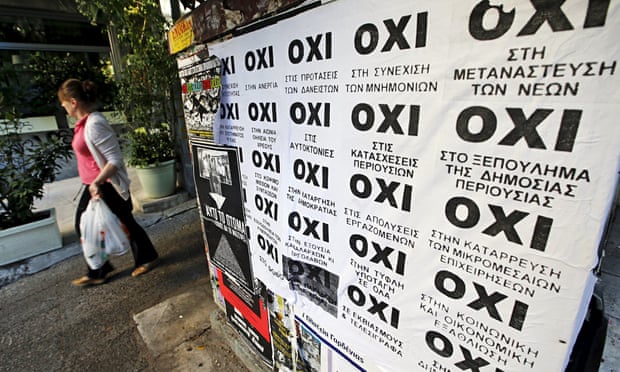
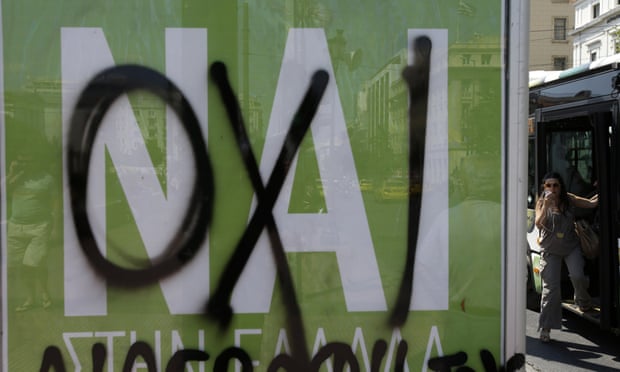
There may also be a true dog whistle going on here.  By making his slogan Ohi! -- No! -- to a German ultimatum, Prime Minister Tsipras may be making a strong nationalist appeal with symbolism apparent to a Greek, but not to an American.  (I can't say about other Europeans). To recap, in October, 1940 the Nazis had overrun Poland, France, the Low Countries, and seemed invincible.  Mussolini, wanting in on the action, made demand on October 28, 1940 that Greece lay itself open to Italian troops.  The Greek Prime Minister answered in French,  "Alors, c’est la guerre.”  "Then this is war." But the Greeks preferred to believe that he answered in Greek, "Ohi!" "No!"  Greeks poured out into the street shouting "Ohi! Ohi!" to proclaim their support.  War ensued, the Nazis behaved like Nazis, and Greece suffered more than the worst possible outcome anyone can contemplate here.  Despite the horrors that followed, Greeks are proud of their defiance and celebrate every October 28 as Ohi Day, the day we said no.  So making Ohi! one's slogan, parading signs saying Ohi! in the streets and calling on the Greeks to say Ohi! to this ultimatum are more potent appeals to nationalism than we may realize.

And they appear to have worked.  Talk about the mysteries of the "Greek temperament" are futile here.  And this does not contradict the foregoing paragraph.  The symbols of nationalism and defiance differ from one country to the next, but underneath it all, human nature is the same.   And it is human nature to dislike being bullied, humiliated or coerced and to respond with defiance -- often foolish and self-destructive defiance, but defiance nonetheless.

And make no mistake, what the Europeans were trying to do was bully, humiliate and coerce.  They determined their offer and made clear that there was to be no negotiations, no concessions, no face-saving compromise that was really a capitulation in disguise.  Capitulation must be open and acknowledged.  This looked suspiciously like a move to depose the Syriza government and install one more to Europe's liking.  Such a move would not be unprecedented, after all.  Th EU has already deposed Silvio Berlusconi in Italy, although the Italians don't seem to have minded much.  But Berlusconi was unpopular, scandal-plagued, and had overstayed his welcome. In the case of Greece, the EU was seeking to depose a leader duly elected less than six months earlier and replace him with someone more subservient.  And they were shocked -- shocked -- that the people responded with anger.  And now Europe and Germany are reacting with their own anger and shutdown.

Europeans ask why the Greeks were such fools as to think they had options when there was only one option all along -- submission.  Well, not quite.  Syriza proved quite wrong if they they thought there was a good option.  But when you present and ultimatum, you are ultimately offering two options -- submit or be crushed.  And looking over the history of warfare, an extraordinary number of nations in such a position have chosen "be crushed."  Well, it is my belief that this whole showdown should be analyzed through the lens of war.  In all probability, Ohi! means  "Alors, c’est la Grexit.”  How does  "Alors, c’est la Grexit” compare to  "Alors, c’est la guerre"?

We know that in old-style warfare, the early ravages of war -- bombed cities, invasions, soldiers coming home in body bags, etc. does not undermine a nation's resolve, but rather strengthens it.  But we also know that morale and resolve don't survive famine.  When food runs out, so to does the will to fight. On the other hand, sanctions that pinch but do not starve have proven to be most ineffective. They simply give the sanctioned government a scapegoat to  blame for the country's misfortunes and rally against.  In case of Grexit, Greece is apt to experience something worse than mere sanctions, but not as bad as true famine and blockade.  And I wonder now as I did before how long a country's resolve can hold up under surging costs of imports, plummeting values of savings, surging foreign debts, widespread bankruptcy, economic crisis and all the other hardships that will attend a devaluation.  We have the answer on at least one question.  A nation's resolve can withstand a week of frozen bank accounts and limited withdrawals.  But how much more?

Friday, July 3, 2015

Greece: Yes is Ahead by an Eyelash

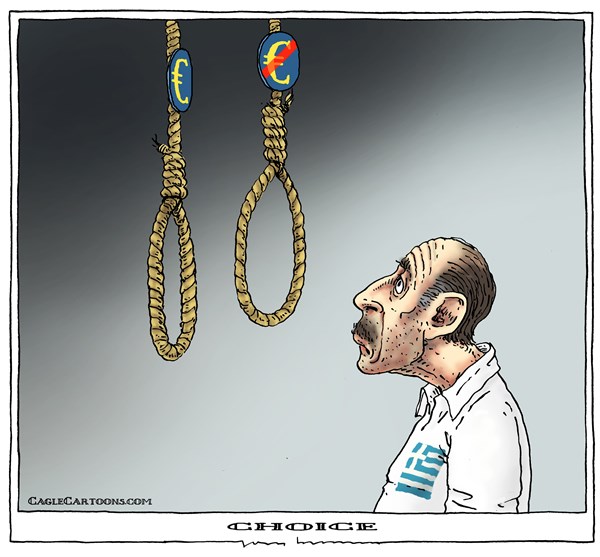
Alas, I couldn't find my favorite cartoon depiction of the upcoming referendum which shows Greece as a diner at a restaurant given a choice between two menu items -- yes and a noose, or no and a pistol.  The image was apt -- yes for slow strangulation, no for a sudden, severe, self-inflicted and possibly fatal wound. Not much of a choice!  But the cartoon on the left conveys the message pretty well.

In the latest update from Greece two opinion polls are quoted.  One poll, conducted June 30-July 1 has the "yes" vote at 41.5%, no at 40.2% and undecided at 10.9%.  A small number intend to abstain or leave their ballots blank.  Another poll conducted July 1-3 has "yes" at 41.7%, "no" at 41.1%, and undecided at 10.7%  Margin for error is 3.1%.  So far Nate Silver's statistical blog 538 has not found enough meat here to aggregate polls.  So a very slight preference for the noose over the gun, but basically too close to call.

At least my first question has been resolved.  The pressure will not be strong enough to force the Grexit ahead of the referendum.  But another question remains.  Given how close the sides appear to be, it may very well take several days to determine who won.  Will events force the Grexit in that time?  And what if the vote is yes?  The current government will fall.  This article points out that it may take several  days (at least) to form a new one.  And the deal being approved is (theoretically at least) no longer on the table, so even a yes vote may lead to new negotiations and more time for the pressure to build.  And (possibly worst of all), the creditors are now divided, with the IMF calling for debt relief and the others refusing, so a deal may not be possible.  So events may end up forcing Greece to leave the euro even if the vote is yes.

Like most people, I take for granted that a no vote will mean default and devaluation.  The only question is how long it will take.

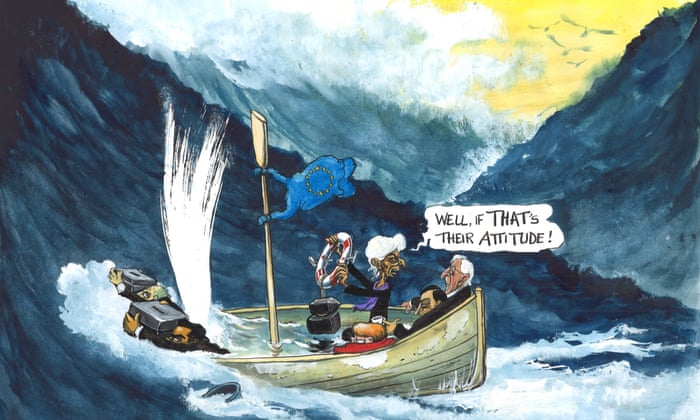
I also attach the cartoon below.  It appears to derive from a 1930's cartoon by David Lowe, which showed the various countries in stormy seas in one boat, with the debtors frantically bailing and the creditors complacently saying, "Good thing it's not in our end of the boat."  It has seemed most appropriate in Europe in the current crisis.  This is a variant on it.


Wednesday, July 1, 2015

The Appeal of the Euro

Despite the disasters the euro has wrought for Southern Europe in general and Greece in particular, there are still plenty of countries, from Eastern Europe to Iceland, that want to join.  I am very grateful to this article for making me understand why.  While belonging to the euro causes one set of problems, having a fluctuating currency causes others.  The grass is always greener on the other side of the fence.  People get frustrated with the problems they have and don't recognize the problems they are avoiding.

To a large country like the US, where most debts are internal, a fluctuating currency just means fluctuating import prices.  And we are large enough that imports don't make up all that much of our consumption, so currency fluctuations are at worst mildly inconvenient for most Americans.  In a country where a very large amount of what is consumed is imported, changes in import prices are more painful.  And to a country where many individuals and small businesses have foreign debt, a currency drop can mean a sudden, devastating surge in debt service costs for large segments of the population.  The article explains that this lead to political pressure in these countries to peg their currencies to the one most debt are in, with all the related dangers of an overvalued currency.

In Iceland, what was at work was apparently that even a highly successful adjustment to the worst financial crisis of all time is still necessarily painful.  A country as tiny as Iceland imports almost everything it uses.  As its currency plunged, prices of everything skyrocketed.  And foreign debts surged.

As for why they haven't learned anything from the experience of Southern Europe, well, they blame those lazy, profligate Southern Europeans and are confident they could never make the same mistakes.  I have seen quite a few articles (too lazy to look for them) commenting that Greece is not getting much sympathy from Eastern Europe, strapped though many countries there are.  In fact, it is a point of pride to many former Communist countries that they are not the center of the crisis and take it as evidence of their superior virtue.  More likely, being out of the euro and therefore able to devalue has been more at work, and if East European countries ever do get into the euro, they are most likely to learn that the hard way.

As for Iceland -- well, if Iceland had been in the euro, the EC would never have allowed it to stiff its foreign creditors, and it would be sentenced to be drained dry in perpetuity to repay them.

Perpetual Depression for the Sake of Growth

OK, I lied.  Again.  I know there isn't too much to do on the subject of Greece between now and Sunday other than watch and wait.  But there are so many related subject crying out for discussion that I sort of can't resist.  This time the subject of "structural reforms."

When you talk about the health and growth of a general economy, there are two sides of the equation, the demand side and the supply side.  Roughly speaking, the demand side is about how close to capacity an economy is operating.  Supply side is how fast that capacity can grow.  Traditional macroeconomics has been about the demand side.  How do we keep an economy from falling below its capacity.  I am not familiar with the "real business cycle theory" which attempts to explain business cycles from the supply side, but in general "structural reforms" are on the supply side, i.e., how things are produced and therefore how fast economic capacity can grow.  Traditionally, at least, they are considered part of micro.

"Structural reforms" also have a serious problem.  In almost all cases structural reforms mean ending job security, which tend to lead to layoffs and increase unemployment; reform means shutting down inefficient sections of the economy, which tends to increase unemployment; reform means getting rid of a lot of surplus work force, which tends to increase unemployment.  It also tends to mean cutting pensions (why pay people not to work?), weakening the safety net, and generally increasing the penalty for being unemployed at exactly the same time you are taking actions that will increase unemployment.  The goal here is that newer, more efficient, more competitive industries will rise to take the place of the old ones so the overall economy will grow.  (Greater "efficiency" tends to mean employing fewer people, and "more competitive" tends to mean paying less, but we can ignore that for now).

There is an obvious problem with these calls for supply side reforms.  All those people who have been laid off or had their pensions cut or made to feel the squeeze from being unemployed will respond by spending less.  This, in turn, will mean less business for remaining industry, unbought inventory, which will lead to fewer orders, less stuff being manufactured, and in turn, more layoffs and industries closing.  In other words, supply side reforms to improve the economy's capacity for growth can lead to reduced domestic consumption and thus a demand-side recession (or depression). The people calling for structural reforms tend not to see this as a serious problem.  More industry shutting down and more people being laid off just shows more aggressive structural reforms underway and are taken as proof of virtue.  If a country fails to rebound, it obviously just shows they didn't implement enough "structural reforms."  Nothing a few more shutdowns, layoffs, and spending cuts won't cure.  This is a lot of what is happening in Greece today.  It happened to Argentina at the turn of the millennium.  And to Europe in the 1930's.  And to Latin America in the 1980's.  And to Eastern Europe after the fall of Communism.  And to Asia in the 1990's.  And to peripheral Europe today.  But no one ever seems to learn from it.

Besides, the structural reform crowd usually disapproves of producing for domestic consumption anyhow.  Countries should produce for export.  (They tend also to disapprove of importing even as they encourage exports).

That opens at least one possibility as to how a country can get through supply-side domestic reforms without causing a demand-side depression.  It can allow its currency to fall and make up for the decline in domestic consumption by exporting more.  A falling currency will also give domestic industry a boost by making prices more competitive with imports.  This is not to say that a falling currency is painless.  It raises the prices of imports and inflates the value of foreign debts.  That latter is not a serious problem in a country like the US where most borrowing is domestic anyhow, but in a smaller country with a lot of cross-border borrowing, it can be ruinous.  These are unpleasant tradeoffs, but in general the best a country can do is either not peg its currency, or abandon the peg before it undertakes structural reforms.  The longer it delays a devaluation, the bigger the currency tumble will be when it occurs and the more traumatic the aftermath.  That, too, is what happened to Argentina, which had pegged its currency to the dollar and was unable to compensate by devaluation until the pressure became truly unbearable and the collapse catastrophic.  The recovery was rapid, but it would have been much better to have devalued in the first place and avoided the crisis.

That is precisely what Greece is now incapable of doing because it has not merely pegged its currency but given it up and therefore cannot devalue.

Another alternative if the country undergoing "structural reforms" is a debtor country (as it usually is) is to relax demands for austerity and allow the debtor country (Greece in this case, Argentina in another, also Latin America 1980's, Asia 1990's, southern Europe in general today, etc) to spend more of its income on domestic consumption and less on foreign debt service.  But there are obstacles there too.  First of all, creditors never seem to agree.  Second of all, keeping the squeeze on a debtor's economy is a great way of maintaining control.  Control to do what?  Why to force structural reforms, of course.  And what if those structural reforms continue to depress domestic demand and interfere with recovery?  So much the better.  It give greater leverage to demand more structural reforms.

At this point it become fair to ask what the purpose of all those structural reforms is supposed to be. It can't be entirely to get one's debts repaid, since the debtor country will never be able to repay its debts so long as its economy remains depressed.  So what is the purpose?  The usual answer is to improve economic health and allow for faster growth.  This is insane!  Keeping an economy perpetually depressed and crushed with debt in order to encourage faster growth makes about as much sense as invading another country to impose democracy at gunpoint.  (Another reason for my war analogy).

The usual objection is that you have to keep the pressure on to make structural reforms because if countries are instead allowed to experience a devaluation-fueled boom, they will neglect to make such reforms and their economies will end up in trouble anyway, as is happening to Argentina now.

And in the end, the answer has to be so what?  If a country is more interested in bringing its economy back to capacity right now than undertaking reforms that will allow its capacity to grow over the long run, but which also tend to shrink it farther and farther below capacity right now, is that such an unreasonable decision?  If a country breaks out of its immediate depression now, only to grow more slowly in the future, really who does it hurt but itself, and whose business is it but its own?

The analogy I often see given by austerity critics is that if a sedentary, morbidly obese patient has a heart attack, no one doubts that he should go on a diet and adopt an exercise program.  But an immediate starvation diet before he has had time to recover from the heart attack is a poor decision. And too strenuous exercise too soon can be fatal.  But really, a better analogy here might be a doctor deliberately keeping a patient sick so he will be more submissive to medical advice.  Advice about how to get well.  Think about it.