In the wake of the Charlie Hebdo terror attack, there have been a few warnings against Islamophobia. Conservatives are freaking out. Granted, they say, there have been a few anti-Islamic hate crimes, but no widespread riots or pogroms, no threats of riots or pogroms, so what's the big deal. Suggesting that Islamophobia is any sort of threat is just a way of showing hatred of the native-born white working class, treating them as a deranged mob on the verge of mass riots or pogroms. Anti-Muslim hate crimes are rare! Show some perspective!
I suppose my response would be, show some perspective yourself. Consider the overall response to the attack. Denunciation of the crime were widespread across the political spectrum. The police posted guards to protect Jewish areas and launched a crackdown, arresting 54 people for expressing support for terrorism. Over a million Frenchmen turned out to show solidarity against terror. Charlie Hebdo magazines sold out. Many people flocked to republish its offensive cartoons. The New Yorker, bastion of the sort of liberal multiculturalism conservatives despise ran a cover in solidarity. The French sent an aircraft carrier to fight ISIS. One mosque was shot at, one burned down, and another had a grenade thrown at it. Approximately 50 lesser crimes against Muslims such as graffiti were also reported. And a few newspaper articles warned against an anti-Muslim backlash. I would not say that liberals are taking advantage of the terror attacks to show hatred to the white working class. I would say liberals fully support the rally against terror and just don't want it to go too far.
Or consider George Bush's response to 9-11. He authorized the Air Force to shoot down planes they believed had been hijacked. He authorized the FAA to shut down all air traffic. He got up and made a speech expressing the nation's grief and outrage. He authorized a general crackdown on suspects. He asked for (and received) the Patriot Act vastly increasing the government's powers of surveillance. He immediately began planning an invasion of Afghanistan. He began remotely planning an invasion of Iraq. Oh, yes, and he assured everyone that we are not at war with Islam and urged Americans not to punish American Muslims as a whole. Does that mean that he, too, hated the white working class and regarded them as an unruly mob?* Was he engaged in a "culture war status contest" to burnish his politically correct credentials? Or was he saying something that needed saying?
And, after all, why does "Islamophobia" or "anti-Muslim backlash" have to mean mass riots or pogroms? Neither of the cited articles I was able to access suggested anything of the kind. One specifically referred to "the inevitable statist backlash," (emphasis added), making clear that this was a warning against giving police increased surveillance powers, ethnic profiling, and other civil libertarian concerns. The other spoke of Muslims being "hated, targeted and discriminated against," something already ongoing and well short of riots or pogroms.
And you don't need riots or pogroms or even widespread hate crimes to have a serious problem. Just as the number of police killed on the job is just the tip of the iceberg of danger and stress cops experience on the job, and just as the number of black people killed by police is just the tip of the iceberg of general harassment and indignity that black people experience from police, so to are hate crime just the tip of the iceberg of Muslim complaints throughout Europe. Europe has a lot of angry, alienated Muslims, resentful of a society that rejects them. And yes, I know, Muslims bear a considerable share of blame for this situation. And yes, I know, young Muslim men often express their anger and alienation in ways that makes society (justifiably) reject them all the more. It is a vicious cycle. It is a cycle that terrorists want to perpetuate. "Islamophobia" or "anti-Muslim backlash" don't have to mean widespread riots or pogroms. All these terms have to mean is anything that makes Muslims more rejected by society and makes the anger and alienation worse. And that, my friend, is an absolutely legitimate fear.
________________________________________
*Actually, given his pro-immigration stance, a lot of nativists would probably say yes.
Wednesday, January 14, 2015
Memo to Conservatives on Islamophobia: Have Some Perspective
Obligatory Charlie Hebdo Post
![]() |
| A Charlie Hebdo cover |
My first introduction to Charles Krauthammer was in 1989 during an uproar over some Robert Mapplethorpe photographs. Some of the pictures were grotesque -- Mapplethorpe with a bullwhip in his rectum, one man urinating in another man's mouth, a man sticking his finger into his penis, and so forth. They were shown in an art museum in Cincinnati, in a separate room from more innocent ones. Krauthammer used this to illustrate the point that censorship is a relative, not an absolute, concept. News broadcasts only showed only the innocent photos -- they merely talked about the nasty ones. Museum brochures were presumably just as circumspect. To see the photos, one had to pay the museum price and pass through the door, and even then the nasty pictures were kept in a separate room. So, Krauthammer argued, the broader the exposure, the narrower the range of what can be shown. And consider the range of exposure possible. Public billboards. Broadcast on television. Museum brochures. Red light districts. Museums. In a special room in the museum. Cable pay-per-view. Mail order photographs. Krauthammer argued that the real controversy was where on the spectrum you place Mapplethorpe, a less dramatic question than the question of whether you are for or against censorship. (This was before the internet, which renders many of those categories obsolete. But highly public sites like You Tube do (presumably) ban extreme material and set up gatekeeping for others).
It seems to me that the same applies not just to how broad exposure material receives, but also to the penalties for publishing unacceptable materials. The harsher the penalty, the more sparingly it should be applied. Consider possible penalties for a magazine like Charlie Hebdo that specializes in maximally offensive covers:
- Murder
- Lesser acts of violence
- Criminal prosecution
- Civil suit
- Boycott by retailers
- Boycott by advertisers
- Loss of advertising revenue
- Having retailers sell the magazine, but no on the stands. Customers must go up to the counter and ask for the magazine.
- Having retailers sell the magazine, but with an opaque cover over the cartoon.
- Social rejection for offensive content
- Mockery
- Being told to have better manners
All right, we all reject murder and other criminal violence. I think it safe to say that Americans overwhelmingly reject criminal prosecution and even civil suit. But what about the rest? One blog commenter remarked that, although the US has fewer legal penalties on the press than any other country, we do not have magazines with such offensive covers. Advertisers would refuse to advertise and retailers would refuse to sell. And whoever would reject a mere lecture on manners -- well, let's just say it is all a matter of whose ox is being gored.
One final comment here. Glenn Greenwald, weighing in with the people who think Charlie Hebdo should show better manners says:
Central to free speech activism has always been the distinction between defending the right to disseminate Idea X and agreeing with Idea X, one which only the most simple-minded among us are incapable of comprehending.With all due respect to Greenwald, he is wrong, wrong, wrong about that. Most people are not, in fact, capable of distinguishing between support the right to express an idea and supporting the idea itself. That is what is causing much of the tug-of-war about Charlie Hebdo now.
Wednesday, January 7, 2015
Fortune's Favorites: Character Study: Caesar
![]() |
| Julius Caesar |
Certainly, Caesar is portrayed as very talented, but then again, he was. Cicero and Pompey are two upstarts, ambitious, but outsiders without pedigree. Cicero is brilliant, learned, cultured, an outstanding lawyer, orator and scholar, but physically clumsy and timid in the face of danger. Pompey is a brilliant general, brave and athletic, but uncultured and crude. Caesar is as cultured and polished as Cicero and his match (or nearly so) as an orator and lawyer, but also as brave and athletic as Pompey and an even better general. And he's a brilliant politician. And he has super human sexual prowess. And he has the perfect pedigree, coming from the cream of Rome's aristocracy, a descendant of the kings of old and (according to legend), from Aphrodite* through her son, Aeneas. (He often brags that he is not just a patrician, he is a Julian!) And it is pointless to criticize the author for all of that. It is historically true. But how morally decent is he?
![]() |
| Caesar |
Plutarch and Seutonius agree that Caesar was flamen dialis (high priest of Jupiter) and was married to Cornelia (Cinilla), daughter of Marius' right hand man, Lucius Cornelius Cinna. Seutonius says Caesar was appointed to the job by Marius and Cinna. Plutarch says he ran for it in defiance of Sulla. McCullough decides to give her story greater drama by having Marius appoint Caesar to the office against his will to thwart his ambitions. (The High Priest of Jupiter was subject to a wide range of taboos that precluded any sort of military or political career). Plutarch and Seutonius agree that Sulla ordered Caesar to divorce his wife and, when he refused, saw the spark of Marius in him and stripped him of his office, his property, and his wife's dowery. Caesar fled for his life, moving from house to house, sick with malaria, and had to bribe his pursuers to spare him. Plutarch says he then fled to Bithynia. Seutonius says that Sulla pardoned him upon the intercession of friends and relatives, and that Caesar then went to Bithynia on military assignment to raise a fleet.
Either way, the story is made for drama, and Caesar comes across as heroic. McCullough gets to it the right way. She has Sulla concentrate first on purging his enemies and placing his supporters in office. He then turns to reforming matters of religion and has some doubts about the young priest. His supporters give the opinion that Cornelia Cinilla is not a citizen because her father was proscribed and that Caesar must therefore take a new wife. (The flamen dialis could not hold office without a proper wife because she also had an important ceremonial role). When Caesar refuses the order to divorce her, his bravery is extraordinary, but his motives are selfish -- he wants out of the job so he can pursue a political and military career. His flight is less dramatic than one might hope because he is soon stricken by malaria and put altogether out of action. Others protect him and his mother organizes a group to intercede for him. Caesar is sullen and resentful that his illness denied him the chance to be heroic and relegated him to a mostly passive role. His mother tells him not to be so full of himself, and that the gods sent his illness to teach him a lesson in humility.
And, indeed, Caesar, though very accomplished (he was) comes across as insufferable. Not as bad as Pompey, but supremely arrogant nonetheless. As for being morally decent -- well, sometimes he is and sometimes he is not.
Seutonius says that Caesar lingered so long in Bithynia that it led to rumors that he had a gay affair with King Nicomedes. McCullough has the king, aged 80, fall in love with Caesar, while Caesar loves the king as a grandfather and takes about as much carnal interest in him as he would in his own grandfather. The king is so infatuated that he gives Caesar his fleet right away at a very reasonable price. Caesar makes the mistake of being arrogantly boastful about this seemingly impossible achievement, which leads everyone else to believe that he convinced the king by sleeping with him. Seutonius says he won the Civic Crown, a military award for holding his ground and saving fellow soldiers, but does not give any details. McCullough is therefore free to make them up. After Sulla died, Caesar returned to Rome. Seutonius says he considered joining Lepidus' revolt, but decided against it when Lepidus did not appear up to the job.
Both Plutarch and Seutonius agree that he prosecuted Gnaeus Cornelius Dolabella for extortion and/or misgovernment of his province and failed. Seutonius says Caesar was forced to withdraw to Rhodes because of the "ill will" he incurred, implying that the charges lacked merit. Plutarch says that many cities of Greece came to attest to it, implying that the charges had merit. A leading member of Dolabella's staff was Gaius Verres, who Cicero later prosecuted for extortion of Sicily. Verres is known mostly through Cicero's prosecution speeches, an obviously biased source, but his extortions are generally believed to have been real enough. I don't know if Cicero also alleged misconduct in the East, but it seems likely enough. And was Dolabella his accomplice? Who knows?
McCullough, in any event, uses this as an occasion to show Caesar being morally decent. Nicomedes sends him to watch and see what Verres and Dolabella are up to. Caesar is appalled, but is not powerful enough to stop them. In particular, a leading man of the city has a daughter he keeps secluded and never allows anyone to see. Rumor has it that she is of such outstanding beauty and virtue that he has to hide her away lest she drive men to desperation. Much is made of Verres trying to get in and see her by force, the girl's father trying to stop him, Roman officials being killed in the fight, and the father put to death for it. But Caesar has figured out that daughters of such beauty and virtue that they have to be secluded are a romantic fantasy, and that if her father won't let anyone see her, it is probably because she is deformed. And so she is. When Verres unveils her and discovers, Caesar laughs. When Verres leaves, Caesar weeps for her. He also persuades Nicomedes to leave his kingdom to Rome and helps him and his wife catalog all the valuables so he can prosecute any Roman governor who steals. None of this is historical, of course; McCullough made it up to show her hero to best advantage.
Plutarch says that Caesar also prosecuted Gaius Antonius Hybrida and was thwarted only when the tribunes exercised their sole remaining right to deliver him from the magistrate. Nothing in Plutarch suggests one way or the other whether the prosecution had merit. Wikipedia quotes other sources as saying that Gaius Antonius plundered his territories and was rumored to have tortured and maimed the local population, and that Hybrida did not mean halfbreed in the sense that his mother was not Roman, but half-beast. So this prosecution appears to have had merit as well. Just for spice, McCullough also has Hybrida torture and kill his slaves (not a crime; a Roman slave holder had the power of life and death over his slaves, as the book emphasizes elsewhere) and has him bribe the tribunes. Another chance to show off her hero's moral decency. But she undermines it in other ways as well, large and small, historical and fictitious.
Small and historical: Caesar's unsavory reputation with women, which was real enough. The author actually has his mother suggest it, as a way of dispelling these rumors that he was gay. She says that instead of sticking to women of low estate, he should prey on the wives of his political opponents. (But no virgins! That would be going too far!) She even says that Sulla was a fool not to sleep with his rival's wife when he had the chance because it allowed his rival to maintain the more dignified position. Caesar is shocked that such a virtuous woman would give such immoral advice. But he soon learns to relish the role of predator, and to like ruining women for their husbands. Jerk!
Large and historical: The pirates. Plutarch and Seutonius agree that he was captured by pirates, and that they demanded a twenty-talent ransom for him, the going rate for a Senator, but he insisted he was worth fifty. He had good times with them and often said he would crucify them if he got the chance. They thought he was joking, but as soon as he was freed, he led an expedition against them and did just that. McCullough shows this in really painful detail. We think of the Stockholm syndrome in terms of pathology, but really at its root is just the normal, healthy urge to form emotional ties with the people around us. Caesar has good times with the pirates, laughs and jokes and sleeps with their women but never ones who belong to another man. Everyone is sorry to see him go. Some weep for him. To have formed no emotional ties, to go back and kill them in cold blood is the act of a sociopath. Furthermore, Plutarch says, Caesar applied to the governor to crucify his prisoners, but the governor preferred to make money selling them as slaves. So Caesar proceeded without his authorization. This is included in unflinching detail. Indeed, McCullough makes it worse than it was. Seutonius says that when Caesar crucified the pirates, he at least had the decency to cut their throats first. He includes this in a chapter on Caesar's general mercy to his enemies, including that when one of his slaves tried to poison him, Caesar killed him without torture. The modern reader might not agree that these show any special mercy! But it does suggest that cruelty and sadism were not part of his makeup. But McCullough has him crucify some 500 pirates. And although he breaks the legs on the others, when the pirate chief attempts to joke with him, Caesar punishes him by letting him linger. It really makes you hate the guy!
Large and fictitious: Plutarch and Seutonius agree that upon returning to Rome, Caesar was elected military tribune. Although neither mentions it, this appears to have been around the time of Spartacus' revolt. Neither author says anything about what Caesar did as military tribune or his role in the revolt. Presumably this means he did not do anything of significance. But McCullough has him serve as Crassus' chief adviser and thereby fully implicates him in Crassus' atrocities. He gives no sign of finding them even mildly distasteful.
He ends on a better note. Seutonius says that Caesar was a major supporter of restoring power to the tribunes and recalling people banished by Sulla, and so he is shown to do. Both biographers agree that he gave a magnificent funeral for his aunt Julia, wife of Marius, and for his own wife. Plutarch also says that he reintroduced the images of Marius at Julia's funeral and proved that, despite his reign of terror, Marius remained popular.
So in the end, our impression of Caesar is mixed. He is very accomplished but supremely arrogant, capable of great decency but also great cruelty and sometimes outright sociopathy. And perhaps it is right that he should be portrayed that way, as he remains deeply controversial to this day.
_________________________________
*The Romans call her Venus, of course, the the legend originated with the Greeks.
Fortune's Favorites: Character Study: Crassus
![]() |
| Crassus |
To the extent he is remembered today, it is as a villain for his role in suppressing the Spartacus revolt. Inheriting a craven army that had run from Spartacus' slave army, he decimated them, i.e., chose one out of ten to be killed and forced his fellow soldiers to do the killing, a thing that had not been done in many years. McCullough, it should be noted, makes this even worse than it was. Where Plutarch says that Crassus picked the 500 worst offenders and executed one out of ten (total: 50), McCullough has him decimate the whole legion of 7500 (total: 750). Crassus makes clear that his war against Spartacus and his followers is one of extermination. When the starving slaves ask his terms of surrender, he says he has none; his goal is to destroy them. And when some 6,600 are taken alive, he has them crucified along the roadside and does not break their legs. While Pompey, equally rich but more respectably so, gets his faction in the Senate by bribing them, Crassus lends Senators money without interest and then calls in favors by threatening to call in the loan.
Crassus was described has having hay on his horns. Though horns are often associated with a cuckold, the meaning in this case is not sexual. When an ox was prone to gore, Romans would tie hay on his horns to show that this beast, however, docile and placid he might seem, was dangerous. McCullough takes this to mean that Crassus seemed outwardly placid and bovine, but was actually no one to be messed with, as many a slave or soldier learned the hard way.
Oh, yes, and he is a close friend and ally of Caesar. That is historically accurate. Caesar was in constant debt because of expensive personal and political habits, and Crassus regularly bailed him out. Their alliance does not say much in favor of Caesar! Which leads to my final character study: the hero of the series.
____________________________________________________________
*There are probably not many ways a Roman could get rich that modern sensibilities would approve of. Large land holdings, the most approved form of wealth, meant squeezing out small holders and increasingly meant the use of slave gangs chained together and locked in barracks for the night. Mining used an even more brutal form of slavery. The point is not so much that these forms of wealth used slaves, which was an unavoidable practice at the time, but that they were especially badly treated. If anyone in the novels so far made what we would consider an honorable fortune, it would actually be Quintus Servilius Caepio, Jr., who invested his vast fortune in gold in shops and smithies to equip Rome's armies, spreading great wealth wherever he went. And where did he get all that gold? Honorably enough, he inherited it from his father, QSC, Sr. And where did QSC, Sr. get the gold? He stole it on its way to the Roman treasury, killing hundreds of Roman soldiers guarding it. Junior had no role in his father's crime, but his wealth was nonetheless generally seen as tainted.
**Some libertarians would presumably defend his actions, saying that people are better off selling their houses at an inadequate price, saving their movables, and being able to leave in an orderly fashion than having their house burn down and losing everything.
***Of course, no libertarian would defend that.
Tuesday, January 6, 2015
Fortune's Favorites: Character Study: Servilia
It is very hard to tangle out history from fiction in McCullough's portraits of Sulla, Pompey, or Spartacus. But her portrait of Servilia Caepionis is completely fanciful. Servilia is a minor character in this novel, but she will become important in the next one as Caesar's long-term mistress. McCullough rightly points out that the women are not very well characterized the the all-male historians, so she has to exercise her imagination. Fine. But why does she have to use her imagination to make Servilia evil, evil, evil!
Because she certainly does that. In First Man in Rome, Servilia is just a baby, so she has no chance to make her personality felt. The only significant thing about her is that her mother (Livia Drusa) doesn't love her because she hates her father, and her father (Quintus Servilius Caepio) doesn't love her because he wants a boy.
But at the age of seven, she already establishes herself as evil in The Grass Crown. She is a patrician Servilian whose grandfather was a tremendous snob as a matter of historical record, so it is not so far-fetched to suspect that he passed the attitude on to his son, who passed it on to his daughter. But it is still possible to be snobby and still be decent in other ways. Servilia is not. Unloved and unwanted by either parent, she nonetheless sides with her father. By the age of seven, she knows how to be hurtful. ("We only talk about important things," Servilia tells her mother. "We don't talk about you.") While her father is away on a long business trip, Servilia's mother moves them out into the country and pretends to go on long walks, but actually carries on an affair with Cato Salonianus and gets pregnant so soon that she is able to pass her son off as legitimate. Servilia makes an off-hand remark about her mother having a "friend," and her mother looks so panicked at the mention that Servilia follows her on one of her "walks" and finds out what is really going on.
QSC comes home and is so angered at his wife's coldness toward him that he starts beating her and then discovers that he is really a sadist. Livia's brother, Marcus Livius Drusus, the non-protagonist hero comes to her rescue (and makes up for forcing her to marry him in the first book). The Servilia steps forward with the Big Reveal of her mother's affair and says, "Don't just beat her. Kill her! She deserves it." QSC walks out and divorces his wife. Although under Roman custom, when a couple divorces, the children go to their father, but QSC refuses to accept any of them, saying that he does not believe any of them are really his. Drusus therefore takes responsibility for the children. Livia marries Cato Salonianus, and the couple stay with Drusus, who is married to QSC's sister.
Drusus is the biggest champion of Italian citizenship, which Servilia and her father snobbishly reject. Despite her father's rejection of her, Servilia acts as his spy, sneaking through the papers of her uncle's guests and letting her father know what they are up to. When Drusus finds out, he confines her to the house and will not even let her leave the nursery without being watched. Knowing Servilia's snobbishness and what will hurt her most, Drusus threatens to marry her to a country squire with no pedigree. Servilia curses the four adults. "May you all be dead before I 'm old enough to marry."
And, of course, under the rules of fiction, these curses always come true. Drusus' wife is pregnant and perfectly well, but shortly afterward she develops a hemorrhage and dies. When Servilia is ten, her youngest brother is born in the breach and her mother is damaged in the birth. She seems to be making a good recovery until Servilia says, "You will die because I wish you dead. I have the evil eye." She claims that her aunt is dead because she wished her dead. Well, as we all know, these curses can work if you believe in them. Servilia's mother worsens and dies. Cato Salonianus, broken-hearted, takes a foreign assignment and is killed. Three down, one to go! The nursery is the scene of endless fights and quarrels between the half-siblings, driven mostly by Servilia and little Cato, with Servilia taunting the Cato children for their inferior pedigree. And then Drusus, on the verge of admitting the Italians to citizenship, is fatally stabbed and dies, screaming in pain. The other children huddle together in the nursery, crying, but Servilia comes out to investigate. Sulla asks her what she is doing and she says she is looking for her father. Sulla tells her her father wouldn't dare show is face because people suspect him of being behind the murder. Servilia's face lights up. "Is he really dying?" Sulla tells her yes. "Good!" That is the last we see of her in The Grass Crown.
In Fortune's Favorites, the author allows us maybe a glimpse of sympathy for Servilia, spending her childhood imprisoned in a house where she is unloved and unwanted. She is given in marriage to Marcus Junius Brutus, who lets her come and go as she pleases, but neither loves nor wants her. He carries on his life as if she weren't there at all, never invites her anywhere or shows her anything he buys, never lets her into his study, sends her away when he has friends over, and sleeps in a separate room. He is dominant and she never dares displease him lest he divorce her and send her back to her uncle's house. Their relationship does not go much beyond his occasionally going to her for sex, a tiresome business for Servilia, but one she is glad he did anyhow because it results in a son. So she puts all her love-starved energy and loneliness, hopes, dreams and longings into this one baby. Poor him!
She also reminds us that, despite this flash of sympathy, she is still evil. When the laundry girl holds the baby, Servilia gets jealous and hits her so hard that she drops him. Servilia then says to flog and sell her, but the beating is so severe as to make the girl worthless, so Servilia has her crucified, leading at least one reviewer to hope that she dies in a fire.
She doesn't kick all that many dogs for the rest of the novel (at least not compared with the last one). When Sulla starts drawing up hit lists of his enemies, Brutus is not on it, even though his father and uncle were killed fighting against Sulla. He realizes that is because his wife is the niece of Sulla's son-in-law. Suddenly, he does not dare divorce Servilia and the balance of power in their marriage begins to shift. He discusses worldly matters with her as an equal. Servilia begins to take a most unfeminine interest in politics and to cultivate her information network among the wives of the elite, subtly drawing them out on what their husbands are up to and turning out to know a lot more than her husband. And then she starts thinking her husband is not important enough to be worth talking to and conveys the information to his superior. She becomes more and more the dominant partner, treating her husband almost as disdainfully as he once treated her. He ends up leading a rebellion and being killed in a futile attempt to impress her. Some of her more conservative relatives disapprove when she resolves to remarry as soon as she can. This gives her a chance to show how much she despises her relatives, especially Cato. The last we hear from her is from Caesar's mother who says she has remarried and had two daughters and who comments on her political savvy. Caesar is uninterested. He will become very interested indeed in the next book.
So, in the end, the question has to be, McCullough could portray Servilia any way she wanted. Why does she decide to make her so evil? I can think of several possibilities.
Because she certainly does that. In First Man in Rome, Servilia is just a baby, so she has no chance to make her personality felt. The only significant thing about her is that her mother (Livia Drusa) doesn't love her because she hates her father, and her father (Quintus Servilius Caepio) doesn't love her because he wants a boy.
But at the age of seven, she already establishes herself as evil in The Grass Crown. She is a patrician Servilian whose grandfather was a tremendous snob as a matter of historical record, so it is not so far-fetched to suspect that he passed the attitude on to his son, who passed it on to his daughter. But it is still possible to be snobby and still be decent in other ways. Servilia is not. Unloved and unwanted by either parent, she nonetheless sides with her father. By the age of seven, she knows how to be hurtful. ("We only talk about important things," Servilia tells her mother. "We don't talk about you.") While her father is away on a long business trip, Servilia's mother moves them out into the country and pretends to go on long walks, but actually carries on an affair with Cato Salonianus and gets pregnant so soon that she is able to pass her son off as legitimate. Servilia makes an off-hand remark about her mother having a "friend," and her mother looks so panicked at the mention that Servilia follows her on one of her "walks" and finds out what is really going on.
QSC comes home and is so angered at his wife's coldness toward him that he starts beating her and then discovers that he is really a sadist. Livia's brother, Marcus Livius Drusus, the non-protagonist hero comes to her rescue (and makes up for forcing her to marry him in the first book). The Servilia steps forward with the Big Reveal of her mother's affair and says, "Don't just beat her. Kill her! She deserves it." QSC walks out and divorces his wife. Although under Roman custom, when a couple divorces, the children go to their father, but QSC refuses to accept any of them, saying that he does not believe any of them are really his. Drusus therefore takes responsibility for the children. Livia marries Cato Salonianus, and the couple stay with Drusus, who is married to QSC's sister.
Drusus is the biggest champion of Italian citizenship, which Servilia and her father snobbishly reject. Despite her father's rejection of her, Servilia acts as his spy, sneaking through the papers of her uncle's guests and letting her father know what they are up to. When Drusus finds out, he confines her to the house and will not even let her leave the nursery without being watched. Knowing Servilia's snobbishness and what will hurt her most, Drusus threatens to marry her to a country squire with no pedigree. Servilia curses the four adults. "May you all be dead before I 'm old enough to marry."
And, of course, under the rules of fiction, these curses always come true. Drusus' wife is pregnant and perfectly well, but shortly afterward she develops a hemorrhage and dies. When Servilia is ten, her youngest brother is born in the breach and her mother is damaged in the birth. She seems to be making a good recovery until Servilia says, "You will die because I wish you dead. I have the evil eye." She claims that her aunt is dead because she wished her dead. Well, as we all know, these curses can work if you believe in them. Servilia's mother worsens and dies. Cato Salonianus, broken-hearted, takes a foreign assignment and is killed. Three down, one to go! The nursery is the scene of endless fights and quarrels between the half-siblings, driven mostly by Servilia and little Cato, with Servilia taunting the Cato children for their inferior pedigree. And then Drusus, on the verge of admitting the Italians to citizenship, is fatally stabbed and dies, screaming in pain. The other children huddle together in the nursery, crying, but Servilia comes out to investigate. Sulla asks her what she is doing and she says she is looking for her father. Sulla tells her her father wouldn't dare show is face because people suspect him of being behind the murder. Servilia's face lights up. "Is he really dying?" Sulla tells her yes. "Good!" That is the last we see of her in The Grass Crown.
In Fortune's Favorites, the author allows us maybe a glimpse of sympathy for Servilia, spending her childhood imprisoned in a house where she is unloved and unwanted. She is given in marriage to Marcus Junius Brutus, who lets her come and go as she pleases, but neither loves nor wants her. He carries on his life as if she weren't there at all, never invites her anywhere or shows her anything he buys, never lets her into his study, sends her away when he has friends over, and sleeps in a separate room. He is dominant and she never dares displease him lest he divorce her and send her back to her uncle's house. Their relationship does not go much beyond his occasionally going to her for sex, a tiresome business for Servilia, but one she is glad he did anyhow because it results in a son. So she puts all her love-starved energy and loneliness, hopes, dreams and longings into this one baby. Poor him!
She also reminds us that, despite this flash of sympathy, she is still evil. When the laundry girl holds the baby, Servilia gets jealous and hits her so hard that she drops him. Servilia then says to flog and sell her, but the beating is so severe as to make the girl worthless, so Servilia has her crucified, leading at least one reviewer to hope that she dies in a fire.
She doesn't kick all that many dogs for the rest of the novel (at least not compared with the last one). When Sulla starts drawing up hit lists of his enemies, Brutus is not on it, even though his father and uncle were killed fighting against Sulla. He realizes that is because his wife is the niece of Sulla's son-in-law. Suddenly, he does not dare divorce Servilia and the balance of power in their marriage begins to shift. He discusses worldly matters with her as an equal. Servilia begins to take a most unfeminine interest in politics and to cultivate her information network among the wives of the elite, subtly drawing them out on what their husbands are up to and turning out to know a lot more than her husband. And then she starts thinking her husband is not important enough to be worth talking to and conveys the information to his superior. She becomes more and more the dominant partner, treating her husband almost as disdainfully as he once treated her. He ends up leading a rebellion and being killed in a futile attempt to impress her. Some of her more conservative relatives disapprove when she resolves to remarry as soon as she can. This gives her a chance to show how much she despises her relatives, especially Cato. The last we hear from her is from Caesar's mother who says she has remarried and had two daughters and who comments on her political savvy. Caesar is uninterested. He will become very interested indeed in the next book.
So, in the end, the question has to be, McCullough could portray Servilia any way she wanted. Why does she decide to make her so evil? I can think of several possibilities.
- Servilia defies the accepted Roman role for women. She is assertive, meddles in politics, and swears like a man. In the next book, she will have an extended affair with Caesar. Maybe the author has adopted Roman prejudice against women who don't know their place. On the other hand Caesar's mother also defies conventional Roman roles for women (at least upper class Roman women). The author never thinks less of her.
- Servilia's grandfather was a truly odious man. Maybe the author thinks the apple never falls far from the tree.
- Servilia is the mother of Brutus. Maybe the author couldn't forgive her for that.
- And finally, there is a general consensus that the author is in love with Caesar herself. Maybe she resents Servilia as a romantic rival.
Make of it what you will.
Fortune's Favorites: Character Study: Spartacus
Character Study: Spartacus. McCullough writes at length about Spartacus, but her real interest appears to be less in Spartacus himself than in gladiatorial combat during the Roman Republic, and particularly in vindicating the Republic against its reputation for bloodthirstiness in that regard. This does not mean vindicating Roman slavery in general. Granted, the brutal lot of a field slave, let along a mine slave, is never more than faintly hinted at. Granted, many household slaves are shown as having real affection for their owners. Granted, slaves are shown in skilled positions such as clerk and scribe. And granted that elsewhere the author shows educated and cultured Greeks voluntarily offering themselves up as slaves to Romans because it offers a better career than remaining in impoverished Greece. But she also makes clear that in Rome the owner of slaves exercised the absolute power of life and death over them and could crucify a slave any time at a whim.
A gladiator, now, is a different matter. First Man in Rome has many retired gladiators running around working as hired muscle and making the point that gladiatorial combat was rarely fatal at the time. If McCullough made that point with some subtlety in First Man in Rome, she brutally beats the audience over the head with it in Fortune's Favorites. She says that, although the fiction was maintained that gladiators were captured foreign soldiers, really they were deserters and mutineers from the Roman legions, a fact most Romans preferred to forget because they regarded gladiators as sports stars. She says it was a voluntary career choice, although that is clearly an exaggeration. As she portrays him, Spartacus began life as an ordinary (unnamed) Roman boy with a natural affinity for all things military. His first choice of career was as a soldier. Later he was charged with mutiny, no details given except that he denies it. He was court martialed, convicted, stripped of his citizenship, and drummed out of the army. Then he was given a choice, lifetime exile from Italy, or becoming a gladiator. So it was hardly a voluntary career choice for him, but it did not seem such a bad one either. A gladiator, after all, was a kind of sports star, with all the glamour of a sports star, and a handsome one (which he was) could have so many women offer to sleep with him that he could afford to be choosy.
Gladiators are chosen at least partly for their looks. He is so good-looking that he goes for 100,000 sesterces. Point of comparison: When Caesar says he will sell the pirates who capture him as slaves, the women and children will go for 600 to 1000 sesterces each. 500 strong but unskilled men will fetch a cool 2,000,000, or about 4,000 each. Cato the Censor used to boast that he never paid more for a slave than 6,000 sesterces, although that included skilled workers and clerks. And a top-notch, highly educated Greek tutor fetches 200,000 to 300,000 sesterces. So a handsome gladiator fetches the price of about 25 field hands, but only half to a third as much as a Greek tutor. Then again, a Greek tutor is expected to tutor your sons until they reach manhood and possibly your grandsons, while a gladiator retires after only about five years. Retired gladiators appear to occupy and odd space as neither slave nor freedman. Retired gladiators have no masters and run their lives as they please, mostly as hired muscle. But they are not admitted to citizenship, as a freedman would be. And it is not altogether clear whether a gladiator is truly a slave, or whether they are sold in the same manner as sports stars to this day.
Anyhow, gladiators take ring names like professional wrestlers. Our 100,000 sesterces gladiator calls himself Spartacus. He soon proves to be a problem because he keeps fighting gladiatorial combat as if it were war and not just a sport. His trainer lectures Spartacus, for benefit of the reader, about gladiatorial combat really, really being just a sport and not true combat. Gladiators are supposed to get cut in the ring and bleed to satisfy the audience's blood lust, but no one wants a 100,000 sesterces investment to be killed or maimed (even if it does amortize over a mere five years). But Spartacus forgets this the first time he steps into the ring and his opponent cuts him. He chops his head off. Everyone is shocked and horrified. Some vomit or faint.
So Spartacus is sent to a school for problem gladiators that is really a prison. Its brutality is described in considerable detail. Plutarch, incidentally, agrees that Spartacus and his fellow gladiators are mistreated. But, the author makes clear, this is not typical. Only problem gladiators are treated so brutally. Most live in a barracks, but are free to come and go as they please, are feted as sports stars, and save up for retirement.
In any event, the gladiators plan a revolt. The women sent to service them participate by smuggling in kitchen tools. The men reward them by allowing the women to kill the master of the school by themselves. The leading woman, a barbarian priestess, eats his heart (literally). Together they escape. Spartacus picks two other gladiators as his lieutenants and the barbarian priestess who is also a seer as his girlfriend to round out his inner circle. The escaped slaves assemble and vote on what to do next. The text does not say so, but I assume this includes the women out of respect for their role in the revolt. When the gladiators fight the Roman legions, the women serve as torch bearers.
Spartacus defeats the unsuspecting Roman army on numerous occasions. His forces swell. Some of the followers are other escaped slaves, but mostly Spartacus heads for the rebellious parts of Italy that still have not reconciled themselves to Roman rule and starts up the rebellion once more. His force swells to 70,000 to 100,000. But many are women and children straggling in the train, and so many camp followers slow them down.
Which calls for a digression on camp followers, a subject the author slightly touches on in earlier novels. Contrary to popular belief, camp follower is not just a euphemism for prostitute. War has not always been as all-male as most people think. Many soldiers who went off to war did not leave their wives and children behind. Rather, their wives and children followed behind the army and served in support roles such as cooks, laundresses, and nurses. Roman warfare, on the other hand, was all-male. In the first two books, the author describes at some length that the Roman army, like any other, needed support forces as well as combat forces, so about a third of any troop were non-combatants. But the non-combatants were still support troops. They didn't fight, but they signed up as soldiers, were under military discipline, and were expected to march as fast as the fighting troops and carry as much. Spartacus' support forces, by contrast, were a drag on him that we was required to divert forces to protect.
They end up deciding to escape to Sicily, right across the straits of Messina. There is a chapter in the Odyssey in which Odysseus sails his ship through and unnamed narrow straits guarded by two monsters -- on one side Scylla a monster with man-eating heads and Charybdis, who sucks in and out the water to create a whirlpool. Thucydides, that unrelenting rationalist, later identified the unnamed straits with the straits between Sicily and the Italian mainland and said that the narrow channel and swirling currents are the Charybdis of legend. Scylla was later identified with the jagged rocks on the Italian side. It should also be noted that the Greeks settled Sicily and had a major presence there as far back as the founding of Rome and presumably taught local Italian fishermen the legend of Scylla and Charybdis. Anyhow, Spartacus has to convince his followers to overcome their fear of Scylla and Charybdis. There is great disagreement by people in the area whether they exist or not, but local fishermen are sure they have the spell to avoid them. (No one has actually seen the six-headed Scylla, after all). Spartacus hires some pirates to take his followers across the channel, offering to pay half now and half later. But they decide that getting half for doing nothing is a great deal, so they take the money and run.
Now Spartacus and his forces are fighting the Roman army under the command of Crassus, who is fighting a war of extermination. And between war, cold, and hunger, his forces are all killed off. Spartacus falls, but his body is never found. His wife and infant son escape. Crassus crucifies 6,600 survivors along the roadside. Gladiatorial combat may not have been as bloody as popularly believed, but the real violence of Rome was bad enough without it.
A gladiator, now, is a different matter. First Man in Rome has many retired gladiators running around working as hired muscle and making the point that gladiatorial combat was rarely fatal at the time. If McCullough made that point with some subtlety in First Man in Rome, she brutally beats the audience over the head with it in Fortune's Favorites. She says that, although the fiction was maintained that gladiators were captured foreign soldiers, really they were deserters and mutineers from the Roman legions, a fact most Romans preferred to forget because they regarded gladiators as sports stars. She says it was a voluntary career choice, although that is clearly an exaggeration. As she portrays him, Spartacus began life as an ordinary (unnamed) Roman boy with a natural affinity for all things military. His first choice of career was as a soldier. Later he was charged with mutiny, no details given except that he denies it. He was court martialed, convicted, stripped of his citizenship, and drummed out of the army. Then he was given a choice, lifetime exile from Italy, or becoming a gladiator. So it was hardly a voluntary career choice for him, but it did not seem such a bad one either. A gladiator, after all, was a kind of sports star, with all the glamour of a sports star, and a handsome one (which he was) could have so many women offer to sleep with him that he could afford to be choosy.
Gladiators are chosen at least partly for their looks. He is so good-looking that he goes for 100,000 sesterces. Point of comparison: When Caesar says he will sell the pirates who capture him as slaves, the women and children will go for 600 to 1000 sesterces each. 500 strong but unskilled men will fetch a cool 2,000,000, or about 4,000 each. Cato the Censor used to boast that he never paid more for a slave than 6,000 sesterces, although that included skilled workers and clerks. And a top-notch, highly educated Greek tutor fetches 200,000 to 300,000 sesterces. So a handsome gladiator fetches the price of about 25 field hands, but only half to a third as much as a Greek tutor. Then again, a Greek tutor is expected to tutor your sons until they reach manhood and possibly your grandsons, while a gladiator retires after only about five years. Retired gladiators appear to occupy and odd space as neither slave nor freedman. Retired gladiators have no masters and run their lives as they please, mostly as hired muscle. But they are not admitted to citizenship, as a freedman would be. And it is not altogether clear whether a gladiator is truly a slave, or whether they are sold in the same manner as sports stars to this day.
Anyhow, gladiators take ring names like professional wrestlers. Our 100,000 sesterces gladiator calls himself Spartacus. He soon proves to be a problem because he keeps fighting gladiatorial combat as if it were war and not just a sport. His trainer lectures Spartacus, for benefit of the reader, about gladiatorial combat really, really being just a sport and not true combat. Gladiators are supposed to get cut in the ring and bleed to satisfy the audience's blood lust, but no one wants a 100,000 sesterces investment to be killed or maimed (even if it does amortize over a mere five years). But Spartacus forgets this the first time he steps into the ring and his opponent cuts him. He chops his head off. Everyone is shocked and horrified. Some vomit or faint.
So Spartacus is sent to a school for problem gladiators that is really a prison. Its brutality is described in considerable detail. Plutarch, incidentally, agrees that Spartacus and his fellow gladiators are mistreated. But, the author makes clear, this is not typical. Only problem gladiators are treated so brutally. Most live in a barracks, but are free to come and go as they please, are feted as sports stars, and save up for retirement.
In any event, the gladiators plan a revolt. The women sent to service them participate by smuggling in kitchen tools. The men reward them by allowing the women to kill the master of the school by themselves. The leading woman, a barbarian priestess, eats his heart (literally). Together they escape. Spartacus picks two other gladiators as his lieutenants and the barbarian priestess who is also a seer as his girlfriend to round out his inner circle. The escaped slaves assemble and vote on what to do next. The text does not say so, but I assume this includes the women out of respect for their role in the revolt. When the gladiators fight the Roman legions, the women serve as torch bearers.
Spartacus defeats the unsuspecting Roman army on numerous occasions. His forces swell. Some of the followers are other escaped slaves, but mostly Spartacus heads for the rebellious parts of Italy that still have not reconciled themselves to Roman rule and starts up the rebellion once more. His force swells to 70,000 to 100,000. But many are women and children straggling in the train, and so many camp followers slow them down.
Which calls for a digression on camp followers, a subject the author slightly touches on in earlier novels. Contrary to popular belief, camp follower is not just a euphemism for prostitute. War has not always been as all-male as most people think. Many soldiers who went off to war did not leave their wives and children behind. Rather, their wives and children followed behind the army and served in support roles such as cooks, laundresses, and nurses. Roman warfare, on the other hand, was all-male. In the first two books, the author describes at some length that the Roman army, like any other, needed support forces as well as combat forces, so about a third of any troop were non-combatants. But the non-combatants were still support troops. They didn't fight, but they signed up as soldiers, were under military discipline, and were expected to march as fast as the fighting troops and carry as much. Spartacus' support forces, by contrast, were a drag on him that we was required to divert forces to protect.
They end up deciding to escape to Sicily, right across the straits of Messina. There is a chapter in the Odyssey in which Odysseus sails his ship through and unnamed narrow straits guarded by two monsters -- on one side Scylla a monster with man-eating heads and Charybdis, who sucks in and out the water to create a whirlpool. Thucydides, that unrelenting rationalist, later identified the unnamed straits with the straits between Sicily and the Italian mainland and said that the narrow channel and swirling currents are the Charybdis of legend. Scylla was later identified with the jagged rocks on the Italian side. It should also be noted that the Greeks settled Sicily and had a major presence there as far back as the founding of Rome and presumably taught local Italian fishermen the legend of Scylla and Charybdis. Anyhow, Spartacus has to convince his followers to overcome their fear of Scylla and Charybdis. There is great disagreement by people in the area whether they exist or not, but local fishermen are sure they have the spell to avoid them. (No one has actually seen the six-headed Scylla, after all). Spartacus hires some pirates to take his followers across the channel, offering to pay half now and half later. But they decide that getting half for doing nothing is a great deal, so they take the money and run.
Now Spartacus and his forces are fighting the Roman army under the command of Crassus, who is fighting a war of extermination. And between war, cold, and hunger, his forces are all killed off. Spartacus falls, but his body is never found. His wife and infant son escape. Crassus crucifies 6,600 survivors along the roadside. Gladiatorial combat may not have been as bloody as popularly believed, but the real violence of Rome was bad enough without it.
Monday, January 5, 2015
Fortune's Favorites: Character Studies: Sulla and Pompey
![]() |
| Sulla |
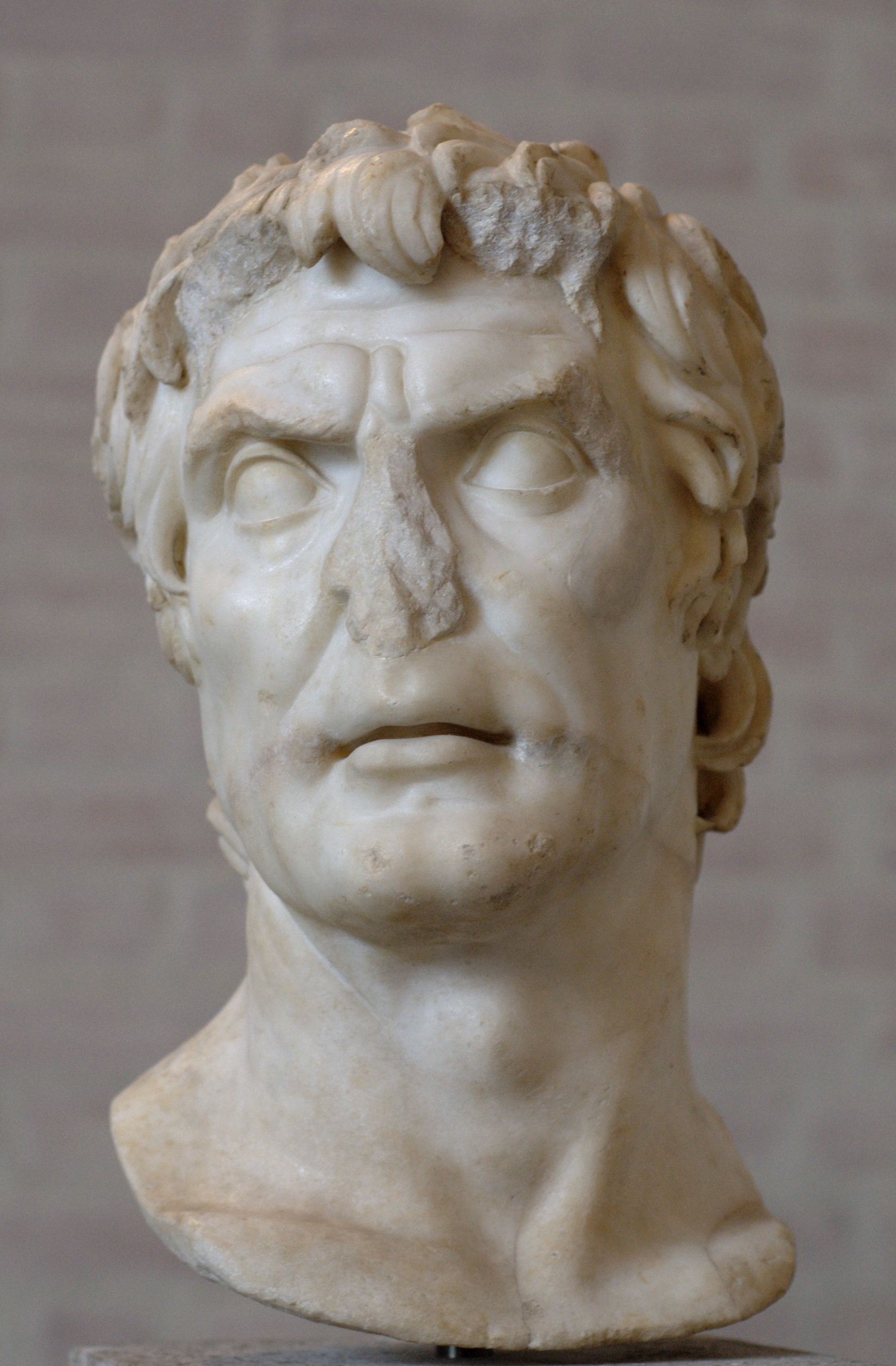
In the first two books, the author goes out of her way to emphasize that Sulla is very handsome. This is apparently based on his bust which is, indeed, quite handsome, at least with the paint worn off. Plutarch describes his complexion as splotchy, so much so that his enemies said he looked like a mulberry sprinkled with meal. Plutarch also says that during his war in the east, Sulla had a numb and heavy feeling in his feet that he took as a sign of gout and so took a hot springs cure.
There is also another bust of Sulla, much older and less attractive. McCullough, a neuroscientist, takes this to mean that Sulla was prematurely aged by a terrible illness. She takes the numbness and heaviness in his feet as signs of diabetes, which caused him to gain and lose an immense amount of weight, ruining his beauty. In the early books he is so fair as to be almost albino and very prone to sunburn. The author has his mulberry look result from a terrible sunburn and further burning from the hot spring. He has gone from ungodly handsome to human wreck and become somewhat warped as a result. He has also taken to heavy drinking because nothing else relieves the itching.
Interestingly enough, although Sulla is not a household name on the level of Nero or Caligula, the author does portray him as a sort of degenerate Roman Emperor, much like one might portray Nero or Caligula. Erratic and temperamental, he loves acting even more erratic than he really is and tormenting the people around him with fear and keeping them forever guessing what he might do next. Only Pompey is too thick-skinned to be intimidated. Outwardly, he seems a bit crazy. Soon it becomes clear that he is crazy like a fox. Upon retiring, he behaves just like a degenerate Roman Emperor and goes off with his theater friends to live a life of wild excess in luxury, food, drink, and sex, alternating with attacks of serious illness (driven, in large part by his excesses) and violent fits of rage. Over time, the partying binges become less and less common and the sickness and rage more and more common and he dies horribly, vomiting blood.
![]() |
| Alexander the Great |
So how does the fictional Pompey compare to the historical record? My guess is that McCullough is being less than just to him. On the other hand, Plutarch's biography, at least for these early years, reads like a whitewash. Despite his generally conservative sympathies, Plutarch ignores a whole lot of traditions that Pompey flouted, such as demanding a triumph when he had not held any public office, running for consul when he had not held any office or even been in the Senate, and refusing to disband his army until he got his way. Portraying
him as bribing a large faction in the Senate to his bidding appears to be a slander by McCullough.
![]() |
| Pompey (see any resemblance?) |
Setting aside the real Pompey as unknowable, McCullough's Pompey certainly makes his personality felt. He comes across as self-centered, over confident, crude, insensitive, fond of giving offense, and so arrogant as to make even Caesar look good by comparison. But he does have considerable ability in war and administration, charm of a manipulative type, and a way of making his wives happy.
When we first meet him, he has bribed a judge into letting him off by marrying his daughter, makes her happy in their marriage, and then casts her off as soon as a better opportunity comes along. He presents his army to Sulla with maximum high-handedness, making demands that Sulla's other followers consider an appalling lack of respect. But Sulla tolerates him because he wins battles. Twice Sulla gives him as wife the widow or forcibly divorced wife of a political opponent, much against her wishes. Twice Sulla wins his wife over, the first one with sickeningly sweet flattery, the other by respecting her mind and opinions. He is so coarse that when Sulla says that Pompey, his father, and his infant son should be called the Butcher, the Kid Butcher, and the Baby Butcher, Pompey doesn't even notice that he has been insulted. He uses his army to exert political pressure, though only as a bluff, not really meaning it. Fighting wars in Africa and Spain, he arrogantly presumes to lecture men who have fought there much longer on the lay of the land. Then he loses some battles and gets some arrogance kicked out of him, at least for the time being. His lack of education and polish show up in the dispatches he writes home, which scandalize some Senators, while others applaud his plain style for plain truths.
In the end, he overreaches politically as well as militarily. He wants to parlay his wealth and military might into political power unbounded by law and custom and, indeed, in defiance and scandal of it. But he doesn't want to go so far as to be a military dictator. He wants to outrage the Senate and rub their noses in his power, but a military dictatorship wouldn't do that properly. If he established a military dictatorship, the Senate would submit but take comfort in knowing that his power was built on force only and that they submitted only out of coercion, as with Sulla. He wants the Senate to accept his power as necessary and legitimate, even as they hate it. Sulla likes being feared and learns to accept being hated. Pompey wants to be loved. And since he also wants the Senate to hate him but be forced to accept his power, his natural affinity is as a populist. But it is an unfamiliar hat to Sulla's man. Besides, like Marius, Pompey is a much better general than he is a politician.
Enter Caesar. Though quite unhistorical, he negotiates a settlement between Pompey and Crassus in which they share the consulship in exchange for restoring power to the tribunes and getting them to pass a pardoning them for any treason they may have committed. Pompey uses his huge wealth to offer extravagant entertainment. He proves a good administrator. Knowing such games are accompanied by outbreaks of crime and disease, he hires retired gladiators to maintain order and puts up signs everywhere warning people not to relieve themselves outside a public latrine, and reminding them of the importance of hand washing and eating only fresh food. (!) Outbreaks of crime and disease are averted. But politicking has exhausted him, and at the end of his term, Pompey his happy to return to private life.
Subscribe to:
Posts (Atom)