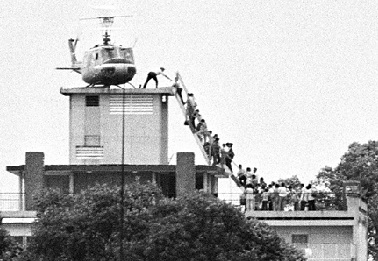
I am not old enough to remember the Vietnam War, including its conclusion, the fall of Saigon. But from what I have heard about it, events in Iraq are following a familiar pattern. When we withdrew from Vietnam, the Viet Cong were largely eliminated as a force. We were able to cobble together something that could loosely be called victory. We claimed to have achieved peace with honor. And a war-weary public didn't want to hear any more about it.
But the government of South Vietnam we left in power was a frail, artificial construct, too weak to stand on its own. Once we left, it soon collapsed. The North Vietnamese blitzkrieg came charging across the border, and the government we had been propping up fell with little resistance. All pretenses of victory were at an end. We had lost.
Of course, there were hawkish hard liners who considered the situation salvageable to the very end. If only we had gone in and propped up the South Vietnamese government again, we would have been able to turn back the North Vietnamese invasion and all would have been well, or, if not well, back to the status quo ante. The hardliners were mostly Republicans. A Republican President (Nixon) had negotiated the fragile peace that we could pretend was a victory. A Republican President (Ford) was in the White House when Saigon fell. But the Democrats controlled Congress and cut off any funds for continuing the war. So certain unrepentant hard liners always insisted that we could have won if those treacherous Democrats hadn't stabbed a Republican President in the back.
Oh, yes, and once South Vietnam fell, it soon became apparent that, although the government we had been backing were bad guys, the enemy we were fighting were worse. A lot of Americans whose opposition to the war spilled all the way over into support for the enemy had a hard time admitting it.
Fast forward another 40 years, and it looks very similar (though not the same). We managed to cobble together what could roughly be called a victory in Iraq. The Sunnis turned against Al-Qaeda in Iraq and took sides with us in defeating them. The Iraqi government requested -- nay, demanded -- our withdrawal and was in charge when we left. We claimed that the surge worked. And a war-weary public didn't want to hear any more about it.
But the government of Iraq we left behind was a frail, artificial construct, too weak to stand on its own. Once we left, it soon enraged the Sunnis, and they once again started working with AQI and others like it. ISIS is launching its blitzkrieg across the Syrian border, and towns have been falling with little resistance. All pretenses of victory are at an end, or nearly so. If ISIS wins, we have lost.
Of course, there are hawkish hard liners who still consider the situation salvageable. They are convinced that if only we had left a small residual force in Iraq (against the express wishes of the Iraqi government) we could have stopped this from happening, or that a few troops even now will work wonders. But all that either action would achieve would be to continue the situation that most Americans (and Iraqis) found so intolerable and were unwilling to continue. Deep sigh of frustration.
Of course, there are differences between then and now. This time, a Republican negotiated our exit, including the possibility of a small residual force, while a Democrat actually made the exit, without such a force. And the fall of Mosul has taken place with a Democrat in the White House and a Republican Congress. Which means, based on its past record, that Congressional Republicans will scream bloody murder, demanding that Obama intervene until he actually makes some move to do so, whereupon they will scream bloody murder denouncing his actions. Partisanship is a lot sharper now than it was then.
Oh, yes, and this time no one had any illusions about the nature of the people we are fighting. The government we propped up may be bad guys, but no one doubts that ISIS is even worse.
Monday, June 16, 2014
Sunday, June 15, 2014
Just want to give a quick hat tip to the linked column by Jonathan Chait to the effect that what really drove opposition to Eric Cantor what not so much the substance of any particular proposal he made, but to the fact that he made any sort of deal with the Democrats at all. He shows how even the most conservative voters are actually split on the issue of immigration and then adds:
Conservative Republicans may not hate immigration reform, but they hate compromise in general. By an 82-14 margin, liberals want their elected officials to make compromises. By a 63-32 margin, conservatives want elected officials not to compromise. Republicans simply don’t trust bipartisan deals.
It’s an ideological trait that goes beyond mere hatred for Obama, which is considerable. During the Bush years, why did the conservative base revolt against immigration reform but not the prescription-drug entitlement? Surely one reason, aside from the substance of the two bills, is that immigration reform was a bipartisan effort with the high-profile involvement of right-wing hate figure Ted Kennedy, while the prescription-drug bill was rammed through Congress on a partisan basis.
The conservative revolt against compromise expresses itself constantly. It comes through in the ever-present trope of citing the length of legislation as a primary reason to oppose it. It likewise comes through in the way conservative intellectuals routinely attack bills as a "stew of deals, payoffs, waivers, and special-interest breaks" — which is to say, they hate the fact that passing bills in Congress requires cutting deals with disparate constituencies, which is how legislation works.In other words, Republicans' real opposition is not to the substance of legislation at all, but to any cooperation with Democrats. In some ways, this viewpoint is not new. I am reminded of Richard Hofstadter's Anti-Intellectualism in American Life, in which he remarks:
The fundamentalist will have nothing to do with all this [the normal politics of compromise]: it is essentially Manichean; it looks upon the world as an arena for conflict between absolute good and absolute evil, and accordingly it scorns compromises (who would compromise with Satan?) and can tolerate no ambiguities. It cannot find serious importance in what it believes to be trifling degrees of difference: liberals support measures that are fol all practical purposes socialistic, and socialism is nothing more than a variant of Communism, which, as everyone knows, is atheism.
The difference is that today this attitude has taken over the entire Republican Party. This once again shows the problems with combining a presidential system of government with something increasingly approaching parliamentary-style party discipline. In a parliamentary system, this would not necessarily be a problem. In a parliamentary system, all power rests in a single legislative body with tightly disciplined parties. No one attempts bipartisan compromise, the "in's" simply enact their program without consulting the "out's." It is assumed that if the In's ran on a particular platform, they will draw up legislation entirely by the In's without consulting the Out's and pass it with all the In's voting yes and all the Out's voting no. The main check on passing anything too crazy is that the In's know if they do anything too crazy, they will lose the next election.
Such tight party discipline does not work so well under a presidential system because of its many veto points. For any measure to pass, it must have the support of the House, the Senate and the President. Any one of them can block any measure. In fact, with the rise of the routine use of the "filibuster," we have added that new veto point that any measure must have a 60% supermajority in the Senate, and that means 60 absolute votes, not just 60% of those present. When one party, let alone both parties, develops a parliamentary-style discipline, that means that legislation becomes impossible unless one party controls not only the House, the Senate and the Presidency, but at least 60 seats in the Senate. That is simply an insane way of running a country.
Republicans quite simply have what conservatives claim to despise -- a sense of entitlement, in this case to political power. When the Democrats hold the Presidency, Senate and House, Republicans want their representatives to block all action and make the country ungovernable. When the Republicans hold any one of these (in this case, the House), they want it to translate into complete power. The real reason they are angry at Cantor is that he could not parley control of the House into complete control of the government, but ended up making a deal with Democrats who controlled the Presidency and Senate. If that is the Republicans' goal, it is one they are unlikely to achieve, making these last two years ones of ever increasing anger and frustration. Rough seas ahead.
Labels:
dangerous polarization,
Election,
Partisan politics
Wednesday, June 11, 2014
And Another Thought on Right Wing Populists
All right, I have a few more reflections on the right wing populists who have been so successful in the recent EU elections, including a possible refinement of my definition of right wing populism. I have commented before that populists don't fit very well on the conventional right-left spectrum. The usually lean left on economic issues and right on social issues. They both punch up and kick down. Identifying populists as right wing or left wing is therefore a relative matter.
The populists who are on the rise in Europe are a classic example. The both punch up at Eurocratic elites and kick down at immigrants. The Guardian article naturally is most alarmed at these parties' tendency to punch up at the Eurocratic elite. But in this, they are doing no worse than the Eurocrats deserve. The Eurocrats have imposed the euro on an unwilling public and thereby prevented appropriate adjustments by falling currencies; they have egregiously mismanaged the financial crisis; they have inflicted senseless pain on member states and have nothing to offer but ever more pain and empty promises; and they have even overridden the democratic process in some countries to impose policies more to their liking. It is entirely appropriate to punch up at such an elite. Besides, the elites are not in danger from mobs in the; they are quite capable of protecting themselves. The article says precious little about right wing populist parties' eagerness to kick down at immigrants, many of whom are not capable of protecting themselves and are in danger from violent acts.
Likewise the Guardian is so spectacularly obtuse as to define turning left as not Eurosceptic, i.e., not punching up at an entirely appropriate target. Interestingly enough, such countries include Greece, Spain, Portugal and Italy, i.e., the Mediterranean countries that have suffered most from the EU's destructive policies. Italy has actually suffered the indignity of seeing the EU depose a democratically elected Prime Minister and replace him with someone more to their liking. By all means, let us applaud these countries to the extent they are refraining from kicking down at immigrants. But if they aren't as mad as hell at the Eurocrats, what's wrong with them?
Still, it does give me some further food for thought as to defining right wing populism. (A favorite subject of mine). It is my hypothesis that typical populist movements both punch up and kick down, and that whether they are defined as right wing or left wing is simply a matter of which is emphasized more. I further proposed that there are pure left wing populist movements that punch up only and do not kick down, but they usually have limited appeal. Still further, I proposed that there could hypothetically be pure right wing populist movements than only kicked down and did not punch up, but that as a practical matter, they do not seem to occur in the real world. But maybe we should define right wing populists versus left wing populists not only by whether they punch up (invariably they do), but what sort of target they punch up at.
Recall Jonathan Haidt's definition of conservatives -- they are people who value in-group loyalty, respect for authority and tradition, and reverence for the sacred. (Liberals, by contrast, are people who do not value these things). So when populists punch up, perhaps we should look at whether they are punching up along these lines. Do the denounce elites who are outsiders infringing on our in-group's autonomy and sovereignty? Elites who threaten traditional values, or lack respect for the sacred? It may be that this is a specifically right wing form of punching up, as opposed to left wing punching up which is resentment of elites who economically exploit us, or simply who are wealthier than we are.
Something to think about.
The populists who are on the rise in Europe are a classic example. The both punch up at Eurocratic elites and kick down at immigrants. The Guardian article naturally is most alarmed at these parties' tendency to punch up at the Eurocratic elite. But in this, they are doing no worse than the Eurocrats deserve. The Eurocrats have imposed the euro on an unwilling public and thereby prevented appropriate adjustments by falling currencies; they have egregiously mismanaged the financial crisis; they have inflicted senseless pain on member states and have nothing to offer but ever more pain and empty promises; and they have even overridden the democratic process in some countries to impose policies more to their liking. It is entirely appropriate to punch up at such an elite. Besides, the elites are not in danger from mobs in the; they are quite capable of protecting themselves. The article says precious little about right wing populist parties' eagerness to kick down at immigrants, many of whom are not capable of protecting themselves and are in danger from violent acts.
Likewise the Guardian is so spectacularly obtuse as to define turning left as not Eurosceptic, i.e., not punching up at an entirely appropriate target. Interestingly enough, such countries include Greece, Spain, Portugal and Italy, i.e., the Mediterranean countries that have suffered most from the EU's destructive policies. Italy has actually suffered the indignity of seeing the EU depose a democratically elected Prime Minister and replace him with someone more to their liking. By all means, let us applaud these countries to the extent they are refraining from kicking down at immigrants. But if they aren't as mad as hell at the Eurocrats, what's wrong with them?
Still, it does give me some further food for thought as to defining right wing populism. (A favorite subject of mine). It is my hypothesis that typical populist movements both punch up and kick down, and that whether they are defined as right wing or left wing is simply a matter of which is emphasized more. I further proposed that there are pure left wing populist movements that punch up only and do not kick down, but they usually have limited appeal. Still further, I proposed that there could hypothetically be pure right wing populist movements than only kicked down and did not punch up, but that as a practical matter, they do not seem to occur in the real world. But maybe we should define right wing populists versus left wing populists not only by whether they punch up (invariably they do), but what sort of target they punch up at.
Recall Jonathan Haidt's definition of conservatives -- they are people who value in-group loyalty, respect for authority and tradition, and reverence for the sacred. (Liberals, by contrast, are people who do not value these things). So when populists punch up, perhaps we should look at whether they are punching up along these lines. Do the denounce elites who are outsiders infringing on our in-group's autonomy and sovereignty? Elites who threaten traditional values, or lack respect for the sacred? It may be that this is a specifically right wing form of punching up, as opposed to left wing punching up which is resentment of elites who economically exploit us, or simply who are wealthier than we are.
Something to think about.
Labels:
dangerous polarization,
Election,
euro crisis,
Failures of Democracy,
General macro,
populism
EU Elections: The Elite Gets What it Deserved
And at last I return to what I promised to post about -- Europe's elections of EU representatives. Right wing populists have done very well. The establishment is running around wailing and wringing its hands, wondering how we could have come to this. The establishment has no one to blame but itself. It made a series of serious mistakes and prefers to ask the public to make ever greater and greater sacrifices, rather than admit that it was wrong.
It began with the euro. The euro was a cherished project of European elites, deeply distrusted by the general public. It should be obvious by now that the ignorant masses were right and "enlightened" elites were wrong about the euro -- it really was an intolerable violation of national sovereignty. Granted, the public was right for the wrong reasons. In the absence of a trans-national currency, the most stressed countries can let their currencies fall and export their way out of trouble. The process is painful, but not disastrous. It also violates elite and public intuition, which says that falling currencies are bad and to be avoided. But being wrong about the euro is forgivable. Everyone is wrong sometimes. Refusing to undo the euro is forgivable. The process might be so messy that even the current situation is preferable. But goddamit, even countries like Poland that benefited from not being in the euro want to get in. Even Iceland, which not only benefited from being outside the euro, but had a semi-revolution, wrote a new constitution, and prosecuted the bankers, the @#$%^!! authorities still want to get into the euro!
Since the crisis broke, mistake has compounded mistake, following a familiar script from Europe in the 1930's, Latin America from the 1980's, Asia from the 1990's, etc. Each time, conventional wisdom has called on countries facing massive capital flight to put wooing capital at the top of their priority list. Cut spending, shred the safety net, fire everyone with a good paying job, make sacrifices and ever more sacrifices, inflict general economic devastation on one's self to win the approval of international investors. Yet inexplicably, no one ever seems to want to invest in economic devastation. This is conventional wisdom. All respectable people agree to it. Is it any wonder, then, that if the only people who question the need to keep following failed policies, to keep inflicting ever more pain, to insist that lowered bond ratings are the be-all and end-all and that the human consequences are of no importance, are well outside the respectable mainstream, that such parties are gaining in popularity?
People are forgetting the whole purpose of the European Union in the first place. It grew out of the horrors of WWII and the hope that closer integration would prevent future wars and nationalism. But then again, the horrors of nationalism, of fascism, and (ultimately) of WWII arose from the Great Depression and the conventional wisdom among all respectable people of the day that more sacrifices and ever more sacrifices were what was called for. When respectable people could not deliver, but public turned to the disrespectable -- to fascists and other dictators. Is that what we want to see happen again?
I outsource my comments to Paul Krugman:
It began with the euro. The euro was a cherished project of European elites, deeply distrusted by the general public. It should be obvious by now that the ignorant masses were right and "enlightened" elites were wrong about the euro -- it really was an intolerable violation of national sovereignty. Granted, the public was right for the wrong reasons. In the absence of a trans-national currency, the most stressed countries can let their currencies fall and export their way out of trouble. The process is painful, but not disastrous. It also violates elite and public intuition, which says that falling currencies are bad and to be avoided. But being wrong about the euro is forgivable. Everyone is wrong sometimes. Refusing to undo the euro is forgivable. The process might be so messy that even the current situation is preferable. But goddamit, even countries like Poland that benefited from not being in the euro want to get in. Even Iceland, which not only benefited from being outside the euro, but had a semi-revolution, wrote a new constitution, and prosecuted the bankers, the @#$%^!! authorities still want to get into the euro!
Since the crisis broke, mistake has compounded mistake, following a familiar script from Europe in the 1930's, Latin America from the 1980's, Asia from the 1990's, etc. Each time, conventional wisdom has called on countries facing massive capital flight to put wooing capital at the top of their priority list. Cut spending, shred the safety net, fire everyone with a good paying job, make sacrifices and ever more sacrifices, inflict general economic devastation on one's self to win the approval of international investors. Yet inexplicably, no one ever seems to want to invest in economic devastation. This is conventional wisdom. All respectable people agree to it. Is it any wonder, then, that if the only people who question the need to keep following failed policies, to keep inflicting ever more pain, to insist that lowered bond ratings are the be-all and end-all and that the human consequences are of no importance, are well outside the respectable mainstream, that such parties are gaining in popularity?
People are forgetting the whole purpose of the European Union in the first place. It grew out of the horrors of WWII and the hope that closer integration would prevent future wars and nationalism. But then again, the horrors of nationalism, of fascism, and (ultimately) of WWII arose from the Great Depression and the conventional wisdom among all respectable people of the day that more sacrifices and ever more sacrifices were what was called for. When respectable people could not deliver, but public turned to the disrespectable -- to fascists and other dictators. Is that what we want to see happen again?
I outsource my comments to Paul Krugman:
[T]he European elite remains deeply committed to the project [the euro and European Union], and, so far, no government has been willing to break ranks. But the cost of this elite cohesion is a growing distance between governments and the governed. By closing ranks, the elite has in effect ensured that there are no moderate voices dissenting from policy orthodoxy. And this lack of moderate dissent has empowered groups like the National Front in France, whose top candidate for the European Parliament denounces a “technocratic elite serving the American and European financial oligarchy.”I also highly recommend this piece on how the center-left is committing suicide by insisting on placing European integration ahead of domestic well-being.
Labels:
euro crisis,
Failures of Democracy,
General macro
Tuesday, June 10, 2014
And Another Reminder Why Private Armies are Not So Great
So, it appears that Jerad and Amanda Miller, the couple who killed two Las Vegas police and a store manager were supporters of the Patriot movement and participants in the Clive Bundy standoff. According to the Bundys, they were asked to leave because of their radicalism and felony record. Other observers say there were nothing to distinguish them from any other supporters present. But one way or the other, this should once again be taken as a warning as to why private armies dedicated to violent revolution are not the best protectors of liberty in a country with a democratically elective government.
So let me give the usual disclaimers here. Most Fox New/Tea Party right wingers are not militia members. Most militia members do not go on mad shooting sprees. But both groups need to police their fringes a whole lot better. Rachel Maddow brilliantly pointed out that when Fox News was so energetically championing Clive Bundy, it had ample evidence readily available that he held extremely radical views that presumably neither Fox nor most of its viewers shared. Yes, one can deplore federal heavy-handedness toward someone with odious views. But too close an embrace tends, after all, to imply affection. And while militia members are quick to dismiss people like the Millers as a few bad apple and assure us that most of their crew are peace and freedom loving, such protestations are naive. Combining an ideology of fear and loathing (regardless of the targets of that fear or loathing), constant warnings about the possible need to resort to violence, and lots and lots of guns is a positive invitation to bad elements to infiltrate your movement. To pretend otherwise is to close one's eyes to reality. The assumption that elective government is simply tyranny waiting to happen while private armies are necessarily champions of liberty is simply not convincing.
At the same time, I would give a piece of advice to my own side. Don't panic. Remember, crime rates are continuing to fall. Remember, all combined acts of right wing terrorism aren't enough to add up to even a blip in the total crime rate. And besides, panic is what fuels the whole Patriot movement. Don't let it fuel us, too.
So let me give the usual disclaimers here. Most Fox New/Tea Party right wingers are not militia members. Most militia members do not go on mad shooting sprees. But both groups need to police their fringes a whole lot better. Rachel Maddow brilliantly pointed out that when Fox News was so energetically championing Clive Bundy, it had ample evidence readily available that he held extremely radical views that presumably neither Fox nor most of its viewers shared. Yes, one can deplore federal heavy-handedness toward someone with odious views. But too close an embrace tends, after all, to imply affection. And while militia members are quick to dismiss people like the Millers as a few bad apple and assure us that most of their crew are peace and freedom loving, such protestations are naive. Combining an ideology of fear and loathing (regardless of the targets of that fear or loathing), constant warnings about the possible need to resort to violence, and lots and lots of guns is a positive invitation to bad elements to infiltrate your movement. To pretend otherwise is to close one's eyes to reality. The assumption that elective government is simply tyranny waiting to happen while private armies are necessarily champions of liberty is simply not convincing.
At the same time, I would give a piece of advice to my own side. Don't panic. Remember, crime rates are continuing to fall. Remember, all combined acts of right wing terrorism aren't enough to add up to even a blip in the total crime rate. And besides, panic is what fuels the whole Patriot movement. Don't let it fuel us, too.
Saturday, May 31, 2014
Why Are Our Elites so Stupid, Take II
To repeat the closing line from my last post, if recent events have not done much for my faith in democracy and the common people, they have done even less for my confidence in purportedly enlightened elites.
I have long been aware of many of the capital flaws of elites (enlightened or not) -- their tendency to confuse their own interests with the common good, their stubbornness in protecting their own privileges and status, their gross overreaction to even the slightest challenge to their domination. But I don't think it was until this last decade that I became aware of another capital flaw of elites -- their incredible denseness. I had no idea that elites were so utterly unwilling to learn the lessons of evidence that was staring them in the face.
My first clue to that was with the Iraq War. Public and elite opinion are both at fault here -- both foolishly allowed themselves to be stampeded into it. (Although to what extent public opinion was driven by elite opinion is a different question). But at least the public was willing to learn something from the debacle. The general public seems to have learned that making open-ended military commitments to reshape countries on the far side of the world in our image is not a good idea. Elite opinion does not seem to be so quick on the uptake. Reading the Economist in 2002 urging war in Iraq without giving any coherent reason for it was bad enough. Reading it now explaining that just because military intervention went badly in Iraq, Afghanistan, Libya, etc. is no reason not to try it in latest confrontation they have cooked up. Elite opinion on foreign intervention is sounding very much like that famous definition of insanity -- to continually keep doing the same thing while expecting a different result.
But public opinion is running a fair record of overruling elite opinion on starting foreign wars. More dangerous is the matter of economic policy. What is really dangerous here is that elite opinion and public opinion share the same basic, but mistaken, intuitions. People's basic gut-level intuition tells us that if everyone else is cutting back, government should cut back too; that no one should get an unfair break; that inflation is particularly noxious under conditions of stagnant wages, and that falling currencies are something to get upset about. The problem is that these gut-level intuitions are wrong, at least under current economic conditions. When everyone else is cutting back, someone needs to spend more to keep the total economy from shrinking. When the economy is shrinking, everyone needs a break, fair or unfair. When the debt burden becomes crushing, inflation is just what we need to shrink it. And when an economy becomes stressed, a falling currency is therapeutic. Furthermore, it is not true that a common failing of democracy is that it prevents government from taking painful but necessary measures because the public is just not willing to make the sacrifice. Quite the contrary, in times of crisis, the public is willing and eager to make material sacrifices. What the the public (and the elite as well) refuse to sacrifice is its basic intuition of what should be done. Thus I would say that the difficulty in selling fiscal conservatism in good times is not that it is unpleasant or that people are unwilling to make the sacrifice, but that it is counter-intuitive. People just don't feel the need for sacrifice when all is going well. It is proving equally difficult to persuade the public not to make sacrifices in bad times because basic intuition says those sacrifices are called for.
But if public opinion and elite opinion are essentially the same in their moral intuitions, and equally wrong, elite opinion his been the more harmful. When conditions get bad enough, the public will ultimately try anything, even violating its intuitions. Elites pigheadedly stick to the old formulas that have been so ruinous before. I can think of several reasons why this might be so. One is that the public is not all that well informed on what actual government policy is at any time, but is mostly just aware of results. Thus during Franklin Delano Roosevelt's day, Keynesian economics could persistently poll badly, the public could persistently say it was worried about deficits and wanted Roosevelt to cut spending -- and Roosevelt could persistently be wildly popular and be reelected by a landslide and only see his popularity fade when he actually cut spending and returned to recession. In the end, policies did not matter as much as results. Elites, on the other hand, are more closely informed about what government is actually doing, while relatively shielded from the actual consequences of what they are inflicting on the public.
Yet they are not shielded altogether. Various lefties come up with various far-fetched theories about how really a depressed economy is in the elite's interest and that is why they resist any cure. I find such arguments unconvincing. John Kenneth Galbraith once caustically commented that our financial elites preferred Hoover over Roosevelt even though Hoover caused greater losses to capital than anyone since Lenin. And with all due discount for exaggeration, he has a point. For stocks to lose as much as 90% of their value cannot possibly be in the interests of our plutocrats. So why did they hate Roosevelt so much, just because he imposed more taxes and regulations in return for saving the economy? And why do they so hysterically overreact to the tiniest criticism from Obama? And why do they persist in demanding such disastrous policies in Europe? I do not think it is too glib to say that it is because our elites are dense -- and that giving up their denseness would mean giving up their authority.
I saw a fascinating article somewhere arguing that one of the reasons Paul Krugman is so hated, and so often criticized as elitist is that his prescriptions violate people's intuitions -- that to be told no, your intuitions are wrong, trust the economists whose specialized knowledge means they know better is deeply offensive to most people. But it is less offensive to general public, who hear this sort of thing all the time from a lot of experts, that it is to our business leaders who specifically consider themselves experts on how an economy works and resent being told that some ivory tower professor who has never run a business knows more than they do. And that, I suspect, is what really lies at the heart of elite resentment toward the FDR's, the Krugmans, and all the other people who would revive the economy without seriously changing the underlying economic order or distribution of wealth, but in a manner that violates basic elite intuition about what should be done. Part of it is simply the usual elite hypersensitivity about the slightest infringement on their power and privilege. But part of it is that it threatens not so much their existing wealth and power, but the basic source of legitimacy of that wealth and power -- their ability to run an economy. A serious economic downturn inherently calls that ability into question and elicits a defensive reaction from our economic elites to begin with. But a proposed remedy that violates elite intuition looks like a frontal attack. Even if it does not directly threaten the existing distribution of wealth and power, merely to suggest that people who hold wealth and power might not know best how to use it is perceived as an existential challenge to their hegemony.
So I suppose maybe the maddening denseness of purportedly enlightened elites is closely linked to their defensiveness of their wealth and privilege and overreaction to the tiniest infringement against it. For elites to admit that they might be wrong is to call their whole claim to power into question.
All of which closely ties in the the topic of my next intended post -- the elections to European parliament.
I have long been aware of many of the capital flaws of elites (enlightened or not) -- their tendency to confuse their own interests with the common good, their stubbornness in protecting their own privileges and status, their gross overreaction to even the slightest challenge to their domination. But I don't think it was until this last decade that I became aware of another capital flaw of elites -- their incredible denseness. I had no idea that elites were so utterly unwilling to learn the lessons of evidence that was staring them in the face.
My first clue to that was with the Iraq War. Public and elite opinion are both at fault here -- both foolishly allowed themselves to be stampeded into it. (Although to what extent public opinion was driven by elite opinion is a different question). But at least the public was willing to learn something from the debacle. The general public seems to have learned that making open-ended military commitments to reshape countries on the far side of the world in our image is not a good idea. Elite opinion does not seem to be so quick on the uptake. Reading the Economist in 2002 urging war in Iraq without giving any coherent reason for it was bad enough. Reading it now explaining that just because military intervention went badly in Iraq, Afghanistan, Libya, etc. is no reason not to try it in latest confrontation they have cooked up. Elite opinion on foreign intervention is sounding very much like that famous definition of insanity -- to continually keep doing the same thing while expecting a different result.
But public opinion is running a fair record of overruling elite opinion on starting foreign wars. More dangerous is the matter of economic policy. What is really dangerous here is that elite opinion and public opinion share the same basic, but mistaken, intuitions. People's basic gut-level intuition tells us that if everyone else is cutting back, government should cut back too; that no one should get an unfair break; that inflation is particularly noxious under conditions of stagnant wages, and that falling currencies are something to get upset about. The problem is that these gut-level intuitions are wrong, at least under current economic conditions. When everyone else is cutting back, someone needs to spend more to keep the total economy from shrinking. When the economy is shrinking, everyone needs a break, fair or unfair. When the debt burden becomes crushing, inflation is just what we need to shrink it. And when an economy becomes stressed, a falling currency is therapeutic. Furthermore, it is not true that a common failing of democracy is that it prevents government from taking painful but necessary measures because the public is just not willing to make the sacrifice. Quite the contrary, in times of crisis, the public is willing and eager to make material sacrifices. What the the public (and the elite as well) refuse to sacrifice is its basic intuition of what should be done. Thus I would say that the difficulty in selling fiscal conservatism in good times is not that it is unpleasant or that people are unwilling to make the sacrifice, but that it is counter-intuitive. People just don't feel the need for sacrifice when all is going well. It is proving equally difficult to persuade the public not to make sacrifices in bad times because basic intuition says those sacrifices are called for.
But if public opinion and elite opinion are essentially the same in their moral intuitions, and equally wrong, elite opinion his been the more harmful. When conditions get bad enough, the public will ultimately try anything, even violating its intuitions. Elites pigheadedly stick to the old formulas that have been so ruinous before. I can think of several reasons why this might be so. One is that the public is not all that well informed on what actual government policy is at any time, but is mostly just aware of results. Thus during Franklin Delano Roosevelt's day, Keynesian economics could persistently poll badly, the public could persistently say it was worried about deficits and wanted Roosevelt to cut spending -- and Roosevelt could persistently be wildly popular and be reelected by a landslide and only see his popularity fade when he actually cut spending and returned to recession. In the end, policies did not matter as much as results. Elites, on the other hand, are more closely informed about what government is actually doing, while relatively shielded from the actual consequences of what they are inflicting on the public.
Yet they are not shielded altogether. Various lefties come up with various far-fetched theories about how really a depressed economy is in the elite's interest and that is why they resist any cure. I find such arguments unconvincing. John Kenneth Galbraith once caustically commented that our financial elites preferred Hoover over Roosevelt even though Hoover caused greater losses to capital than anyone since Lenin. And with all due discount for exaggeration, he has a point. For stocks to lose as much as 90% of their value cannot possibly be in the interests of our plutocrats. So why did they hate Roosevelt so much, just because he imposed more taxes and regulations in return for saving the economy? And why do they so hysterically overreact to the tiniest criticism from Obama? And why do they persist in demanding such disastrous policies in Europe? I do not think it is too glib to say that it is because our elites are dense -- and that giving up their denseness would mean giving up their authority.
I saw a fascinating article somewhere arguing that one of the reasons Paul Krugman is so hated, and so often criticized as elitist is that his prescriptions violate people's intuitions -- that to be told no, your intuitions are wrong, trust the economists whose specialized knowledge means they know better is deeply offensive to most people. But it is less offensive to general public, who hear this sort of thing all the time from a lot of experts, that it is to our business leaders who specifically consider themselves experts on how an economy works and resent being told that some ivory tower professor who has never run a business knows more than they do. And that, I suspect, is what really lies at the heart of elite resentment toward the FDR's, the Krugmans, and all the other people who would revive the economy without seriously changing the underlying economic order or distribution of wealth, but in a manner that violates basic elite intuition about what should be done. Part of it is simply the usual elite hypersensitivity about the slightest infringement on their power and privilege. But part of it is that it threatens not so much their existing wealth and power, but the basic source of legitimacy of that wealth and power -- their ability to run an economy. A serious economic downturn inherently calls that ability into question and elicits a defensive reaction from our economic elites to begin with. But a proposed remedy that violates elite intuition looks like a frontal attack. Even if it does not directly threaten the existing distribution of wealth and power, merely to suggest that people who hold wealth and power might not know best how to use it is perceived as an existential challenge to their hegemony.
So I suppose maybe the maddening denseness of purportedly enlightened elites is closely linked to their defensiveness of their wealth and privilege and overreaction to the tiniest infringement against it. For elites to admit that they might be wrong is to call their whole claim to power into question.
All of which closely ties in the the topic of my next intended post -- the elections to European parliament.
Wednesday, May 28, 2014
Is Democracy so Great, Anyhow?
In writing about the failures of democracy, I have been making the unstated assumption the democracy is good and that its failures are bad. But recent events have rather undermined my enthusiasm for democracy. Seeing one newly democratic government after another veer off in a disturbing direction has not done much for my confidence in the virtues of the common people, and, after all, if the common people are not virtuous, giving them power can be disastrous. Nonetheless, if recent events have not done much for my confidence in the common people, they have done even less for my confidence in purportedly "enlightened" elites.
As for the failings of the common people, I look back to old history books I read in high school and college, about the simultaneous rise of democracy and nationalism in Europe in the late 19th Century. These two trends, one good, one bad, occurred together, one holding bright shining promise, the other little more than a distant menace -- until it exploded in to orgy of destruction that was WWI, and again into WWII. At the time, I could dismiss this as mere coincidence. The fact that these two developments occurred hand-in-hand was simply an accident of fate, or perhaps engineered by sinister elites to defuse class struggle by channeling aggression outward. But looking at the rise of democratically elective governments in the Middle East and Eastern Europe, and of growing popular mobilization in China, it is becoming increasingly clear that this was a comfortable illusion. Nationalism sells. Scapegoating of vulnerable minorities sells. Appeals to baser instincts are more successful than appeals to better angels. And it is of no use for conservatives to argue that these are reasons to reject ethnic diversity, that ethnic uniformity is the only hope for democracy to succeed. This is nonsense for several reasons. One is that ethnic uniformity can be highly subjective. The tendency to factionalism is deep in human nature, and people are quite good at magnifying minor difference into major ones if that is all they have to work with. Another is that ethnic uniformity is a fantasy. Ethnic groups do not line up neatly on one side or the other of an artificial line. Achieving ethnic uniformity is a blood, brutal business, one that we wish to avoid. And finally, assuming no domestic minorities to serve as scapegoats, these aggressive impulses simply turn outward, from civil strife to international war. We can certainly hope that the people of Eastern Europe or the Middle East can learn from Western Europe's mistakes and refrain from their most ghastly manifestations. But hoping to avoid WWI or WWII is not setting the bar very high.
I should add here that the failings of democracy and the common people are not the ones that democracy's elite critics have so often claimed, from Classical antiquity down well into the 19th Century. Their criticisms took two general forms -- that the people are fickle, and that they are too eager to tear down their betters, i.e., that they are always eager to punch up. Neither of these is born out.
Complaints that the people are fickle really amount to saying that the people (like elites) may define politics in terms of leaders, but the really make their judgments based on results. Suppose there are food shortages and the people riot and overthrow their leader and cheer on a new one, who promises cheap bread. Cheap bread fails to materialize, so the people riot and overthrow this leader and flock to the banner of yet another, and so on indefinitely. In one sense, the people are being fickle -- they have no lasting loyalty to any leader. But in another sense they are being perfectly consistent -- they want cheap food. Their wishes may not be realistic, but they are altogether consistent. A leader, no matter how popular at the outset, will never stay popular if he governs badly. And a leader who starts out unpopular may win the people over by doing well. Furthermore, as this post points how, starting with extremely strong popularity can actually be a disadvantage because it means people have unrealistic expectations that are bound to be disappointed. I think many of democracy's aristocratic critics recognize this -- that the people's purported fickleness is simply a tendency to turn against leaders who don't deliver. But they resent the people for lacking loyalty and not standing by a leader through bad times. I would say it depends. A leader who has banked significant political capital can hold onto the people's loyalty for a significant time and get a reasonable chance to turn things around. But in the end, no one's political capital lasts forever. Fail to deliver and the people will turn against you. Indeed, philosopher Karl Popper cited this as the capital virtue of democracy -- it gives a mechanism for getting rid of leaders who have outlasted their usefulness without resorting to violence.
This, incidentally, closely matches a modern criticism of democracy, that the people are unwilling to make sacrifices, and that it is almost impossible to pass necessary but unpopular measures. But the events of the recent economic downturn have proven this accusation false as well. In fact, in time of crisis, the people are eager to make sacrifices, whether helping out their fellow citizens in a natural disaster, the sacrifices associated with war, or austerity measures in times of economic downturn. It is true that the people lose patience when asked for more and ever more sacrifices because they perceive such calls (usually correctly) as evidence of incompetent management. What has proved to be difficult in the recent downturn is persuading people to go against their intuitions and take necessary but counterintuitive measure. (But more on this in my next post).
The other elite criticism of democracy, that the people left to themselves will overindulge in punching up and just want to tear down their betters is not born out by the evidence. That elites are so constantly afraid the majority punching up reflects two things. One is an exaggerated fear for their prerogatives and believe that the slightest infringement on elite prerogative is the prelude to some all-out assault. The other may stem from cases in which a formally democratic system had degenerated into a cozy little oligarchy and the oppressed public was engaging in the sort of destructive punching up that really does happen in non-democratic systems. John Stuart Mill in his preface to de Tocqueville's Democracy in America addresses these common elite fears and why they are groundless:
Mill, like de Tocqueville, gropes at, but fails to quite grasp, the true capital flaw of democracy -- its deplorable tendency to kick down. Polished elites, from Classical times to the 19th Century feared that democracy simply meant mob rule. The events Mill and deTocqueville describe show that such fears were not altogether unjustified. But polished elites were quite wrong in believing that they were the most likely targets of the mob. The most likely targets were some despised ethnic minority. This was the great stain on democracy in the US, it is proving the great stain on newly democratized countries in Eastern Europe and the Middle East; and it is spreading like cancer in Western Europe as well.
This being said, if recent events have not done much for my confidence in democracy and the common people, they have done even less for my confidence in purportedly "enlightened" elites. A subject to be addressed in my next post.
As for the failings of the common people, I look back to old history books I read in high school and college, about the simultaneous rise of democracy and nationalism in Europe in the late 19th Century. These two trends, one good, one bad, occurred together, one holding bright shining promise, the other little more than a distant menace -- until it exploded in to orgy of destruction that was WWI, and again into WWII. At the time, I could dismiss this as mere coincidence. The fact that these two developments occurred hand-in-hand was simply an accident of fate, or perhaps engineered by sinister elites to defuse class struggle by channeling aggression outward. But looking at the rise of democratically elective governments in the Middle East and Eastern Europe, and of growing popular mobilization in China, it is becoming increasingly clear that this was a comfortable illusion. Nationalism sells. Scapegoating of vulnerable minorities sells. Appeals to baser instincts are more successful than appeals to better angels. And it is of no use for conservatives to argue that these are reasons to reject ethnic diversity, that ethnic uniformity is the only hope for democracy to succeed. This is nonsense for several reasons. One is that ethnic uniformity can be highly subjective. The tendency to factionalism is deep in human nature, and people are quite good at magnifying minor difference into major ones if that is all they have to work with. Another is that ethnic uniformity is a fantasy. Ethnic groups do not line up neatly on one side or the other of an artificial line. Achieving ethnic uniformity is a blood, brutal business, one that we wish to avoid. And finally, assuming no domestic minorities to serve as scapegoats, these aggressive impulses simply turn outward, from civil strife to international war. We can certainly hope that the people of Eastern Europe or the Middle East can learn from Western Europe's mistakes and refrain from their most ghastly manifestations. But hoping to avoid WWI or WWII is not setting the bar very high.
I should add here that the failings of democracy and the common people are not the ones that democracy's elite critics have so often claimed, from Classical antiquity down well into the 19th Century. Their criticisms took two general forms -- that the people are fickle, and that they are too eager to tear down their betters, i.e., that they are always eager to punch up. Neither of these is born out.
Complaints that the people are fickle really amount to saying that the people (like elites) may define politics in terms of leaders, but the really make their judgments based on results. Suppose there are food shortages and the people riot and overthrow their leader and cheer on a new one, who promises cheap bread. Cheap bread fails to materialize, so the people riot and overthrow this leader and flock to the banner of yet another, and so on indefinitely. In one sense, the people are being fickle -- they have no lasting loyalty to any leader. But in another sense they are being perfectly consistent -- they want cheap food. Their wishes may not be realistic, but they are altogether consistent. A leader, no matter how popular at the outset, will never stay popular if he governs badly. And a leader who starts out unpopular may win the people over by doing well. Furthermore, as this post points how, starting with extremely strong popularity can actually be a disadvantage because it means people have unrealistic expectations that are bound to be disappointed. I think many of democracy's aristocratic critics recognize this -- that the people's purported fickleness is simply a tendency to turn against leaders who don't deliver. But they resent the people for lacking loyalty and not standing by a leader through bad times. I would say it depends. A leader who has banked significant political capital can hold onto the people's loyalty for a significant time and get a reasonable chance to turn things around. But in the end, no one's political capital lasts forever. Fail to deliver and the people will turn against you. Indeed, philosopher Karl Popper cited this as the capital virtue of democracy -- it gives a mechanism for getting rid of leaders who have outlasted their usefulness without resorting to violence.
This, incidentally, closely matches a modern criticism of democracy, that the people are unwilling to make sacrifices, and that it is almost impossible to pass necessary but unpopular measures. But the events of the recent economic downturn have proven this accusation false as well. In fact, in time of crisis, the people are eager to make sacrifices, whether helping out their fellow citizens in a natural disaster, the sacrifices associated with war, or austerity measures in times of economic downturn. It is true that the people lose patience when asked for more and ever more sacrifices because they perceive such calls (usually correctly) as evidence of incompetent management. What has proved to be difficult in the recent downturn is persuading people to go against their intuitions and take necessary but counterintuitive measure. (But more on this in my next post).
The other elite criticism of democracy, that the people left to themselves will overindulge in punching up and just want to tear down their betters is not born out by the evidence. That elites are so constantly afraid the majority punching up reflects two things. One is an exaggerated fear for their prerogatives and believe that the slightest infringement on elite prerogative is the prelude to some all-out assault. The other may stem from cases in which a formally democratic system had degenerated into a cozy little oligarchy and the oppressed public was engaging in the sort of destructive punching up that really does happen in non-democratic systems. John Stuart Mill in his preface to de Tocqueville's Democracy in America addresses these common elite fears and why they are groundless:
It is not easy to surmise any inducements of interest, by which, in a country like America, the greater number could be led to oppress the smaller. When the majority and the minority are spoken of as conflicting interests, the rich and the poor are generally meant; but where the rich are content with being rich, and do not claim as such any political privileges, their interest and that of the poor are generally the same: complete protection to property, and freedom in the disposal of it, are alike important to both. When, indeed, the poor are so poor that they can scarcely be worse off, respect on their part for rights of property which they cannot hope to share, is never safely to be calculated upon. But where all have property, either in enjoyment or in reasonable hope, and an appreciable chance of acquiring a large fortune; and where every man’s way of life proceeds on the confident assurance that, by superior exertion, he will obtain a superior reward; the importance of inviolability of property is not likely to be lost sight of.In other words, the democratic public does not engage in excesses of punching up unless outward democratic forms mask a true oligarchy. But then, although he seems to deny that this is a true tyranny of the majority, Mill acknowledges the real faults of democracy:
It is not from the separate interests, real or imaginary, of the majority, that minorities are in danger: but from its antipathies of religion, political party, or race; and experience in America seems to confirm what theory rendered probable, that the tyranny of the majority would not take the shape of tyrannical laws, but that of a dispensing power over all laws. The people of Massachusetts passed no law prohibiting Roman Catholic schools, or exempting Protestants from the penalties of incendiarism; they contented themselves with burning the Ursuline convent to the ground, aware that no jury would be found to redress the injury. In the same reliance the people of New York and Philadelphia sacked and destroyed the houses of the Abolitionists, and the schools and churches of their black fellow-citizens, while numbers who took no share in the outrage amused themselves with the sight. The laws of Maryland still prohibit murder and burglary; but in 1812, a Baltimore mob, after destroying the printing office of a newspaper which had opposed the war with England, broke into the prison to which the editors had been conveyed for safety, murdered one of them, left the others for dead; and the criminals were tried and acquitted. . . . It is not so much the riots, in such instances, that are deplorable; these might have occurred in any country: it is the impossibility of obtaining aid from an executive dependent on the mob, or justice from juries which formed part of it . . . For where the majority is the sole power, and a power issuing its mandates in the form of riots, it inspires a terror which the most arbitrary monarch often fails to excite.Mill then makes a sort of half-way apology for such lawless outbreaks of mob rule -- they are short lived and not really dangerous because "[There is] no permanent class to be tyrannized over. The subjects of oppression are casual objects of popular resentment." In that, Mill was entirely wrong. Despised racial and religious minorities were, indeed, a "permanent class to be tyrannized over, and oppression of these groups proved to be prolonged and intractable. He makes the further argument that, although the US has temporary outbreaks of majority tyranny in the form of mob rule, at least it does not have the more permanent oppression of unjust laws. Given that at that time large swaths of the country by law permitted slavery, his argument is most unconvincing. (And even most free states had harshly discriminatory racial laws).
Mill, like de Tocqueville, gropes at, but fails to quite grasp, the true capital flaw of democracy -- its deplorable tendency to kick down. Polished elites, from Classical times to the 19th Century feared that democracy simply meant mob rule. The events Mill and deTocqueville describe show that such fears were not altogether unjustified. But polished elites were quite wrong in believing that they were the most likely targets of the mob. The most likely targets were some despised ethnic minority. This was the great stain on democracy in the US, it is proving the great stain on newly democratized countries in Eastern Europe and the Middle East; and it is spreading like cancer in Western Europe as well.
This being said, if recent events have not done much for my confidence in democracy and the common people, they have done even less for my confidence in purportedly "enlightened" elites. A subject to be addressed in my next post.
Subscribe to:
Posts (Atom)

