Amazing! It actually seems to have happened! Rick Santorum is looking to be the ultimate challenger to Mitt Romney. I'm not sure what to make of this. I can think of three points though:
(1) Give him points for sincerity. I know this isn't an original insight, but Santorum looks to be by far the most honest of the Final Four. Mitt Romney is a shameless panderer, telling audiences anything they want to hear. So is Newt Gingrich, although he channels their anger a lot more convincingly. Ron Paul likes to portray himself as the straight talker in contrast to all those other pandering politicians, but his newsletters prove otherwise. The difference is that Ron Paul was pandering to people so far out of the mainstream that most people have trouble imaging why he would want to. Only Santorum looks like a genuine tell the truth and damn the consequences sort of guy.
(2) Santorum is not one of these people who wants to get government out of our boardrooms and into our bedrooms. He thinks it has a place in boardrooms, too. Mitt Romney is a plutocrat. Santorum is not. He holds decidedly un-Republican views on economic issues. This seems to be a key part of his appeal in rust belt states. It may, after all, make him a more formidable candidate than I am giving him credit for.
(3) In the end, though, I think he takes culture war issues too far. Americans like a culture warrior like Ronald Reagan, who saluted Ozzie and Harriet as the ideal, while blithely ignoring the fact that most Americans (the Reagans included) did not live up to it. This makes culture wars a seriously losing issue for liberals. We tend to attack the Ozzie and Harriet ideal as repressive because we tend to interpret any praise of Ozzie and Harriet as criticism of people who fail to meet the ideal. This is a mistake. For most people, 1950's sitcoms still are the ideal, and hostility to that ideal expresses a hostility to people's deeply held values. But culture war conservatives make the opposite mistake and assume that admiration for Ozzie and Harriet translates into a wish to shame people who don't meet the ideal. The trouble, of course, it that most people don't live up to the ideal and resent criticism on that count. Santorum, to all appearances, has it in spades. My own belief is that whichever side is the aggressor in the culture wars ends up as the loser.
But we will soon see.
Sunday, February 12, 2012

Saturday, February 11, 2012
Something I Actually Do Understand About the Economy
I do think that I understand why people are so fearful of inflation right now.* My guess is that there are two reasons.
One is that we are pursuing highly unconventional policies. Since the 2008 crash, the U.S. has been running budget deficits are large as 10% of GDP and pursuing highly expansionary monetary policies. The Federal Reserve has lowered short term interest rate to zero and pursued repeated rounds of quantitative easing, i.e., purchase of long-term treasury bonds to bring down long-term interest rates. This is what critics call financing government by printing money. Under all normal circumstances it is, indeed, inflationary. The thought that there might be exceptions is difficult to fathom.
The other reason is that people tend to think of inflation in terms of rising prices, and ignore rising (nominal) incomes. So, when incomes stagnate, people become highly inflation-averse, fearing any rise in prices, and not taking into account that true inflation will raise their incomes as well.
__________________________________
*And just for the record, although Republican sabotage may be a part of it, I can think of three reasons why other things are at work. (1) Even people of very liberal outlook are on record as fearing inflation. (2) The fear is not limited to the U.S.; Europeans have it too. (3) There were similar fears during the Great Depression which, as now, made it extremely difficulty to counter the downturn with expansionary policies.
One is that we are pursuing highly unconventional policies. Since the 2008 crash, the U.S. has been running budget deficits are large as 10% of GDP and pursuing highly expansionary monetary policies. The Federal Reserve has lowered short term interest rate to zero and pursued repeated rounds of quantitative easing, i.e., purchase of long-term treasury bonds to bring down long-term interest rates. This is what critics call financing government by printing money. Under all normal circumstances it is, indeed, inflationary. The thought that there might be exceptions is difficult to fathom.
The other reason is that people tend to think of inflation in terms of rising prices, and ignore rising (nominal) incomes. So, when incomes stagnate, people become highly inflation-averse, fearing any rise in prices, and not taking into account that true inflation will raise their incomes as well.
__________________________________
*And just for the record, although Republican sabotage may be a part of it, I can think of three reasons why other things are at work. (1) Even people of very liberal outlook are on record as fearing inflation. (2) The fear is not limited to the U.S.; Europeans have it too. (3) There were similar fears during the Great Depression which, as now, made it extremely difficulty to counter the downturn with expansionary policies.
Why Are Conservatives So Afraid of Currencies Falling?
An article I saw recently [once again, can’t find link] commented that an economy experiences recession when its domestic consumption and investment have fallen below capacity. That leaves essentially three options for recovery. (1) Government can step up spending to make up for the gap in the private sector. (2) The central bank can expand the money supply to lower interest rates and encourage more borrowing and investment. (3) The currency can fall to make exports cheaper and make up the drop in domestic production by exporting more.
All three options have some tendancy to occur spontaneously. A shrinking economy causes revenues to drop and unemployment payments to rise, forcing government to borrow more to make up for the lack of private borrowing. Lack of private borrowing tends to make interest rates drop and thereby make government borrowing easier, even in the absence of action by the central bank. And currencies of distressed economies fall, boosting exports. The point of the article was that the European Union is hard at work cutting off all three options for distressed members. Another point may be that conservatives seem determined to cut off all three options in all circumstances.
I understand the first one very well. If you regard all government spending as a great evils, then naturally you will regard increased government spending to boost the economy as a monstrosity. The second one is a little more difficult, but not too hard to understand. A central bank, though an independent agency, is ultimately part of the government, so monetary expansion is still government intervention in the economy. Besides, conservatives are famously inflation averse, and monetary expansion is, after all, inflationary, or at least potentially so.
But what is the problem with currency devaluation? It doesn’t call for government action, just for government sitting by and letting nature take its course. And it revives the economy, not by actions in the public sector, but by a private sector boost from exports. Indeed, one of the earliest and strongest champions of flexible exchange rates was no less a conservative and libertarian than Milton Friedman.* Friedman argued as far back as 1953 that it made more sense for exchange rates to adjust to the needs of an economy than the economy to adjust to maintain a fixed exchange rate.
Why floating exchange rates would appeal to liberals is straightforward enough. I read the case clearly made in college by a Keynesian writing in 1951. His words were, “We cannot have fixed exchange rates, full employment, and free trade. We can have any two, but not all three.” This was two years before Friedman warned of the dangers of fixed exchange rates. About a decade later, Robert Mundell made the case that these three items are the impossible trinity. He, too, believed that if one had to go, it was fixed exchange rates. So, if you value being able to fight recessions with expansionary policies (fiscal or monetary) you would prefer not to have your hands tied by maintaining a fixed exchange rate. The ability to fight recessions is a high priority for liberals. If that means fixed exchange rates have to go, so be it.
By contrast, conservatives are more driven by fear of inflation. I suppose this might partially explaint conservative fondness for fixed exchange rates -- as a barrier against inflation. Certainly during the same research in which I found the Keynesian quoted above, I also saw a work by a conservative Briton writing in the late 1960’s, a time when his country really had gone too far in fighting unemployment with fiscal and monetary expansion and was developing a serious problem with inflation.** He pitched fixed exchange rates as a necessary discipline to prevent inflationary policies.
But what if inflation is not a big problem? What if the big problem is recession (or even depression), rather than inflation? Even if the goal is to tie governments’ hands and keep them from intervening to fight recession, fixed exchange rates do not, after all, prevent government intervention in the economy. They simply replace intervention to fight recession with intervention to maintain an exchange rate. What’s so free market about that?
__________________________________
*Of course, these days Friedman is looking more and more like a lefty on macro issues.
**US inflation in the 1970’s peaked around 13% annually. British inflation peaked at about twice that rate, or 27%.
All three options have some tendancy to occur spontaneously. A shrinking economy causes revenues to drop and unemployment payments to rise, forcing government to borrow more to make up for the lack of private borrowing. Lack of private borrowing tends to make interest rates drop and thereby make government borrowing easier, even in the absence of action by the central bank. And currencies of distressed economies fall, boosting exports. The point of the article was that the European Union is hard at work cutting off all three options for distressed members. Another point may be that conservatives seem determined to cut off all three options in all circumstances.
I understand the first one very well. If you regard all government spending as a great evils, then naturally you will regard increased government spending to boost the economy as a monstrosity. The second one is a little more difficult, but not too hard to understand. A central bank, though an independent agency, is ultimately part of the government, so monetary expansion is still government intervention in the economy. Besides, conservatives are famously inflation averse, and monetary expansion is, after all, inflationary, or at least potentially so.
But what is the problem with currency devaluation? It doesn’t call for government action, just for government sitting by and letting nature take its course. And it revives the economy, not by actions in the public sector, but by a private sector boost from exports. Indeed, one of the earliest and strongest champions of flexible exchange rates was no less a conservative and libertarian than Milton Friedman.* Friedman argued as far back as 1953 that it made more sense for exchange rates to adjust to the needs of an economy than the economy to adjust to maintain a fixed exchange rate.
Why floating exchange rates would appeal to liberals is straightforward enough. I read the case clearly made in college by a Keynesian writing in 1951. His words were, “We cannot have fixed exchange rates, full employment, and free trade. We can have any two, but not all three.” This was two years before Friedman warned of the dangers of fixed exchange rates. About a decade later, Robert Mundell made the case that these three items are the impossible trinity. He, too, believed that if one had to go, it was fixed exchange rates. So, if you value being able to fight recessions with expansionary policies (fiscal or monetary) you would prefer not to have your hands tied by maintaining a fixed exchange rate. The ability to fight recessions is a high priority for liberals. If that means fixed exchange rates have to go, so be it.
By contrast, conservatives are more driven by fear of inflation. I suppose this might partially explaint conservative fondness for fixed exchange rates -- as a barrier against inflation. Certainly during the same research in which I found the Keynesian quoted above, I also saw a work by a conservative Briton writing in the late 1960’s, a time when his country really had gone too far in fighting unemployment with fiscal and monetary expansion and was developing a serious problem with inflation.** He pitched fixed exchange rates as a necessary discipline to prevent inflationary policies.
But what if inflation is not a big problem? What if the big problem is recession (or even depression), rather than inflation? Even if the goal is to tie governments’ hands and keep them from intervening to fight recession, fixed exchange rates do not, after all, prevent government intervention in the economy. They simply replace intervention to fight recession with intervention to maintain an exchange rate. What’s so free market about that?
__________________________________
*Of course, these days Friedman is looking more and more like a lefty on macro issues.
**US inflation in the 1970’s peaked around 13% annually. British inflation peaked at about twice that rate, or 27%.
Monday, February 6, 2012
A Note to All Pundits Calling the Election Already
Just shut up and quit, okay? We've got nine months to go. A lot can happen in that time.
Besides, remember when you were calling the primary, and quite possibly the general, for Rick Perry?
Besides, remember when you were calling the primary, and quite possibly the general, for Rick Perry?
Sunday, February 5, 2012
On Actually Reading Irving Fisher
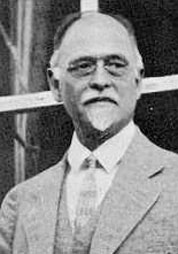 Irving Fisher
Paul Krugman has provided a link to a paper by Irving Fisher, apparently dated 1933, setting forth his debt deflation theory of depressions. I must confess, this was the first time I actually read Fisher as opposed to reading about him. Fisher's essential theory of great depression is that they are caused by too much debt building up in the system and then all having to be paid down at once. It is a sub-category of the credit bubble theory.
Any discussion of Fisher has to compare and contrast with a closely related but decidedly different credit bubble approach to business cycles – the Austrian School. The Wikipedia proposes that the two are complementary halves of a whole – the Austrians show the credit bubble building up, while Fisher shows it crashing own.
Up to a point, their differences are mostly matters of emphasis. Austrians emphasize bad investments, presumably in the sense of physical investment, that must be shaken out. Fisher emphasizes bad investments made with borrowed money, which lead to bad debts. Austrians emphasize too-easy credit as the sole cause of bad investments. Fisher agrees that easy credit is one possible source of bubbles, but not the only one. Another source, depressingly, is inventions and technological improvements leading to very real investment opportunities. In 1837, the culprit was canals spanning the Appalachians, leading to a vast expansion in trade. In 1873, it was a railroad boom.* In the 1920's it was presumably the manufacture of consumer durables. In other words, even without too-easy credit, prosperity and technological innovation are in and of themselves dangerous because they can easily give way to irrational exuberance.
However, their views on a remedy are diametrically opposed. The Austrians might agree with Fisher that bad debts are a major part of the problem, but their response is to call for the debts to be paid off or, as Ron Paul puts it, “debt liquidation.” Fisher’s truly original insight is that such attempts are counterproductive. If everyone starts liquidating debt at the same time, the result is to shrink the economy, cause it to become deflationary and thereby raise the debt burden.
The graph below clearly bears out Fisher’s views. It makes clear that the debt level in 1929 was, in and of itself, manageable. The real spike in debt relative to GDP occurred only after the Depression set in and nominal GDP fell precipitously. Furthermore, as soon as nominal GDP began to recover, the relative debt burden fell just as impressively. This makes clear why nominal GDP is every bit as important as real GDP -- debt cannot exist relative to real GDP, only relative to nominal GDP.
 It also explains why Fisher and the Austrians disagree on price stability. Both emphasize its importance, but for opposite reasons. Austrians have an absolute horror of inflation and consider avoiding it to be the defining feature of economic health. So great is the Austrian fear of inflation that they attribute the Great Depression to the "inflationary" boom of the 1920's, even though consumer prices actually fell during that time. Their explanation is that if the Federal Reserve had not been overly expansionary, prices would have fallen even more.**
Fisher, at least in the essay above, does not so much as mention inflation. His great fear is of deflation, which magnifies debts. His remedy was "reflation," or reversing deflation to bring debt back to a manageable level. Far from believing, as the Austrians do, that there is an inevitable bottom that must be reached and any attempt to avoid it merely prolongs the agony, Fisher describes this as “the so-called ‘natural’ way out of a depression, via needless and cruel bankruptcy, unemployment and starvation” and says that insisting that the economy reach an inevitable bottom is “as silly and immoral . . . as for a physician to neglect a case of pneumonia.”
Much of this sounds like what just hit our economy, especially the excess debt part. Other portions sound like things we fortunately avoided, particularly the deflation. Unless you count deflation of asset prices, a subject Fisher does not discuss. In other words, not only are bad investments being made with borrowed money, leading to bad debts, but bad (and often speculative) investments are being made with borrowed money, backed by inflated asset prices. Once asset prices fall back to earth, suddenly good debt becomes bad because it is no longer backed by adequate collateral.
It is odd that Fisher did not discuss this subject because it famously happened in the 1920's. It had happened many times earlier in land bubbles and other speculative bubbles. And, of course, it has happened just recently. As the graph above makes clear, our debt level today dwarfs the debt level of 1929, 0r even 1933.*** We have avoided falling into deflation this time around -- at least, wage and price deflation. But asset prices, especially housing prices, have deflated, leaving a lot of suddenly unsecured or under-secured debt. There is no need to "reflate" wage and price levels because they have not fallen. It also makes little sense to reflate housing prices, since those had become clearly excessive relative to the prices of everything else.
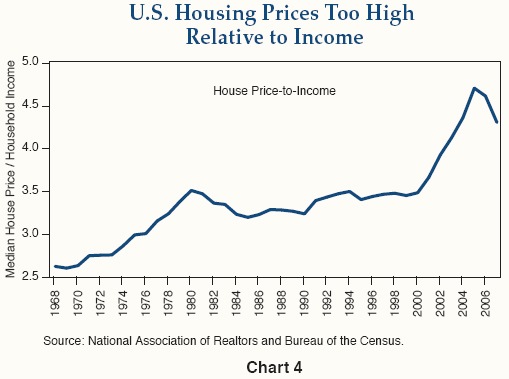

This raises an obvious question. If debt levels are insupportable now, even without wages and prices falling into deflation, and if deflation of the housing that backs our excess debt is necessary in order to bring housing prices realistically in line with income and rental values, where do we go from here?
Would Fisher be willing to go a step beyond mere "reflation " and endorse outright inflation as a way of shrinking debts down to manageable levels?
________________________________________
*The 1837 and 1873 depressions are also neat opposing illustrations of interaction of credit and real investment opportunities. The 1837 depression was caused by irrational exuberance over canals and trans-Appalachian trade, with a bubble abetted by too-easy credit (Jackson de-chartering the national bank and distributing it deposits among private banks). The 1873 depression was caused by irrational exuberance over railroads, with the collapse of the bubble aggravated by too-tight credit (the gold standard).
**And here I must confess to not remembering why Austrians think inflation is so bad. However, during the Depression Hayek definitely blamed it on the inflationary boom of the 1920's, although he later acknowledged he was wrong. Murray N. Rothbard was still doing so in the 1960's.
***I will note that the source of the debt to GDP graph above mentioned that much of the expansion in debt was financial debt, i.e., debt owed by banks to other banks. This is generally considered less dangerous than other forms of debt because it is a mere reshuffling of money among banks. Excluding financial debt, the expansion of debt is not quite as scary.
Saturday, February 4, 2012
The Economy: It's Groundhog Day!
So, employment is ticking up again in January. That's nice. But forgive me if I don't break out the champagne just yet. You see, we've seen this before. Twice now.
At the end of 2009 and the beginning of 2010, the economy began looking up, jobs began climbing and unemployment began falling. Then around March or April the economy began losing steam. By summer people were talking about a double dip. By August or September, it looked all but inevitable.
But at the end of 2010 and the beginning of 2011, the economy began looking up, jobs began climbing and unemployment began falling. Then around March or April the economy began losing steam. By summer people were talking about a double dip. By August or September, it looked all but inevitable.
But at the end of 2011 and the beginning of 2012, the economy began looking up, jobs began climbing and unemployment began falling. But once again economists doubt that this looks sustainable. The main reason for their doubts is the recovery of the last few months has been based more on inventory growth than actual orders. Once inventories are adequately restocked, the momentum for recovery will end. That means expect the economy to begin losing steam by March or April. Why, by summer people may be talking about a double dip. But don't worry, by late 2012 and the beginning of 2013, I'm sure things will get better.
In all seriousness, what is going on? I don't know, but I have heard at least one plausible suggestion (alas, can't find link). Someone suggested that what may be happening is that the government is failing to properly smooth out seasonable factors. Given the marked seasonality of the economy we have seen thus far, I am inclined to suspect this is what is happening.
Of course, I hope I'm wrong.
At the end of 2009 and the beginning of 2010, the economy began looking up, jobs began climbing and unemployment began falling. Then around March or April the economy began losing steam. By summer people were talking about a double dip. By August or September, it looked all but inevitable.
But at the end of 2010 and the beginning of 2011, the economy began looking up, jobs began climbing and unemployment began falling. Then around March or April the economy began losing steam. By summer people were talking about a double dip. By August or September, it looked all but inevitable.
But at the end of 2011 and the beginning of 2012, the economy began looking up, jobs began climbing and unemployment began falling. But once again economists doubt that this looks sustainable. The main reason for their doubts is the recovery of the last few months has been based more on inventory growth than actual orders. Once inventories are adequately restocked, the momentum for recovery will end. That means expect the economy to begin losing steam by March or April. Why, by summer people may be talking about a double dip. But don't worry, by late 2012 and the beginning of 2013, I'm sure things will get better.
In all seriousness, what is going on? I don't know, but I have heard at least one plausible suggestion (alas, can't find link). Someone suggested that what may be happening is that the government is failing to properly smooth out seasonable factors. Given the marked seasonality of the economy we have seen thus far, I am inclined to suspect this is what is happening.
Of course, I hope I'm wrong.
Wednesday, February 1, 2012
Why I Like Groundhog Day

Around Christmas I promised to explain why I think Groundhog Day is so much better than A Christmas Carol.
I should also add that one of the signs that Groundhog Day is a really good movie is that so many different kinds of people relate to it at so many different levels. Accustomed as we are to thinking of time as linear, many people obviously related to an expression of time as cyclical; in fact, Groundhog Day has taken on a new meaning as an expression of cyclical time. Soldiers identified with it as expressing the endless slog of an overseas semi-combat deployment. Economists have used it to illustrate the impossibility of perfect information. The National Review listed it in the top conservative movies because of its rejection of self-indulgence and hedonism. Feminists like it because the main character learns to respect, rather than manipulate, women. And many religions* have applauded its moral and spiritual message. To Christians it is the tale of a sinner redeemed. To Jews, it vindicates a this-worldly spirituality. And to Buddhists, it is an illustration of people being trapped in an endless cycle of repetition until they reach the stage of spiritual development to be released. The people of Puxatwaney, of course, love the movie because it promotes their tourist industry. It's also original, extremely funny, heartwarming without being maudlin, and teaches a moral lesson without being preachy.
I like it as an illustration of A Christmas Carol done right.
It should be needless to recap the plot, but here goes. Bill Murray plays Phil Connors, an obnoxious, overbearing jerk of a TV weatherman in Pittsburgh. He gets sent to Puxatawney to report on their annual Groundhog Day celebration. He despises Puxatawney and its people as a bunch of ignorant hicks, but is happy at the chance to hit on his beautiful producer, Rita. At first he doesn't see this as much more than a chance to notch up another score with a beautiful woman. She responds appropriately. Then, of course, he gets stuck on Groundhog Day, reliving the same day over and over. He is understandably horrified until a couple of drunks at the bowling alley point out that this would mean life without consequences -- he can get away with anything he wants. So for a while he parties like there's no tomorrow because there isn't, but after a while this loses its charm. He learns enough about women on one day to seduce them on the next, but realizes that it is really Rita he wants.
So he starts to work on her. What starts with an attempt to score with a beautiful woman turns into more. The more he gets to know her, the more he sees of her character and comes to genuinely love her. To her, on the other hand, it is merely a pleasant date that might develop into something in time, but it's way to early to commit/sleep with him.** And what she sees, after all, isn't really him, it is a deception he is putting on to manipulate her. Invariably she senses it and ends up slapping him. The unspoken subtext is that if she ever agrees, it will break the spell.
Unable to score with Rita, Phil despairs and kills himself. Again and again, all in vain. Then he resorts to the radical measure (and in his case, it really is radical) of telling her the truth. And it gets him further with her than ever before -- to genuine and sincere friendship. She even spends that night -- but as a friend only. Not good enough. She also suggests that instead of considering this a curse, maybe he should treat it as a blessing. Since he has an unlimited number of lives, why not put them to good use.
He starts just by being nice to people. Then he moves on to learning and art. (He learns to play piano and make ice sculptures). Then, when he tries to help an old beggar, but he dies, Phil learns that even on Groundhog Day, there are consequences. Nothing he does can keep the old man from dying, but Phil starts looking for other things that can make a difference and learns that the joy of a good deed never gets old. On his final go-round, he never even attempts to seduce Rita. She sees, without his making any effort, what a great guy he has become. She finally agrees to sleep with him. The spell is broken, and he resumes normal time.
So, how does it get right everything A Christmas Carol gets wrong?
It makes the protagonist an active participant in his own redemption instead of a passive spectator. He learns the only way anyone ever really learns anything -- by doing, again and again and again.
He begins as a credible, human jerk, not a cardboard cutout caricature. He ends as a credible human artist and nice guy, not a cardboard cutout caricature. And he has many credible human intermediate steps, each reasonably flowing from the one before.
It allows him to develop gradually over time, with resistance to learning, setbacks, and relapses, just the way everyone's moral and spiritual development takes place in the real world. Apparently [can't find link] people debate what event in the movie is Phil's turning point. But the beauty of the movie is that he doesn't have definable turning point, just as real world people often don't. To the extent there is a turning point, it is probably when he tells Rita what is happening to him and she tells him that having an infinite number of lifetimes can be a blessing, not a curse.
It isn't preachy. It lets the audience see the message instead of hammering them over the head with it. Yes, Phil gets two pieces of advice. First the drunks at the bowling alley point out that if there is no tomorrow, there are no consequences and he can do anything he wants. Later Rita tells him what a gift this can be. Both have an immense effect on him. But both are a single line. Otherwise it shows rather than tells. It doesn't say that hedonism gets old, but the joy of a good deed never fades. It shows him tiring of hedonism, but not of good deeds.
It stays funny and therefore avoids the trap of sentimentality.
And besides getting right what A Christmas Carol gets wrong, it is a much better guide to healthy love than your average romantic comedy. Most romantic comedies either show the man and woman bickering until they end up kissing, or have the man overcome the woman's resistance by sheer perseverance. Anyone who takes either approach as a guide to actual romance is headed for trouble. Groundhog Day shows true love as working only when the lovers appreciate each other for who they really are.
So, ghost of Charles Dickens, if you can read my blog where ever your are, take my advice on how to write a better and more convincing story of a mean guy turning nice.
______________________________
*Though presumably not their more conservative members. After all, the movie not only condones sex outside marriage, it strongly implies that it holds the keys to salvation.
**Rita is the modern version of a pure and chaste woman. She has no objection to sex outside of marriage, but only with a man she truly loves.
Subscribe to:
Posts (Atom)