Jonathan Haidt says that people elect politicians and favor or oppose policies, not based so much on anticipated outcomes as on what appeals to their moral intuitions. He concludes from that that liberals should stop focusing so much on outcomes and purely utilitarian calculus and worry more about how to appeal to people's moral intuitions.
I think this is about half right for politicians and about two-thirds right for policies.
I agree that people elect politicians based on moral intuition, not on anticipated outcomes. But I think that people re-elect politicians based on actual outcomes. If the actual outcome is bad, no amount of intuitive appeal will make the politician popular when the next election comes around. Suppose either Obama or McCain had decided to put political expediency ahead of the public good in 2008 and come out against the TARP. Suppose he had led his party in the revolt against it and the TARP had failed. This decision would have been wildly popular. The bank bailouts violated everyone's moral intuitions in the worst way possible. The candidate who defeated them would probably have won by a landslide. Then the financial system would have crashed and the country fallen into a much, much worse economic downturn than it did. And the heroic candidate who defeated the bank bailouts would become increasingly unpopular and lose the next election. Granted, people might not recognize the cause and effect at work. They might not realize that allowing the financial system to crash caused the economic downturn. But the practical unpopularity of economic ruin would far outweigh the theoretical popularity of letting the banks fail.
This is not pure speculation. Consider Franklin Delano Roosevelt. Roosevelt ran in 1932 as a "Tea Party" candidate, denouncing Hoover for his deficits and pledging to make deep cuts in federal spending and balance the budget. Clearly he thought this was a much more intuitively appealing approach than calling for a Keynesian stimulus.* And he was right. Throughout his tenure, Americans surveyed continued to reject Keynesian logic and tell pollsters they favored spending cuts and a balanced budget. But a funny thing happened. When Roosevelt ran huge deficits and the economy made a strong recovery, he was wildly popular. When he balanced the budget and the economy slumped, his popularity slumped along with it. Clearly practical results trumped intuitive appeal, no matter what people told pollsters.
Policies are a bit more complex than politicians. I do agree that people tend to favor or oppose policies based on what appeals to their moral intuitions rather than what the anticipated outcome is. Then again, most people assume that if a policy is intuitively appealing, it will automatically get good results. What if people's intuitions turn out to be wrong?
Well, if an intuitively appealing policy results in immediate catastrophe, it is unlikely to be popular for long. Raising the government debt ceiling goes against most people's moral intuition. Most people, after all, have credit limits and can't unilaterally raise them. It seems unfair that government does not have to play by the same rules the rest of us do. And running up more debt during bad times always seems improvident. So Republicans thought that refusing to raise the debt ceiling would be popular. No doubt failure to raise the debt ceiling would have been popular, but the results would not. The Republicans apparently assumed that people would consider the abstract principle that the debt ceiling should not be raised to be more important that concrete results. like, say, federal contractors not being paid, federal prisons not being guarded, border patrols ceasing, deposit insurance losing its federal backstop, no more air traffic controllers, and so forth. But as the date loomed closer and closer and people became increasingly aware of what could happen if the debt ceiling were not raised, refusing to raise the debt ceiling started losing its appeal. Moral intuition proved unequal to the challenge of the threat of catastrophic results. Imagine how well it would have stood up to an actual catastrophe.
But immediate catastrophes are the exception and not the rule. What of merely ordinary counter-intuitive policies with good results or intuitively appealing policies with bad results? Well, I think that if politicians bite bullet and pass a policy that goes against most people's moral intuitions but yields good results, most people will find a way to modify their intuitions to accept the good outcome. Certainly that is what supporters of Obamacare are hoping for.
But where I agree with Haidt is that unsuccessful policies that are intuitively appealing can be extremely difficult to get rid of. That is why, for instance, so many drugs remain illegal, even though their illegal status does nothing to suppress use and merely leads to criminality and ever more intrusive police surveillance. It is why there is such resistance to fighting AIDS by distributing condoms or needle exchange programs. It is why religious conservatives resist vaccinating their daughters against cervical cancer or insist on abstinence-only education. All of these things are about taking a stand against sin versus being complicit in it. Effectiveness is really not the point. Religious conservatives are well aware that sin isn't going away any time soon. But so long as it exists, they are not willing to adopt policies that condone it. Occasionally, the results of an intuitively appealing but practically disastrous policy can be so bad that even people who supported it end up admitting that their intuitions were wrong. See Prohibition as an example.
In short, I believe that politicians who are intuitively appealing but practically harmful are often elected, but rarely reelected. I believe that counter-intuitive but highly successful politicians and policies alike can overcome people's initial doubts. But I believe that intuitively appealing but practically harmful policies can be extremely difficult to get rid of. And I think Haidt should acknowledge the importance of outcomes as well as intuitions.
________________________________________
*Okay, so Keynes didn't come out with his theories until around 1936, so this is an anachronism. But you know what I mean.
Sunday, November 4, 2012

Saturday, November 3, 2012
The Moral Foundations of Ending FEMA
The whole question of whether Mitt Romney wants to end FEMA because of his remarks during the Republican Primary. His words bear repeating;
Liberals are baffled by all this. Is it really possible for anyone to think it is better for Galveston destroyed than for the federal government to lift a hand to help? So I will do what I now make my habit when conservatives advocate something that baffles my liberal sensibilities -- run it through Jonathan Haidt's moral analysis. Haidt argues that liberals have tunnel vision when they focus solely on harm avoidance, with some secondary concerns for justice and freedom. Instead, he says, liberals should consider that full range of moral foundations that conservatives value -- besides harm avoidance, justice and freedom, we should consider the value of in-group loyalty, respect for authority, and reverence for the sacred. So, how to these values apply to disaster relief, especially to abolishing FEMA. And are such arguments likely to have much traction?
Harm avoidance:
Obviously, disaster relief, including by FEMA, is about harm avoidance. Everyone (I trust) agrees that mitigating harm during a natural disaster is good. Disaster relief is always a popular charitable cause. FEMA, when competently managed, plays a major role in harm mitigation. What values beyond harm mitigation are opposed to FEMA?
Fairness/Justice:
Liberals, Haidt says, tend to equate justice with harm mitigation while conservatives and libertarians see it more as just deserts -- as karma. He has even expressed concerns that this could go too far -- treating the mere fact that people have suffered misfortune as proof that their misfortunes were deserved. For the most part, I do not see these concerns applying to natural disasters. Natural disasters are perhaps the most obvious case possible for bad things happening to good people.
But there are exceptions. In every natural disaster, there are people who put themselves in needless danger by taking unnecessary risks. These are people who don't buy insurance and want FEMA to cover all their losses, people who build in flood plains because they can get federal flood insurance, people who live next to the forest and refuse to clear their land as a firebreak and expect the Forest Service to protect their houses, people who defy evacuation orders despite being healthy and wealthy enough to leave and then expect to be rescued, and (for that matter) people who go hiking during blizzards or take excessively dangerous rock climbs and then expect search and rescue to save them. I have considerable sympathy for conservatives who lack sympathy for such people. They not only put themselves in danger, they endanger rescue workers and waste resources that might go to rescuing people who are genuinely just unfortunate. But these simply means that we should modify disaster relief somewhat to penalize people who take unreasonable risks. Getting rid of FEMA altogether is a classic case of throwing out the baby with the bathwater.
Furthermore, I see no evidence that there is wide popular belief that most people caught in natural disasters are to blame for their own misfortunes. Quite the contrary, the overwhelming response to a natural disaster is one of sympathy and helpfulness, with resentment toward the minority of people who take unnecessary risks as decidedly secondary.
Freedom:
I do not doubt that certain hardcore libertarians or conservatives do see FEMA as in infringement on liberty. These are the ones who oppose all redistributionist taxation as a form of "enslavement." These are the people who assure you that they will be happy to make voluntary donations to rebuild Galveston, to tax them for the benefit of the people of Galveston is morally indistinguishable from kidnapping them off the streets, carrying the off to Galveston, and forcing them "at gunpoint" to work on a chain gang rebuilding the city. The fact that paying a tax is less intrusive does not make it less of an infringement on freedom, just more insidious. Ensuring that the funding for rebuilding Galveston is entirely voluntary is infinitely more important than whether Galveston is actually rebuilt. In fact, whether Galveston is ever rebuilt at all is not an appropriate public policy concern. Let us be plain here. The real argument here is that harm mitigation is not a legitimate public policy concern at all -- only freedom and justice are proper concerns of public policy.** At least one libertarian has taken this to its illogical conclusion -- if an asteroid were on a collision course with earth and government had the technology to destroy it, it would be better to let all life on earth be wiped out than to spend taxpayer funds to prevent such an outcome.
 I do not think this is a viewpoint that is likely to ever have much popular support. If the liberal view that public policy should be solely about harm reduction is unbalanced, the ultra-libertarian view that harm reduction has no proper role in public policy In its most extreme form, very few people are likely to see allowing the world to end in order to avoid paying higher taxes as freedom-enhancing. After all, Patrick Henry notwithstanding, you have to be alive to be free. In its less extreme form, most people are also unlikely to see the ruin accompanying natural disaster and the confusion apt to follow when recovery relies solely on voluntary donations as freedom-enhancing.
Furthermore, government routinely respond to natural disasters with much more intrusive infringements on freedom than just taxing people to pay for the recovery. Governments order people to leave their homes; they set of roadblocks keeping people from going home; they order all traffic except emergency responders off the street; they declare martial law and send in the National Guard. And furthermore, these measures are generally accepted as necessary given the emergency. People expect government to restrict their freedom during natural disasters in ways that would never be tolerated under more normal conditions. People accept these restrictions as necessary for their protection. In short, during natural disasters, most people are willing to temporarily let harm minimization trump freedom. And, what is more, I think most people tend to see more intrusive governmental actions are more freedom-limiting than less intrusive measures, like taxes, offensive as this may be to some libertarians.
Finally, this is just guesswork on my part, but I suspect that most people's objections to redistributionist taxation is more likely to take a conservative/justice perspective than a libertarian/ freedom perspective. In other words, most people do not object so much to their taxes going to benefit someone else as to their taxes going to benefit someone they don't think deserves the benefit. Just as a guess, I would say that if you asked most people what they would be willing to voluntarily donate to and what they would be willing to see their taxes pay for, the lists would be very similar. And disaster relief ranks right up their with cancer research among causes that people like donating to.
Group Loyalty:
This is more fruitful ground. People argue against FEMA not so much on the grounds of freedom, but of federalism. Government has a legitimate role in disaster relief, just not the federal government. This is often expressed in terms of freedom -- federal government is seen as much more dangerous and oppressive than state government. Or freedom is equated with strict constitutionalism -- confining the federal government strictly within the bounds set by Article I, Section 8 of the U.S. Constitution, and any expansion beyond that undermines the rule of law and puts freedom in danger.
I am skeptical that this argument will get very far. Most people do not draw as sharp a distinction between levels of government as many hard-core federalists might wish. The idea that an act that is perfectly acceptable and popular if a state does it becomes a monstrous act of oppression if the federal government is involved is simply to rarified to have much popular currency.
More promising is the argument that close-knit communities should pull together and rebuild out of their own resources. This is an appealing idea. And I will say that natural disasters seem to bring out all the best features of group loyalty -- bringing a community together, neighbors helping each other out, close cooperation for the good of the whole, the desire to be helpful and so forth. And natural disasters seem to suppress the darker side of in-group loyalty -- an us-and-them outlook, and a narrowing of one's moral vision. Natural disasters simultaneously strengthen in-group ties within a community and widen the circle of most people's sympathy. They are the only instance I can think of in which those two tendencies are not opposed to each other.
But natural disasters also run up against the limits of group loyalty. A large-scale disaster often overwhelms the resources of a local community to deal with it. Are there communities so tight-knit and so distrustful of outsiders that they would turn down outside help under the circumstances? Probably some Amish or Hasidic communities would (while drawing on help from other groups of Amish or Hasids), and perhaps some far-from-lovable cults. But I doubt any mainstream community would turn down FEMA if its own resources were overwhelmed.
And local communities are not necessarily all that good at disaster relief, or inherently less oppressive than the federal government. Certainly New Orleans was not during Katrina. It should also be noted that the reason Hoover was put in charge of disaster relief in the 1927 flood, and why disaster relief began being seen as a federal responsibility was that local authorities were doing a terrible job. Communities lacked resources to deal with the damage. Black people were forced to work on the levees at gunpoint, left in flooded areas while white people were evacuated, imprisoned in refugee camps, and denied access to relief. New Orleans officials deliberately blew up the levees protecting the poorer parts of town in order to spare the richer parts. (No doubt this contributed to the widespread belief among black people that something similar happened during Katrina).
 In short, I think that appeals to community loyalty as an argument against FEMA may very well have mainstream resonance, but are unlikely to survive the harsh reality of actually attempting the experiment.
Authority:
This might seem like an odd question even to raise. After all, the government's authority is at its height in the wake of a natural disaster, and notably receives respect. Government authority is only one kind, though. Conservatives also value the authority of parents, clergy, employers, civic organizations, and so forth. Indeed, I suspect one reason they distrust government is the fear that it will seize all authority to itself and undermine these other authorities. During natural disasters, though, most people are willing to defer to the authority of government and accept the temporary subordination of these other possible sources of authority.
Purity and sanctity:
Haidt likes pointing out that many things liberals favor as harm mitigation strategies are deeply offensive to conservatives because they are seen as not merely passively allowing, but requiring active participation, in sin. Examples include offering free birth control, drug legalization, needle exchange programs, and so forth. Needless to say, disaster relief does not fit into this category.
Another party of purity/sanctity that Haidt does not explore as much is seeing certain things, or people, as defiling. In this case, the source of defilement would be the federal government itself. The federal government would be seen as a sort of toxic chemical, necessary in some cases, but to be confined so as to prevent its contamination of our otherwise pure society. I suspect that certain libertarians or hard-core federalists really do see it in these terms. By contrast, the United States as a country, is clearly seen as sacred, hence the outrage over what liberals dismiss as trivial symbolic issues, like flag burning. Furthermore, there is ample evidence that the United States is seen as more sacred than any state or municipality. School children pledge allegiance to the U.S. flag, not to their state flags. Sports events begin with the Star Spangled Banner. How many people even know their state song? Many states fly a large U.S. flag with a smaller state flag below it, on a single flag pole.
Granted, the country is not the same as the government. But the existence of a country more or less implies that it has a government. And if people truly see their government as a desecration polluting everything it touches, even something so popular and uncontroversial as disaster relief, then that government has a serious legitimacy crisis at hand. I do not see such a crisis with us.
CONCLUSION:
Some extreme libertarians or federalists may see federal disaster relief as an outrage against freedom, or as a desecration of the purity of sacred federalism. I doubt very much, though, that either of these ideas has much potential to go mainstream. Two criticisms of FEMA may have some mainstream currency. One is that is subsidizes people who put themselves in danger by taking excessive risks. This, though, sounds more like a call to reform FEMA to penalize the irresponsible than reason to abolish it. The other is that it infringes on the self-sufficiency of communities and discourages them from rebuilding with their own resources. This argument may, indeed, have mainstream appeal. It is unlikely, though, to survive for long in the face of the harsh realities of communities whose resources are overwhelmed. In short, I believe that abolishing FEMA is one of the ideas that appeals to portions of the Republican party faithful, but is unlikely to be popular to anyone else. And the Republican party faithful seriously overestimate their numbers compared to the general population.
PS: And right on cue, here we have just that: An expression of fear that if government does too much in terms of disaster relief, people will lose their resilience and self-reliance and be unable to come to the aid of their neighbors. I file that under group loyalty, and consider it the best critique of FEMA. But I don't see it as a plausible argument for abolishing it.
_________________________________________________
*To be fair to Ron Paul, even in the absence of any government intervention whatever, Galveston would not be as badly devastated now as it was in 1900. The technology did not exist then to know in advance when a hurricane would strike.
**This view does allow for harm mitigation in the form of law enforcement and national defense. But these can be defended in terms of justice -- punishing the guilty as well as protecting the innocent.
Romney's position on FEMA is moderate compared to some people's. Ron Paul wants to abolish FEMA altogether and makes clear that he approves of the good old days when a hurricane destroyed Galveston and the federal government did nothing.* Other right wingers have discovered a new reason to hate Hoover. Not only did he cause the Great Depression with his overly interventionist response to the stock market crash, he had already proven himself a socialist by leading federal disaster relief during the Great Mississippi Flood of 1927.Every time you have an occasion to take something from the federal government and send it back to the states, that's the right direction. And if you can go even further and send it back to the private sector, that's even better. Instead of thinking in the federal budget, what we should cut – we should ask ourselves the opposite question. What should we keep? We should take all of what we're doing at the federal level and say, what are the things we're doing that we don't have to do?
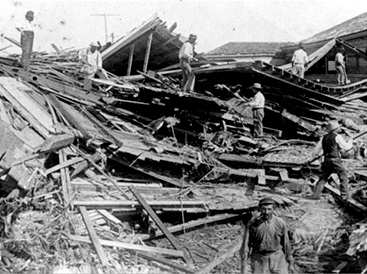 Ruins of Galveston
Liberals are baffled by all this. Is it really possible for anyone to think it is better for Galveston destroyed than for the federal government to lift a hand to help? So I will do what I now make my habit when conservatives advocate something that baffles my liberal sensibilities -- run it through Jonathan Haidt's moral analysis. Haidt argues that liberals have tunnel vision when they focus solely on harm avoidance, with some secondary concerns for justice and freedom. Instead, he says, liberals should consider that full range of moral foundations that conservatives value -- besides harm avoidance, justice and freedom, we should consider the value of in-group loyalty, respect for authority, and reverence for the sacred. So, how to these values apply to disaster relief, especially to abolishing FEMA. And are such arguments likely to have much traction?
Harm avoidance:
Obviously, disaster relief, including by FEMA, is about harm avoidance. Everyone (I trust) agrees that mitigating harm during a natural disaster is good. Disaster relief is always a popular charitable cause. FEMA, when competently managed, plays a major role in harm mitigation. What values beyond harm mitigation are opposed to FEMA?
Fairness/Justice:
Liberals, Haidt says, tend to equate justice with harm mitigation while conservatives and libertarians see it more as just deserts -- as karma. He has even expressed concerns that this could go too far -- treating the mere fact that people have suffered misfortune as proof that their misfortunes were deserved. For the most part, I do not see these concerns applying to natural disasters. Natural disasters are perhaps the most obvious case possible for bad things happening to good people.
But there are exceptions. In every natural disaster, there are people who put themselves in needless danger by taking unnecessary risks. These are people who don't buy insurance and want FEMA to cover all their losses, people who build in flood plains because they can get federal flood insurance, people who live next to the forest and refuse to clear their land as a firebreak and expect the Forest Service to protect their houses, people who defy evacuation orders despite being healthy and wealthy enough to leave and then expect to be rescued, and (for that matter) people who go hiking during blizzards or take excessively dangerous rock climbs and then expect search and rescue to save them. I have considerable sympathy for conservatives who lack sympathy for such people. They not only put themselves in danger, they endanger rescue workers and waste resources that might go to rescuing people who are genuinely just unfortunate. But these simply means that we should modify disaster relief somewhat to penalize people who take unreasonable risks. Getting rid of FEMA altogether is a classic case of throwing out the baby with the bathwater.
Furthermore, I see no evidence that there is wide popular belief that most people caught in natural disasters are to blame for their own misfortunes. Quite the contrary, the overwhelming response to a natural disaster is one of sympathy and helpfulness, with resentment toward the minority of people who take unnecessary risks as decidedly secondary.
Freedom:
I do not doubt that certain hardcore libertarians or conservatives do see FEMA as in infringement on liberty. These are the ones who oppose all redistributionist taxation as a form of "enslavement." These are the people who assure you that they will be happy to make voluntary donations to rebuild Galveston, to tax them for the benefit of the people of Galveston is morally indistinguishable from kidnapping them off the streets, carrying the off to Galveston, and forcing them "at gunpoint" to work on a chain gang rebuilding the city. The fact that paying a tax is less intrusive does not make it less of an infringement on freedom, just more insidious. Ensuring that the funding for rebuilding Galveston is entirely voluntary is infinitely more important than whether Galveston is actually rebuilt. In fact, whether Galveston is ever rebuilt at all is not an appropriate public policy concern. Let us be plain here. The real argument here is that harm mitigation is not a legitimate public policy concern at all -- only freedom and justice are proper concerns of public policy.** At least one libertarian has taken this to its illogical conclusion -- if an asteroid were on a collision course with earth and government had the technology to destroy it, it would be better to let all life on earth be wiped out than to spend taxpayer funds to prevent such an outcome.
Furthermore, government routinely respond to natural disasters with much more intrusive infringements on freedom than just taxing people to pay for the recovery. Governments order people to leave their homes; they set of roadblocks keeping people from going home; they order all traffic except emergency responders off the street; they declare martial law and send in the National Guard. And furthermore, these measures are generally accepted as necessary given the emergency. People expect government to restrict their freedom during natural disasters in ways that would never be tolerated under more normal conditions. People accept these restrictions as necessary for their protection. In short, during natural disasters, most people are willing to temporarily let harm minimization trump freedom. And, what is more, I think most people tend to see more intrusive governmental actions are more freedom-limiting than less intrusive measures, like taxes, offensive as this may be to some libertarians.
Finally, this is just guesswork on my part, but I suspect that most people's objections to redistributionist taxation is more likely to take a conservative/justice perspective than a libertarian/ freedom perspective. In other words, most people do not object so much to their taxes going to benefit someone else as to their taxes going to benefit someone they don't think deserves the benefit. Just as a guess, I would say that if you asked most people what they would be willing to voluntarily donate to and what they would be willing to see their taxes pay for, the lists would be very similar. And disaster relief ranks right up their with cancer research among causes that people like donating to.
Group Loyalty:
This is more fruitful ground. People argue against FEMA not so much on the grounds of freedom, but of federalism. Government has a legitimate role in disaster relief, just not the federal government. This is often expressed in terms of freedom -- federal government is seen as much more dangerous and oppressive than state government. Or freedom is equated with strict constitutionalism -- confining the federal government strictly within the bounds set by Article I, Section 8 of the U.S. Constitution, and any expansion beyond that undermines the rule of law and puts freedom in danger.
I am skeptical that this argument will get very far. Most people do not draw as sharp a distinction between levels of government as many hard-core federalists might wish. The idea that an act that is perfectly acceptable and popular if a state does it becomes a monstrous act of oppression if the federal government is involved is simply to rarified to have much popular currency.
More promising is the argument that close-knit communities should pull together and rebuild out of their own resources. This is an appealing idea. And I will say that natural disasters seem to bring out all the best features of group loyalty -- bringing a community together, neighbors helping each other out, close cooperation for the good of the whole, the desire to be helpful and so forth. And natural disasters seem to suppress the darker side of in-group loyalty -- an us-and-them outlook, and a narrowing of one's moral vision. Natural disasters simultaneously strengthen in-group ties within a community and widen the circle of most people's sympathy. They are the only instance I can think of in which those two tendencies are not opposed to each other.
But natural disasters also run up against the limits of group loyalty. A large-scale disaster often overwhelms the resources of a local community to deal with it. Are there communities so tight-knit and so distrustful of outsiders that they would turn down outside help under the circumstances? Probably some Amish or Hasidic communities would (while drawing on help from other groups of Amish or Hasids), and perhaps some far-from-lovable cults. But I doubt any mainstream community would turn down FEMA if its own resources were overwhelmed.
And local communities are not necessarily all that good at disaster relief, or inherently less oppressive than the federal government. Certainly New Orleans was not during Katrina. It should also be noted that the reason Hoover was put in charge of disaster relief in the 1927 flood, and why disaster relief began being seen as a federal responsibility was that local authorities were doing a terrible job. Communities lacked resources to deal with the damage. Black people were forced to work on the levees at gunpoint, left in flooded areas while white people were evacuated, imprisoned in refugee camps, and denied access to relief. New Orleans officials deliberately blew up the levees protecting the poorer parts of town in order to spare the richer parts. (No doubt this contributed to the widespread belief among black people that something similar happened during Katrina).
Authority:
This might seem like an odd question even to raise. After all, the government's authority is at its height in the wake of a natural disaster, and notably receives respect. Government authority is only one kind, though. Conservatives also value the authority of parents, clergy, employers, civic organizations, and so forth. Indeed, I suspect one reason they distrust government is the fear that it will seize all authority to itself and undermine these other authorities. During natural disasters, though, most people are willing to defer to the authority of government and accept the temporary subordination of these other possible sources of authority.
Purity and sanctity:
Haidt likes pointing out that many things liberals favor as harm mitigation strategies are deeply offensive to conservatives because they are seen as not merely passively allowing, but requiring active participation, in sin. Examples include offering free birth control, drug legalization, needle exchange programs, and so forth. Needless to say, disaster relief does not fit into this category.
Another party of purity/sanctity that Haidt does not explore as much is seeing certain things, or people, as defiling. In this case, the source of defilement would be the federal government itself. The federal government would be seen as a sort of toxic chemical, necessary in some cases, but to be confined so as to prevent its contamination of our otherwise pure society. I suspect that certain libertarians or hard-core federalists really do see it in these terms. By contrast, the United States as a country, is clearly seen as sacred, hence the outrage over what liberals dismiss as trivial symbolic issues, like flag burning. Furthermore, there is ample evidence that the United States is seen as more sacred than any state or municipality. School children pledge allegiance to the U.S. flag, not to their state flags. Sports events begin with the Star Spangled Banner. How many people even know their state song? Many states fly a large U.S. flag with a smaller state flag below it, on a single flag pole.
Granted, the country is not the same as the government. But the existence of a country more or less implies that it has a government. And if people truly see their government as a desecration polluting everything it touches, even something so popular and uncontroversial as disaster relief, then that government has a serious legitimacy crisis at hand. I do not see such a crisis with us.
CONCLUSION:
Some extreme libertarians or federalists may see federal disaster relief as an outrage against freedom, or as a desecration of the purity of sacred federalism. I doubt very much, though, that either of these ideas has much potential to go mainstream. Two criticisms of FEMA may have some mainstream currency. One is that is subsidizes people who put themselves in danger by taking excessive risks. This, though, sounds more like a call to reform FEMA to penalize the irresponsible than reason to abolish it. The other is that it infringes on the self-sufficiency of communities and discourages them from rebuilding with their own resources. This argument may, indeed, have mainstream appeal. It is unlikely, though, to survive for long in the face of the harsh realities of communities whose resources are overwhelmed. In short, I believe that abolishing FEMA is one of the ideas that appeals to portions of the Republican party faithful, but is unlikely to be popular to anyone else. And the Republican party faithful seriously overestimate their numbers compared to the general population.
PS: And right on cue, here we have just that: An expression of fear that if government does too much in terms of disaster relief, people will lose their resilience and self-reliance and be unable to come to the aid of their neighbors. I file that under group loyalty, and consider it the best critique of FEMA. But I don't see it as a plausible argument for abolishing it.
_________________________________________________
*To be fair to Ron Paul, even in the absence of any government intervention whatever, Galveston would not be as badly devastated now as it was in 1900. The technology did not exist then to know in advance when a hurricane would strike.
**This view does allow for harm mitigation in the form of law enforcement and national defense. But these can be defended in terms of justice -- punishing the guilty as well as protecting the innocent.
Tuesday, October 30, 2012
Will Paul Ryan be the "Fiscal Cheney"?
A funny thing has happened to the last three Republican tickets. Sometimes people seemed to forget who was at the top. During the Bush Administration, Cheney often seemed to be the sinister puppet master pulling GWB's strings. When McCain chose Sarah Palin as his running mate, overly enthusiastic fans said that it was a shame he was dragging her ratings down. And when Romney chose Paul Ryan, all the focus was on the Ryan budget and how Ryan's vision would govern a Romney administration.
Of course, these things are not all alike. Ryan and Palin were charismatic figures added to give a moderate nominee more appeal to the Republican base. Cheney no doubt advocated for policies that the base favored, but his charisma and personal likeablity scores ranked down there with Richard Nixon's. Cheney had a considerably heftier resume than his boss, especially on matters of foreign policy and national security, two areas in which Bush lacked experience. Sarah Palin, by contrast, had been a reasonably competent governor of Alaska, but had neither the knowledge not the interest in national affairs to carry much weight in actual policy issues. If McCain had won the election, Palin could have joined forces with First Lady Cindy McCain advocating and raising funds for developmentally disabled children -- a worthy cause, but not quite one of presidential caliber.
Well, if Romney wins, I think we can safely assume that Ryan will not be Palin. As a 14-year Congressman and chairman of the House Budget Committee, he is going to be more involved and influential than Sarah Palin. The real question is, will he be Cheney. Obviously, he will not be Cheney in the sense of running foreign and national security policy. While this is not Romney's strong point and he will have to do a lot of delegating, neither is it Ryan's strong point. The question is whether he will be the "fiscal Cheney," acting as de facto President in budgetary matters. That was the idea set forth in this column. Ryan, as fiscal Cheney, would control the budget process in the Romney Administration, pushing for huge tax cuts at the top, huge cuts in programs for the poor, transformation of Medicare into a voucher system and, if possible, of Social Security into a 401-k. This will all be wildly unpopular, but Jonathan Chait, at least, thinks he could pull it off. Daniel Larison, by contrast, things Ryan is too much of a team player.
What is really interesting, though, and what makes me tend to be skeptical, is that Cheney so dominated the Bush Administration in foreign policy because that was Bush's weak point. Romney, by contrast, regards and pitches economy and budget as his strong points. Romney's commitment to fiscal and monetary tightening is dubious. Ryan's is undoubtedly sincere. Whether Romney allows Ryan to dominate in that matter will no doubt be a question of what he thinks is most politically expedient. And that will be a matter of who Romney is more concerned about pleasing -- the general public, or the Republican base.
Of course, these things are not all alike. Ryan and Palin were charismatic figures added to give a moderate nominee more appeal to the Republican base. Cheney no doubt advocated for policies that the base favored, but his charisma and personal likeablity scores ranked down there with Richard Nixon's. Cheney had a considerably heftier resume than his boss, especially on matters of foreign policy and national security, two areas in which Bush lacked experience. Sarah Palin, by contrast, had been a reasonably competent governor of Alaska, but had neither the knowledge not the interest in national affairs to carry much weight in actual policy issues. If McCain had won the election, Palin could have joined forces with First Lady Cindy McCain advocating and raising funds for developmentally disabled children -- a worthy cause, but not quite one of presidential caliber.
Well, if Romney wins, I think we can safely assume that Ryan will not be Palin. As a 14-year Congressman and chairman of the House Budget Committee, he is going to be more involved and influential than Sarah Palin. The real question is, will he be Cheney. Obviously, he will not be Cheney in the sense of running foreign and national security policy. While this is not Romney's strong point and he will have to do a lot of delegating, neither is it Ryan's strong point. The question is whether he will be the "fiscal Cheney," acting as de facto President in budgetary matters. That was the idea set forth in this column. Ryan, as fiscal Cheney, would control the budget process in the Romney Administration, pushing for huge tax cuts at the top, huge cuts in programs for the poor, transformation of Medicare into a voucher system and, if possible, of Social Security into a 401-k. This will all be wildly unpopular, but Jonathan Chait, at least, thinks he could pull it off. Daniel Larison, by contrast, things Ryan is too much of a team player.
What is really interesting, though, and what makes me tend to be skeptical, is that Cheney so dominated the Bush Administration in foreign policy because that was Bush's weak point. Romney, by contrast, regards and pitches economy and budget as his strong points. Romney's commitment to fiscal and monetary tightening is dubious. Ryan's is undoubtedly sincere. Whether Romney allows Ryan to dominate in that matter will no doubt be a question of what he thinks is most politically expedient. And that will be a matter of who Romney is more concerned about pleasing -- the general public, or the Republican base.
Saturday, October 27, 2012
More CEO's for President
So, now that we are on the subject of CEO's for President, how does Mitt Romney compare with other candidates.
Herbert Hoover
I will start with Hoover. Romney's big disadvantage compared to Hoover is that he lacks Hoover's international experience and prestige. Furthermore, since the US is the world's only superpower, foreign policy is more important now than it was in Hoover's day.
In terms of administrative competence, no doubt Romney has it, but Hoover would be a tough act to match. Besides, Romney has a disadvantage in that regard. Hoover favored administrative competence in general, either in the private or the public sector. Romney belongs to a party that is opposed on principle to administrative competence in government (at least in its mommy functions). For anyone, even a Republican President, to display administrative competence in government would be ideologically threatening to many of today's Republicans.
On the other hand, if the Hoover Administration proved one thing, it was that it takes more than administrative competence to make a successful President. Some have suggested that Hoover's failures were because he never learned to be a politician. But I am unconvinced. The only way to know how many of Hoover's failing were the result of poor political skills, one would have to see him as President under more normal circumstances. That option is not available to us. I believe that Hoover's failure was the result, not of poor political skills, but of a conventional wisdom that forced him into taking harmful actions.
Either way, Romney has the advantage here. Unlike Hoover, he had been chief executive of a government as well as a business. While some in the Massachusetts legislature complained* that he had an autocratic CEO style, he was able to work with them and did get a good taste of what running a government is like.
Furthermore, although the conventional wisdom of the 1930's is all too strong today, it is by no means as unanimous. And Romney may not be captive to it. He has sometimes sounded suspiciously Keynesian, and has also hinted that he may favor monetary expansion. I suppose it will all depend on how much power he gives Paul Ryan. (More on that in a later post).
Ross Perot
Ross Perot ran for President in 1992, campaigning mostly on the budget deficit, and later founded the Reform Party. Although I briefly considered voting for him, I decided against it, at least in part because he showed alarmingly autocratic tendencies.** The most popular joke about his was that he would be in for a rude surprise when he found out that the President couldn't fire Congress. But jokes of that sort are usually not really jokes. He really did seem to favor some sort of elective dictatorship and to lack patience with the delays and inconveniences of democracy.
Worse yet, he started making bizarre rants about the Republicans wiretapping his office and seeking to disrupt his daughter's wedding and circulate doctored photographs of her. As his accusations took on a greater and greater air of outright clinical paranoia, one-times supporters increasingly abandoned him. Favoring an elective dictatorship was one thing; having a dictator of dubious sanity was another.
Romney certainly comes in ahead of Perot. As a former state governor, he understands and (presumably) accepts how democratic government works. And he shows no sign of mental derangement. But then again, saying that Romney would make a better President than Perot because he is neither a dictator nor insane is not setting the bar very high.
Herman Cain
I have discussed Herman Cain before. Insofar as he showed none of Perot's disturbing authoritarianism or signs of paranoia, Cain was preferable. He was, however, totally unqualified to be President. He was completely clueless about foreign policy and not a good enough politician to understand all the proper cultural cues the Republican base demanded. But Cain's most serious problem was that he gave no evidence of understanding that running a government is any different from running a business. He did not appear to understand, as this commentator puts it, that running a business is about, "dedication to the narrow welfare of one firm or economic sector" is totally unlike being President, which calls for "reconciling competing interests and voter blocs for the purpose of advancing a semblance of the common, national good. " I hold out some hope that Romney does understand the distinction.
Donald Trump
I understand the unanimous, trans-partisan and trans-ideological desire to forget that Donald Trump ever sought to be President. The mere thought of such a thing is enough to make me want to wash out my brain with bleach. Fortunately, there was no actual danger of such a thing ever coming to pass. I will make one comment on Donald Trump's brief candidacy. To many of the Republican base, obnoxiousness is the most important quality in a leader. They equate obnoxiousness with firm and unyielding principle. So I guess is that if you regard obnoxiousness as the prime qualification in a leader, then Trump is perfect. Otherwise, I can't think of a single good thing to say about him.
Conclusion
Comparing CEO candidates for President, Mitt Romney is way out in front of the pack. Then again, I would put the disastrous Hoover second. Romney has better recession-fighting tools at hand than Hoover did and is less likely to be captive to dangerous conventional wisdom. It is, of course, hard to tell what Romney would actually do or attempt to do once in office. But I believe we are sufficiently out of danger that even if he gives Paul Ryan a free reign, the damage should be considerably less disastrous than what Hoover witnessed. And I am reasonably optimistic that Romney would not do anything too self-destructive. I do give Hoover the advantage in foreign policy, but I suppose we will muddle through.
Distantly trailing Romney and Hoover is Herman Cain who, although unqualified and prone to disastrous policies, is sane and appears to respect democratic norms. Distantly behind him is mad autocrat Perot. And bringing up the rear is Donald Trump, who we will all pretend is not there.
_____________________________________
*Can't find link.
**One of the reasons Ron Paul makes me so uneasy is that he reminds me too much of Ross Perot.
Herbert Hoover
I will start with Hoover. Romney's big disadvantage compared to Hoover is that he lacks Hoover's international experience and prestige. Furthermore, since the US is the world's only superpower, foreign policy is more important now than it was in Hoover's day.
In terms of administrative competence, no doubt Romney has it, but Hoover would be a tough act to match. Besides, Romney has a disadvantage in that regard. Hoover favored administrative competence in general, either in the private or the public sector. Romney belongs to a party that is opposed on principle to administrative competence in government (at least in its mommy functions). For anyone, even a Republican President, to display administrative competence in government would be ideologically threatening to many of today's Republicans.
On the other hand, if the Hoover Administration proved one thing, it was that it takes more than administrative competence to make a successful President. Some have suggested that Hoover's failures were because he never learned to be a politician. But I am unconvinced. The only way to know how many of Hoover's failing were the result of poor political skills, one would have to see him as President under more normal circumstances. That option is not available to us. I believe that Hoover's failure was the result, not of poor political skills, but of a conventional wisdom that forced him into taking harmful actions.
Either way, Romney has the advantage here. Unlike Hoover, he had been chief executive of a government as well as a business. While some in the Massachusetts legislature complained* that he had an autocratic CEO style, he was able to work with them and did get a good taste of what running a government is like.
Furthermore, although the conventional wisdom of the 1930's is all too strong today, it is by no means as unanimous. And Romney may not be captive to it. He has sometimes sounded suspiciously Keynesian, and has also hinted that he may favor monetary expansion. I suppose it will all depend on how much power he gives Paul Ryan. (More on that in a later post).
Ross Perot
Ross Perot ran for President in 1992, campaigning mostly on the budget deficit, and later founded the Reform Party. Although I briefly considered voting for him, I decided against it, at least in part because he showed alarmingly autocratic tendencies.** The most popular joke about his was that he would be in for a rude surprise when he found out that the President couldn't fire Congress. But jokes of that sort are usually not really jokes. He really did seem to favor some sort of elective dictatorship and to lack patience with the delays and inconveniences of democracy.
Worse yet, he started making bizarre rants about the Republicans wiretapping his office and seeking to disrupt his daughter's wedding and circulate doctored photographs of her. As his accusations took on a greater and greater air of outright clinical paranoia, one-times supporters increasingly abandoned him. Favoring an elective dictatorship was one thing; having a dictator of dubious sanity was another.
Romney certainly comes in ahead of Perot. As a former state governor, he understands and (presumably) accepts how democratic government works. And he shows no sign of mental derangement. But then again, saying that Romney would make a better President than Perot because he is neither a dictator nor insane is not setting the bar very high.
Herman Cain
I have discussed Herman Cain before. Insofar as he showed none of Perot's disturbing authoritarianism or signs of paranoia, Cain was preferable. He was, however, totally unqualified to be President. He was completely clueless about foreign policy and not a good enough politician to understand all the proper cultural cues the Republican base demanded. But Cain's most serious problem was that he gave no evidence of understanding that running a government is any different from running a business. He did not appear to understand, as this commentator puts it, that running a business is about, "dedication to the narrow welfare of one firm or economic sector" is totally unlike being President, which calls for "reconciling competing interests and voter blocs for the purpose of advancing a semblance of the common, national good. " I hold out some hope that Romney does understand the distinction.
Donald Trump
I understand the unanimous, trans-partisan and trans-ideological desire to forget that Donald Trump ever sought to be President. The mere thought of such a thing is enough to make me want to wash out my brain with bleach. Fortunately, there was no actual danger of such a thing ever coming to pass. I will make one comment on Donald Trump's brief candidacy. To many of the Republican base, obnoxiousness is the most important quality in a leader. They equate obnoxiousness with firm and unyielding principle. So I guess is that if you regard obnoxiousness as the prime qualification in a leader, then Trump is perfect. Otherwise, I can't think of a single good thing to say about him.
Conclusion
Comparing CEO candidates for President, Mitt Romney is way out in front of the pack. Then again, I would put the disastrous Hoover second. Romney has better recession-fighting tools at hand than Hoover did and is less likely to be captive to dangerous conventional wisdom. It is, of course, hard to tell what Romney would actually do or attempt to do once in office. But I believe we are sufficiently out of danger that even if he gives Paul Ryan a free reign, the damage should be considerably less disastrous than what Hoover witnessed. And I am reasonably optimistic that Romney would not do anything too self-destructive. I do give Hoover the advantage in foreign policy, but I suppose we will muddle through.
Distantly trailing Romney and Hoover is Herman Cain who, although unqualified and prone to disastrous policies, is sane and appears to respect democratic norms. Distantly behind him is mad autocrat Perot. And bringing up the rear is Donald Trump, who we will all pretend is not there.
_____________________________________
*Can't find link.
**One of the reasons Ron Paul makes me so uneasy is that he reminds me too much of Ross Perot.
Friday, October 26, 2012
A Brief Look at the Election as it Progresses
Unsurprisingly, Democrats have a strong lead in early voting. That lead is overwhelming in the very earliest voting and diminishes the closer we draw to the election. Presumably Republicans will have an equally strong lead on election day.
If Obama does pull off a narrow win, no doubt it will be in large part on the strength of early voting. Look to Republicans to start shortening early voting, or end it altogether.
If Obama does pull off a narrow win, no doubt it will be in large part on the strength of early voting. Look to Republicans to start shortening early voting, or end it altogether.
(A Certain) CEO for President
One of Mitt Romney's strongest selling points is that his record in business makes him particularly well qualified to set economic policy in our worst downturn since the 1930's. His shortcomings include that many people doubt whether his background as a corporate raider was actually useful, and his lack of experience on foreign policy and tendency to offend potential allies.
Upon hearing such things, I am tempted to ask people who hold such a view to imagine their ideal candidate for an economic crisis. You would want a President with extensive private sector success. If possible, you would prefer him to have worked in a non-financial industry, producing actual physical things, rather than speculating in paper fortunes. It would also help if he was not born with a silver spoon in his mouth, but self-made, building his company from the ground up. Since he would be our chief executive, a high degree of administrative competence would be absolutely vital. You would want him to set aside Obama's sometime adversarial attitude toward business and think of business, instead, as a partner, distrustful of government regulation, and in favor of private initiative. You would want a real fiscal conservative, one who took balanced budgets seriously and was not afraid to raise taxes on the rich in order to achieve it. You would want someone who looked upon public assistance with suspicion, fearing it would create dependency, and preferring volunteerism to government action. Still, it would be good to have someone above any possible suspicion of being a heartless plutocrat -- a leader renowned for his humanitarian work would be ideal. It would also help if his business experience was of an international scope and he was widely respected and admired the world over. And, as a final icing on the cake, how about a leader so respected by all across the political spectrum as to seem almost above partisan politics.
Is that the sort of leader you would want in the White House during an economic crisis? And then, of course, the punchline. I have good news. He was in the White House during our greatest economic crisis. His name was Herbert Hoover.
So what is one to make of Herbert Hoover? When I was growing up and going to school, we were taught that Herbert Hoover was a good man, in over his head, that he did his best under the circumstances, but his best was not good enough. He attempted to revive the economy with public works and loan assistance, but was not successful. The hatred that rained down on him was mostly undeserved, since he was simply in the wrong place at the wrong time. None of this was permitted to detract from the magnitude of Roosevelt's achievements. Simply put, we were given the impression that Hoover's best was not good enough, but Roosevelt's was.
Starting in college, I began to see right-wing views challenging this conventional view. They argued that Hoover was, indeed, responsible for the Great Depression, not because he did too little, but because he did too much. If he had only let market forces play out on their own, the economy would have quickly recovered, but he interfered and doomed things to ruin. The rejoinder to this is obvious -- if Hoover's interference made things so bad, why did the economy improve so much when Roosevelt interfered even more?
It was not until the current crisis that I began hearing serious arguments for how Hoover could be held responsible for the Great Depression. To Keynesians, his error was trying (most unsuccessfully) to balance the budget. To monetarists, Hoover damaged the economy by maintaining a dollar peg against gold. So it turns out that, yes, Hoover really did do a great deal to damage the economy. Then again, in his defense, Hoover was only doing what conventional wisdom of the day called for. Everyone assumed that the budget should be kept balanced and the gold standard maintained. Anyone else in his place would have done exactly the same thing. Indeed, Roosevelt ran for presidency in 1932 at a "Tea Party" candidate, denouncing Hoover for running large deficits and pledging to make deep cuts in spending. Devaluing against gold was a terrifying, almost unthinkable act. And even after they were discredited, the IMF continued to demand similar policies of countries in economic distress up throughout the 1980's and '90's. And now the European Central Bank is demanding the same of peripheral Europe to this day.
So my final conclusion was that what they taught us about Hoover in school was about right. He was a good man, in over his head. He did his best, but the conventional wisdom of the day (which continues to this day, despite all evidence against it) doomed him to fail. Only when conventional wisdom had been thoroughly discredited was it possible to go against it. What is clear, though, is although Hoover had perhaps the strongest private sector resume and most impressive administrative competence of any President ever, neither of these credentials did him any good when the country hit its worst economic crisis.
Upon hearing such things, I am tempted to ask people who hold such a view to imagine their ideal candidate for an economic crisis. You would want a President with extensive private sector success. If possible, you would prefer him to have worked in a non-financial industry, producing actual physical things, rather than speculating in paper fortunes. It would also help if he was not born with a silver spoon in his mouth, but self-made, building his company from the ground up. Since he would be our chief executive, a high degree of administrative competence would be absolutely vital. You would want him to set aside Obama's sometime adversarial attitude toward business and think of business, instead, as a partner, distrustful of government regulation, and in favor of private initiative. You would want a real fiscal conservative, one who took balanced budgets seriously and was not afraid to raise taxes on the rich in order to achieve it. You would want someone who looked upon public assistance with suspicion, fearing it would create dependency, and preferring volunteerism to government action. Still, it would be good to have someone above any possible suspicion of being a heartless plutocrat -- a leader renowned for his humanitarian work would be ideal. It would also help if his business experience was of an international scope and he was widely respected and admired the world over. And, as a final icing on the cake, how about a leader so respected by all across the political spectrum as to seem almost above partisan politics.
Is that the sort of leader you would want in the White House during an economic crisis? And then, of course, the punchline. I have good news. He was in the White House during our greatest economic crisis. His name was Herbert Hoover.
So what is one to make of Herbert Hoover? When I was growing up and going to school, we were taught that Herbert Hoover was a good man, in over his head, that he did his best under the circumstances, but his best was not good enough. He attempted to revive the economy with public works and loan assistance, but was not successful. The hatred that rained down on him was mostly undeserved, since he was simply in the wrong place at the wrong time. None of this was permitted to detract from the magnitude of Roosevelt's achievements. Simply put, we were given the impression that Hoover's best was not good enough, but Roosevelt's was.
Starting in college, I began to see right-wing views challenging this conventional view. They argued that Hoover was, indeed, responsible for the Great Depression, not because he did too little, but because he did too much. If he had only let market forces play out on their own, the economy would have quickly recovered, but he interfered and doomed things to ruin. The rejoinder to this is obvious -- if Hoover's interference made things so bad, why did the economy improve so much when Roosevelt interfered even more?
It was not until the current crisis that I began hearing serious arguments for how Hoover could be held responsible for the Great Depression. To Keynesians, his error was trying (most unsuccessfully) to balance the budget. To monetarists, Hoover damaged the economy by maintaining a dollar peg against gold. So it turns out that, yes, Hoover really did do a great deal to damage the economy. Then again, in his defense, Hoover was only doing what conventional wisdom of the day called for. Everyone assumed that the budget should be kept balanced and the gold standard maintained. Anyone else in his place would have done exactly the same thing. Indeed, Roosevelt ran for presidency in 1932 at a "Tea Party" candidate, denouncing Hoover for running large deficits and pledging to make deep cuts in spending. Devaluing against gold was a terrifying, almost unthinkable act. And even after they were discredited, the IMF continued to demand similar policies of countries in economic distress up throughout the 1980's and '90's. And now the European Central Bank is demanding the same of peripheral Europe to this day.
So my final conclusion was that what they taught us about Hoover in school was about right. He was a good man, in over his head. He did his best, but the conventional wisdom of the day (which continues to this day, despite all evidence against it) doomed him to fail. Only when conventional wisdom had been thoroughly discredited was it possible to go against it. What is clear, though, is although Hoover had perhaps the strongest private sector resume and most impressive administrative competence of any President ever, neither of these credentials did him any good when the country hit its worst economic crisis.
Thursday, October 25, 2012
Post Script on Romney and Foreign Policy
On the subject of Romney and foreign policy this post expresses my views perfectly:
It is still possible that a President who conducted his foreign policy that way might escape serious political damage. So long as no U.S. ground troops were involved, any resulting blunders would probably not affect most Americans much. And people are more likely to notice the chest-thumping speeches the President makes than actual outcomes on the far side of the world. But this is a terribly irresponsible way for any President to view the world.
The author ends up concluding that, although he dislikes President Obama's foreign policy, at least Obama has a foreign policy and takes it seriously.
As an interesting bonus, consider the same author's preceding piece in which he suggests that maybe Israel is not as unique as I and others have suggested. If your foreign policy is one of "omni-directional belligerence," then you are apt to allow any ally who wants a war with any adversary to drag you in after them. Israel is merely the most obvious example, but the same rule may apply to Georgia and even Taiwan. The result would be to drag us into a lot of wars that are not in our interest, on the general principle of maximalism.
Finally, though not related to foreign policy, I highly recommend this beautiful essay by the same author on the subject of abortion in cases of rape. He points out that it is perfectly morally consistent for anyone who believes that full personhood begins with conception -- that a one-celled zygote is morally equivalent to a newborn -- refusing to condone abortion even in cases of rape is morally consistent, even required. But anyone taking that position should honestly face what he is asking of the women in question and not just pretend that, although rape is a horrible thing, it can be a blessing in disguise if it results in a baby.
[Romney] treats foreign policy as a matter of domestic marketing, and he believes that the people of the United States want our country to be really obnoxious, but not actually take any serious risks.This is probably an accurate take on how most Americans feel about foreign policy. They want America to be loud and assertive and order other countries around, but not to get into any actual wars because that would be messy. Of course, it is also a terrible way to conduct foreign policy. Although I believe a well-executed bluff can occasionally be useful, basing one's entire foreign policy on empty posturing is a surefire recipe for disaster.
It is still possible that a President who conducted his foreign policy that way might escape serious political damage. So long as no U.S. ground troops were involved, any resulting blunders would probably not affect most Americans much. And people are more likely to notice the chest-thumping speeches the President makes than actual outcomes on the far side of the world. But this is a terribly irresponsible way for any President to view the world.
The author ends up concluding that, although he dislikes President Obama's foreign policy, at least Obama has a foreign policy and takes it seriously.
As an interesting bonus, consider the same author's preceding piece in which he suggests that maybe Israel is not as unique as I and others have suggested. If your foreign policy is one of "omni-directional belligerence," then you are apt to allow any ally who wants a war with any adversary to drag you in after them. Israel is merely the most obvious example, but the same rule may apply to Georgia and even Taiwan. The result would be to drag us into a lot of wars that are not in our interest, on the general principle of maximalism.
Finally, though not related to foreign policy, I highly recommend this beautiful essay by the same author on the subject of abortion in cases of rape. He points out that it is perfectly morally consistent for anyone who believes that full personhood begins with conception -- that a one-celled zygote is morally equivalent to a newborn -- refusing to condone abortion even in cases of rape is morally consistent, even required. But anyone taking that position should honestly face what he is asking of the women in question and not just pretend that, although rape is a horrible thing, it can be a blessing in disguise if it results in a baby.
Subscribe to:
Posts (Atom)