Sunday, September 6, 2015

A Short Correction

It would appear that I am wrong, that Black Lives Matter and Campaign Zero are not the same organization.  Like most political movements in this country, the anti-police brutality movement is very diffuse.  Black Lives Matter is both a slogan and a formal organization.  Campaign Zero uses the slogan, but is a separate organization.  To quote from the link:
This raises interesting questions about whether Mckesson [leader of Campaign Zero], as an independent operator, is an appropriate representative of Black Lives Matter. The answer is muddy, and hinges on how you define the organization. It was originally a hashtag that blossomed into an organization founded by three women—Patrisse Cullors, Alicia Garza, and Opal Tometi—in Oakland in July 2013 after Trayvon Martin was shot to death by George Zimmerman. BLM exploded during last year’s highly publicized string of incidents in which unarmed blacks were blown away by police; it now has a board and recognized chapters all over the country. “Black Lives Matter” is now both the specific name of a working organization and a more general rallying cry for people working to halt the steady stream of blacks being killed by agents of the state. Mckesson has become the face of that latter movement [the general rallying cry], operating under its flag; he is not the official face of, or operating under, the organization.
So, it would appear that Campaign Zero is moving in the direction of being a mainstream pressure group with mainstream civil libertarian goals.  The formal "Black Lives Matter" movement does not have anything so specific and may or may not decide to follow in the direction of being a mainstream pressure group.

Of course, I don't expect the movement's right wing critics to know all of this any better than I did.

Black Lives Matter and Groups Outside the Mainstream

Black Lives Matter has been met with conservative outrage from the start, and often with unfounded accusations.  They have been called a hate group and accused of inciting violence against police. And a number have protested that chaos would reign if we abolished police departments altogether.  But Black Lives Matter is not proposing to eliminate police forces, but merely to hold them accountable with a platform well within the mainstream of civil libertarianism.  More realistically, many police would probably complain that one reason for their rough behavior in minority neighborhoods is that crime rates there are genuinely high, that a lot of firepower is aimed against them, and that they feel genuinely threatened and besieged.  They would propose that the community has an obligation to reach out to them, to stop treating them with such hostility, to cooperate better, and to cut back on the firepower.  Black Lives Matter might respond with a "you go first," but I assume that they would basically agree that there is too much firepower in their neighborhoods.

All of which leads to another movement, well outside the mainstream, that would disagree, that does see police as altogether unnecessary, and that believes that more firepower is always the answer to any social problem.  I refer, of course, to the militia/patriot movement.  I have a certain tap-in to groups somewhere along the fringe between radical libertarian and anarchist from a Facebook friend who does not belong to any militias herself, but is a clear sympathizer with them.  She regularly posts accounts of police brutality, accompanied with appropriate denunciation, but not accompanied by any acknowledgment that police do anything other than brutalize.  And these libertarian/anarchists make no secret of their viewpoint -- they do not consider the police to have any legitimate function, and they want to eliminate the office altogether.  They definitely favor decriminalizing not only drugs, but all minor "broken windows" or "quality of life" issues.  Urinating in public, disturbing neighbors with loud noises, and the like are appropriate expressions of individual liberty and nobody else's business.  As for what to replace police with, proposals have ranged from talking things over with your neighbors (great if it works, what if it doesn't) to a neighborhood watch (though with the acknowledgement after the Trayvon Martin shooting that a neighborhood watch can degenerate into vigilantes).  Most recently they have proposed replacing the police with a private security firm citing an alleged instance in which this was highly successful.  Cited advantages -- they lack the authority of the state behind them and therefore have no power beyond the power to make a citizen's arrest, they cannot arrest for misdemeanors, they are paid less than regular police, do not have a union or lobby, and have much less employee protection.

This story is overblown, but it is a rather mild example of the libertarian/anarchist perspective.  More significantly libertarian/anarchists are great champions of the militia movement, even if they do not belong themselves.  They strenuously deny that there is anything racist about the militia movement and assume that so long as it is not racist, what could possibly be wrong with it?  Certainly it is assumed that the more firepower police have, the more dangerous they are, while the more firepower private citizens have, the more virtuous and liberty-loving they are.  For police to look like an army is an outrage.  For private citizens to look like an army is very much a thing to be desired.  And as for the suggestion that private armies might not respect the liberty of outsiders -- now that's just crazy talk!

All of this reached an interesting culture clash when heavily armed members of the Oath Keepers militia showed up in Ferguson for the anniversary protests.  Their presence was not welcome.  Black Ferguson residents resented the fact that white men could get away with being so menacing looking while the police automatically reacted hostilely to any armed black person.  The police described their presence as "inflammatory."  The Oath Keepers apparently originally showed up as bodyguards for a like-minded radio reporter, but they joined the protests and proposed to arm the protesters, saying that their only safety from police brutality was to be as heavily gunned as the police.  They did not receive a friendly reception.  Most Ferguson residents considered armed confrontation with the police to be suicidal.  Certainly my libertarian/anarchist Facebook friend is a big fan of heavily armed guards marching alongside protesters to protect them from the police.

There are, however, any number of good reasons why black people might not like the idea of teaming up with the militia movement.

The militia government focuses heavily on the Federal Government as the enemy:  Some more mainstream member of the states' rights wing of libertarianism acknowledged that this approach has limited appeal with black people.  Clive Bundy, for instance, apparently belongs to a group that believes that the federal government has no legitimate law enforcement powers, and that the highest authority is the local sheriff.  The federal government is presumed always to be oppressive and local sheriffs are presumed never to be oppressive.  But black people have historically looked to the federal government as protector from the oppressive county sheriff.  Nor is this just historical.  Most black people's complaints about police brutality to this day are about their local police and not the federal government.  Bundy and his friends do not appear ever to have considered this.

Alternately, the militia movement may assume that government at all levels is oppressive, but private paramilitaries are always virtuous.  This has not been most black people's experience, to put it mildly. Nor is this concern altogether historical, either.  Even if we dismiss armed racists and vigilantes as ancient history, the main "paramilitaries" in most black neighborhoods have been street gangs, not notably respectful of other people's liberty.

The militia makes an overly binary distinction between "good guys" (us) and "bad guys" (government).  My guess is, that solidarity in the face of police abuse notwithstanding, most black people do not have any illusion that everyone in their neighborhood is a "good guy" who should automatically be trusted with a gun, or that ever-escalating arms races offer any sort of security.  See also the above point.

Finally, black people are probably more realistic that the Oath Keepers about what will be tolerated from black versus white people, and in urban versus rural areas.  The reaction of the more mainstream right is instructive here.  Clive Bundy, after all, had plenty of champions in the mainstream right, including a Nevada Governor and Senator, five members of the Arizona Legislature, and Sean Hannity on Fox, even though Bundy held radical views on the illegitimacy of the federal government these mainstream figures presumably did not share.  When confronted with Bundy's radical and racial views, his more mainstream champions pointed out that you do not have to agree with his politics to champion his rights against a rather heavy-handed federal government.  As for a large, heavily armed paramilitary pointing guns at law enforcement and making them back off -- well that could still be seen as regular citizens standing up to oppression.  Less emphasized -- that the paramilitaries were not so saintly as they liked to think -- that many locals found them intimidating, and that they soon began quarreling among themselves and threatening each other with violence (though stopping short of anything but fists).

Mainstream right wing reaction to Black Lives Matter has been something different altogether.  Even before riots broke out, merely marching and chanting slogan was enough to make the mainstream right freak out and proclaim the police to be under siege.  Can you imagine what they would have done if the protesters had been heavily armed, formed a paramilitary company, and backed the police out of their neighborhoods?  Libertarian/anarchists might have applauded.  Fox News and Republican politicians, not so much.  Furthermore, Ferguson might have found out that being ruled by a black militia might not be all that great, either.  (Many white rural residents have not liked a militia presence all that much).  All-in-all, it seems safe to assume that most Americans would have viewed the development with alarm.  Most black people would expect as much.

Nor would any of this be new.  It would simply be a recycling of the story of the Black Panthers.  At least according to David Frum, it was the Black Panthers who originated the whole idea of a law-abiding paramilitary.  As Frum puts it:
There had been previous cases where Americans organized themselves into anti-governmental paramilitary forces. But in the past, these forces recognized themselves as illegal: that's why the Ku Klux Klan of the late 1860s wore hoods. . . . What was different about the Black Panthers, at least at the start, was the pains they took to organize their militia movement within the law.
They scrupulously followed California's firearms laws, which allowed openly carrying long guns so long as they were not pointed at anyone.  Heavily armed, they trailed the police, observing arrests and making sure there was no police brutality.  Heavily armed, they marched onto the floor of the California Legislature and expressed indignation that anyone would see them as a threat or an attempt to intimidate.

Two things happened.  One was that the white power establishment freaked out.  Willing to cooperate with the peaceful Civil Rights movement, it regarded heavily armed black men forming their own private army -- even a law-abiding private army -- as a different matter altogether and cracked down. The other was that the Black Panthers were not able to maintain their status as a law-abiding private army.  Lots of guns, swaggering machismo, and an ideology that basically glorified violence while stopping short of actually committing it proved to be too great a temptation. They ended up degenerating into police shootouts, terrorism, and in-fighting.

The younger generation may or may not know all the details of this history.  But they have a realistic grasp of what the reaction to a black urban militia would be.  

A Closer Look at Black Lives Matter's Program

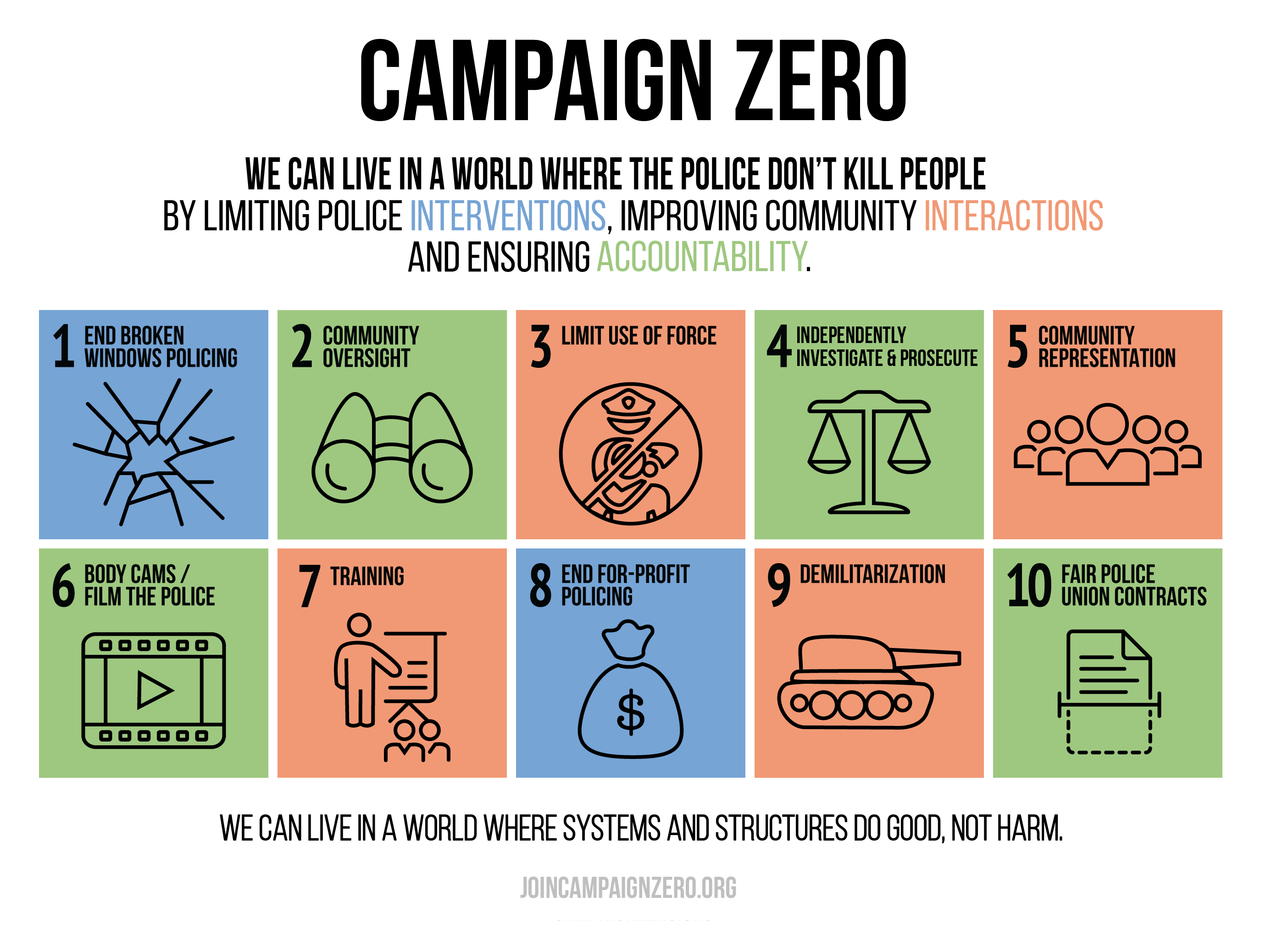
So, Black Lives Matter has come out with a reasonable, mainstream program for addressing police brutality.  By "reasonable" and "mainstream," I mean things that have either been done, or are longstanding proposals by civil libertarians.  "Reasonable" and "mainstream" I do not mean non-controversial, or that no one will oppose them.  I simply mean that anyone bothering to know about these goals will not consider them crazy or completely out of bounds.  Let me go through them, not so much in the number they are ordered, but more by the color coded categories to see what is being asked and what I would expect the response to be.

LIMITING POLICE INTERVENTION

End Broken Windows Policing.   In other words, stop arresting people for minor offenses like public drinking, marijuana, disorderly conduct, trespassing, loitering, disturbing the peace (including loud music), or spitting.  Either decriminalize these activities, or de-prioritize enforcement.  End stop-and-frisk.  You may get somewhere ending stop-and-frisk.  As for these other minor matters, I think there will be strong resistance.  There is no real evidence that ignoring minor infractions leads to major ones, but there is ample evidence that it leads to more minor infractions.  (There was an excellent link on the subject, but too lazy to find it).  These have a large enough quality-of-life impact that people are unlikely to accept an end to enforcement.  (I have some sympathy both ways).

End For-Profit Policing.  This includes both civil forfeiture and putting a stop to using fines for minor infractions as a revenue raising technique.  I favor ending both practices.  Both are sources of serious abuse in the interests of fund raising.  Civil forfeiture has gotten enough bad publicity and has enough property-rights opponents that it that this one is probably achievable.*  As for ending ticketing for revenue it is a great idea, but it will meet with more resistance because, well, it will deprive government of an important source of revenue and force people to face unpleasant tradeoffs between taxes and services.  That along will probably doom it.

IMPROVING INTERACTIONS BETWEEN POLICE AND COMMUNITY

Better Training, particularly in conflict resolution, de-escalation, implicit racial bias, dealing with people with limited English, and dealing with various minority groups.  These all seem like good ideas to me, and I doubt that there will be too much resistance to training in conflict resolution and de-escalation, except among a few hard core types who consider them un-macho.  But any suggestion that police my have an implicit bias, or that different techniques may be called for in dealing with different groups is going to meet with fierce opposition from conservatives who will consider this "race-pimping" or a call for special privileges.

Demilitarization.  This one is pretty straightforward.  Give the police a bunch of military gear and they will be tempted to use it.  I am all for this; a lot of other people are too.  Unfortunately, transfer of military equipment to the police has created a vested interest that will be hard to fight.

Limit Use of Force.  Limit use of force from a "reasonable belief" in danger to an "imminent" deadly threat, better training in de-escalation, force avoidance, and minimal use of force.  End high speed chases.  Report all uses of force, establish early intervention for police who show a tendency toward excessive force.  It has been remarked that this one will meet with particularly strong opposition from police who see it as endangering their lives.  No doubt they will also resist ending chases as making it easier for criminals to get away.  For that reason, it is probably better to focus on de-escalation, avoiding force, minimal use of force, and early intervention.  They may achieve equally good results without having to change the standard of use of force at all.

Community Representation.  In other words, hire more black people so the racial makeup of the police force more closely reflects the racial makeup of the community.  Conservative anti-affirmative action people will fight this one tooth and claw.

ACCOUNTABILITY.

Body cameras and right of bystanders to film the police.  Careful thought is given to giving the people involved to see the incident and protecting their privacy from the general public.  This one is probably fairly uncontroversial and one of the most likely to be achieved.**

Community oversight.  Campaign Zero proposes a civilian commission tasked with oversight of the police force, to include proposing candidates for police chief to be appointed by the mayor, firing the police chief if necessary, setting policies, investigating citizen complaints, and administrative discipline.  I do not have any sense of how this would be received.  If I had to guess, it would be that the police department would be hostile, saying that their lives are not on the line, so the commission would not understand.  My objection would be the opposite.  I do not have that much faith in such commissions because they look like candidates for regulatory capture.  Regularly working with any group you are supposed to be holding accountable can do that.

Independent Investigation and Prosecution.  This is an attempt at avoiding regulatory capture, or at least collusion between the police and the local District Attorney who, after all, regularly work together.  Candidates include the US Department of Justice or a special prosecutor.  No particular comment here.

"Fair" Police Contracts.  This means eliminating a lot of the procedural protections included in police union contracts.  "Fair," of course, is an immensely subjective term that can mean all things to all people.  It seems safe to assume that this one will meet with fierce resistance from police unions, who will see it as stripping them of their procedural rights, even as people complain about having their procedural rights disregarded.  I do not pretend to know enough to weigh in on the merits of this one.

_________________________________________
*My own state of New Mexico is at the forefront of opposing civil forfeiture and has ultimately brought an end to it.  Campaign Zero offers it as a model to follow.  What a shame most of my Facebook friends are a whole lot more interested in stamping out all opposition to same sex marriage.
**As a lawyer I can also attest to its effectiveness.  We had a client suing for wrongful arrest.  The police insisted that she was yelling, using profanity, and disturbing the peace of other people in the area.  She firmly denied the accusation.  Her word against three cops did not look good -- until we heard the belt recording of the arresting officer, which made clear that, although she was being argumentative and perhaps a bit arrogant, she was not in any way raising her voice, using profanity, or disturbing anyone's peace.  Moral: don't always trust a cop.

Black Lives Matter Has a Mainstream Program

Black Lives Matter has had some problems from the start.  It started out as a sense of unfocused rage over police abuses and, as such, threatened to go the way of Occupy Wall Street, a movement that was all passion and no goals and so (unsurprisingly) failed to achieve anything.  The lack of focus proved even more dangerous to the movement in that it allowed hostile critics to project their worst fears onto it, claiming that it was a new Black Panther movement, or wanted to eliminate police departments altogether, or even that it favored killing police officers.  The most galvanizing even in black communities is killing of a black man by a white police officer, but these invariably turn out to be more complicated and ambiguous than they appear on the surface, leading critics to conclude that there is no "there" there.  The ambush killing of police, first in New York and now in Illinois was blamed by the right on Black Lives Matter for stirring up anti-police hostility.  And opening with riots in Ferguson and Baltimore definitely did not help.

But now Black lives matter has coalesced around a specific program which they call "Campaign Zero."  (As in, campaign for zero incidents of police brutality).  It turns out not to be nutty and radical at all, but well within the mainstream of what civil libertarians have been calling for for a long time.

In the color-coded scheme above, blue stands for limiting police interventions, pink stands for making such interventions less confrontational, and green stands for accountability if an intervention goes wrong.  I do not know how they chose what order to put their goals in.  Organizing goals by topic would make more sense to me, but this is a minor matter.  In proposing measure, they cite to either actual measures taken by real governments, actual police policies, or specific proposed measures.  They have made specific proposals at the federal, state, and local levels, and have begun evaluating candidates, much like any other political pressure group.  So far, the things that stand out for me are:

  1. There is not actually all that much to be done at the federal level other than nudge the other levels along.  Most of the action will be state and local.  
  2. Of the Democratic presidential candidates, the left wing, i.e., Martin O'Malley and Bernie Sanders, have a lot more to offer than Hilary Clinton.
  3. Of the Republican candidates they have evaluated so far, only Rand Paul has anything to offer.  He supports the two "limiting interventions" policies of ending interventions for minor matters and ending for-profit policing.  He also supports ending militarization of police forces and requiring police to wear body cameras.  The only other Republicans they have evaluated so far have been Trump and Jeb (the front runners) and both score zero.
  4. None of the candidates evaluated has proposed anything Campaign Zero considers harmful.
In short, Black Lives Matter has taken its place as a mainstream political pressure group, advocating specific, reasonable mainstream goals.  Of course, this is not the same as saying that it is uncontroversial.  More on that in my next post.

Wednesday, September 2, 2015

A Further Note on Nativism

OK, so the right-wing populist combination of preserving social programs (especially for retirement) while keeping out immigrants is proving to be popular world-wide, including in the US (Donald Trump).

The concern is often expressed in economic terms -- immigrants are stealing our jobs.  There is, of course, a problem here.  Namely, most anti-immigration activists aren't exactly clamoring to work in the fields, or in a meat packing plant.  When asked who will do those jobs if we get rid of all the immigrants, most anti-immigration activists are not able to give a very satisfactory answer.  Then, too, while some of the good-paying blue collar jobs are being taken at lower pay by immigrants, most have either been automated away or gone overseas.  And in any event, one thing that the auto bailout in 2009 convinced me is that large sections of the Republican Establishment are opposed to good paying blue collar jobs anyhow.*  So blaming declining wages on illegal immigration looks very much like ethnic scapegoating.

More realistically, many people are troubled by the expense to schools of bilingual education or English as a Second Language classes and worry that their own children are being neglected in the rush to accommodate so many high-maintenance immigrants.  Or they see immigrants without health insurance clogging emergency rooms.

But on the whole, the main issue appears to be the fear of the loss of cultural cohesion, especially the growing status of Spanish as an unofficial second language in this country.  ("For English, press one. Para espanol, oprima dos."  It is, at worst, a trifling inconvenience, but it deeply offends many people).  A German column, commenting on the German nativist movement, remarks that it is mostly a small town phenomenon, little seen in major cities.  He attributes this to high unemployment and limited opportunities.  And certainly it is true that small towns are becoming increasingly unviable, and that people fight more over a shrinking pie than an expanding one.  But the other phenomenon at work is that small towns are more culturally homogeneous, seeing an unfamiliar culture as a threatening intrusion, while large cities are more cosmopolitan and are apt to greet yet another culture added to the mosaic with a shrug.

And what of the merits?  Conservatives often argue the case for homogeneity as necessary to social cohesion.  Homogeneous societies are tighter knit, with people more likely to know their neighbors and to help out friends in trouble, more community involvement, and more community.  Thus they see ethnic variety as a thing to be dreaded lest it unravel the social fabric.  I suppose my critique would be two-fold.  First, ethnic homogeneity is in considerable degree a myth or an ideal that never really was in the real world, and would be a messy, dirty business to achieve.  Second, very close-knit societies have their downside.  Hostility toward outsiders, sometimes even to the point of xenophobia is often the flip side being close-knit.  Their informal methods of enforcing cultural norms -- gossip, cliquishness, social rejection (and sometimes worse) -- can be most unpleasant to people on the wrong side.  And they can be stifling to anyone who just doesn't fit in.  And for all conservatives sing the praises of the cohesion and community of a homogeneous society -- well, let's not forget that the ones enforcing that homogeneity are the likes of Trump (or George Wallace, or Pat Buchanan, etc) and their followers.

So, to circle back to my original question, is there political space on the American scene for the benign manifestation of people who are at once economically liberal and socially conservative -- for what someone referred to as Christian Democrats -- favoring protection of our retirement programs, a robust social safety net, health and safety and labor protective regulation, but conservative on faith and family issue, and on general social mores?  Would the angry wing of the Republican Party be less angry if the Christian Democratic quadrant were recognized as a legitimate political orientation?

I see two basic obstacles to a viable Christian Democratic quadrant in American politics.  One is its lack of elite sponsors -- a donor class.  Our economic, political, and media elite is overwhelmingly politically conservative and socially liberal, with the main difference being one of emphasis.  Whatever its popular following, how would a Christian Democratic movement in the US get its foot in the elite door?  But, alas, I also see an important obstacle to a Christian Democratic popular movement in the US.  Christian Democrats are not xenophobes.  They regard xenophobia as un-Christian.  This not only means no scapegoating of immigrants and ethnic minorities, it also means no reflexive hawkishness.  It means a foreign policy of international cooperation.  Indeed, the Christian Democratic movement is international, which is in itself enough to make it anathema to most of our xenophobes.

I suppose that it should be possible for a Christian Democratic party (under some other name!) to be economically liberal and socially conservative, not to scapegoat immigrants, but to make fairly strong demands that they assimilate to the host culture, and particularly to learn English.  Maybe this would peal off the milder members of the Trump coalition.  Maybe if such a had arisen instead of the Religious Right, it might have taken some wind out of their sails and found a respectable place in US politics, and averted the rise of the enraged wing of the Republican Party.  But all this is pure speculation.  At present, to take the right wing position in the culture war means to scapegoat immigrants and be reflexively hostile to any country that will not toe our line.

______________________________________________
*There was an interesting division there.  Publications like the National Review and the Wallstreet Journal openly denounced the auto unions for continuing to have good paying blue collar jobs with benefits and made clear that they considered the loss of Chysler and GM to be a small price to pay for ending that vile scourge.  And they made quite clear that they regarded banks and hedge funds and noble and honorable players that poured their life's blood into the auto industry, while the auto workers were a bunch of parasites who never invested a thing.  They could be so open, confident in the assumption that members of the auto workers' union didn't read the National Review or the Wallstreet Journal anyhow.  By contrast, Fox News and talk radio, which did have to worry about auto workers listening to their show, were more cautious, saying that boycotting GM would regrettably hurt auto workers, but it was worth it for the all-important principle of fighting government.

Tuesday, September 1, 2015

Donald Trump: Tea Party Candidate?

So, is Donald Trump the Tea Party candidate?  That is just another way of asking, is the Tea Party a libertarian movement or a right-wing populist movement.  My answer has to be quite simply that I don't know.  The Tea Party, like so many American political movements, is highly diffuse.  Anyone who wants can start claim to be the Tea Party and act in its name.  (Its far-right reputation limits who will want).  Thus it is entirely possible for Tea Party donor, think tank and media elites to be libertarians while rank-and-file activists are populists.  Certainly outsiders are not well qualified to tell.

When the Tea Party was founded, I said* that it looked like something new -- an attempt to build a populist movement entirely on economic conservatism, and that time would tell if such a thing was possible.  It seems fair to say that the answer proved to be no.  Republican candidates may be formally pledged to phase out Medicaid, turn Medicare into a voucher system, cut Social Security, and make major tax cuts in the top rates.  But they dare not say so too openly because to do so is wildly unpopular, including with most of the Tea Party.  Meanwhile, people who studied the Tea Party rank-and-file* found that they were not quite so libertarian as the leadership would like. Granted, their top issue was the deficit and cutting government spending.  But as is so often the case, they had a rather specialized definition of "spending."  Spending meant spending on the unworthy. They did not want to cut spending for worthy recipients, such as veterans, or seniors who had paid into the system.  Thus they favored spending cuts on unemployment insurance, food stamps, housing subsidies and the like, but not on Social Security, Medicare or veteran's benefits.  And they were not so absolutely averse to a tax increase at the Republican leadership -- so long as they weren't paying it to a Democratic administration.  The other issue they felt very strongly about was illegal immigration.  And certainly hardcore anti-immigration types are not shy about abandoning small government principles when he comes to immigrants.  In short, the Tea Party looked like a sort of microcosm of the Republican Party -- a libertarian leadership and right populist rank and file.

And therein lies the problem, both for the libertarian Republican leadership and the populist rank-and-file.  Or rather, two problems.  One is political  What is a party to do when the visions of its leadership and the vision of its followers are so strongly at odds?  This difference was papered over during the Cold War because both factions were strongly hawkish.  Maybe they can manage the same feat now in the War on Terror.  But overall the rank-and-file have been expected to mobilize their passions on behalf of causes most did not share.  Now they are threatening to take their revenge by choosing a leader diametrically opposed to what the party elite favors.  "Trump poses a dire threat to the party: If elected, he could not be trusted to work for the Republican agenda. The party elite will oppose Trump with everything it has."

The other problem is practical.  Just because a program is popular does not necessarily make it workable.  Sometimes the elite takes its positions for a good reason.  For instance, one of the reasons there is so much focus on cutting Social Security and Medicare is that as our population ages, those programs will take up a greater and greater share of the budget.  Certainly, they will take up more of the budget than is spent on immigrants, so expelling immigrants (besides being expensive) will not make up for the costs of an aging population.

And then there is the political and practical matter of actually being elected.  As Jonathan Chait puts it, "You can get rich being loved by a quarter of the country and hated by the rest, but you can’t get elected president that way. "  And many of Trump's other traits -- his obnoxiousness, his bombast, his obvious lack of qualification to be President, his utter impracticality -- have presumably alienated some would-be supporters who might have voted for a more reasonable candidate with the same views.  (Admittedly, they may also attract some who mistake obnoxiousness with principle and bombast with speaking truth to power).

In short, I still think that Trump is utterly unqualified to be President and is a panderer without principles.  But this time around he has actually seized on a real issue that really matters.

____________________________
*Was not able to hunt down link.

Donald Trump: Not Far Right, but Populist Right

I vowed I would refrain from commenting about the 2016 election at least until the primaries begin next year.  I promised not to take Donald Trump seriously.  I still believe that he has plenty of time to flame out and fully expect him to.  But a number of commentators have written some good pieces on him, so I simply can't resist wading back in.

First is Paul Krugman.  Krugman comments that Trump fills a much-neglected box in American politics.  There are straight-up conservatives on both economic and social issues.  There are straight-up liberals on both economic and social issues.  And then there are semi-libertarians, not full-on libertarian by any means, but economically conservative and socially liberal.  These last are over-represented in the donor class to both parties and the cultural elite.  These tend to be considered the three options in American politics.  But what of the fourth quadrant, that is economically liberal but socially conservative?  They make up, after all, a substantial portion of the population, but Krugman does not have a name for that quadrant, so he calls it Trumpism or even National Social Democracy.

In fact, plenty of people have a name for that quadrant.  It commonly referred to as populist, but that is only half true.  Populism tends to be used as a pejorative these days (a decidedly elitist view) as one who plays on the public's anger and resentments, rather than their legitimate aspirations.  And an economically liberal/socially conservative viewpoint need not be one of anger and resentment.  In fact,* I have heard that viewpoint described as Christian Democratic, an eminently wholesome and respectable movement in much of Europe and Latin America.

Except for one thing.  Trump's "social conservatism" does not take the form of his views on sex or religion or family life (the less said about Trump on any of those matters the better!), but of immigrant bashing.  Christian Democrats, by contrast, my support a strong welfare state and other constraints on capitalists, and may be be conservative on matters of religion, sex, family life, public mores, etc.  But they do not scapegoat vulnerable minorities.  To do so is un-Christian.  Trump's immigrant-bashing makes him a populist in the pejorative sense -- one who plays to people's anger and base instincts.

Others have commented that Trump's views are not all that unusual.  In fact, they very similar to rising nativist parties in Europe such as the UK Independence Party, Marine LePen's French National Front, the Freedom Party in the Netherlands, and various nativist parties in the Nordic countries.  These parties are described as far right, but they are not far right on economic issues.  In fact, they are often the only ones fighting against EU-imposed austerity and anti-labor measures.  Nor is this combination all that unusual or new even in US politics.  Pat Buchanan and George Wallace were noted for their race-baiting but hewed left on economic matters.  Trump is following in the same tradition when he opposes the Republican Establishment's drive to cut Social Security and Medicare while cutting tax rates at the top.  These parties are not properly labeled far right so much as right-wing populist.  And right wing populism, with its emphasis on kicking down at vulnerable minorities, is an ugly business.

_________________________________________
*Too lazy to hunt down link.