Wednesday, May 20, 2015

From Ancient Greece to Modern Babylon

OK, quick break from ancient Greece because the Iraq War is back in the news and I just can't resist weighing in.  The Republican candidates are being asked if it was a mistake and the consensus answer is that in the clear light of hindsight it was a mistake, but President Bush was misled into it by faulty intelligence.  Hawkish Democrats like Hilary Clinton are saying much the same.  I weigh in as one who opposed the war from the start but never doubted that Saddam had chemical weapons and was open to persuasion on biological weapons.

Let's start with some links.  Paul Krugman links to three: Josh Marshall pointing out that Bush deliberately misrepresented the intelligence to make the case for war; Greg Sargent pointing out that plenty of people, faced with the same intelligence, did not see that it make the case for war; and Duncan Black arguing that in any event, being right was less important to the in crowd than being part of the Washington Consensus.  Of these articles, Marshall's is by far the best.  That many people opposed the war should go without saying (but then again, I was one of the people who opposed it, as were most people I knew).  Black is always more snark than serious analysis.  But Marshall makes an important point.  The intelligence was, indeed, wrong, but Bush did not simply go along with it.  He did his utmost to make it sound a lot worse than it really was.  On the subject of weapons of mass destruction, the intelligence of the day really did believe that Saddam had chemical and possibly biological weapons, but not nuclear weapons.  Bush and other members of his administration ran around talking about WMD and strongly implying that they meant nuclear weapons without quite coming out and saying so (most notoriously Condoleeza Rice who said that we didn't want the smoking gun to be a mushroom cloud).  They also talked about "terrorism" and "taking the fight to the enemy" in such a way as to imply without quite saying that Saddam was responsible for 9-11.  These may not have been technical lies, but they insinuated something false with the intent to be understood that way.  I am not one who believes that there is any moral distinction between lying and making a technically accurate but deliberately misleading statement meant to be understood in an inaccurate way.  Or, as one famous critic of the Iraq War said:
We also learned in accounting class that the difference between "making a definite single false claim with provable intent to deceive" and "creating a very false impression and allowing it to remain without correcting it" is not one that you should rely upon to keep you out of jail. Even if your motives are noble.
Others argue that since the whole Washington consensus believed that Saddam had WMD, there was no deception involved, only intelligence failure. The obvious problem with that argument was that in the buildup to the war, the Bush Administration clearly thought the intelligence was faulty in the opposite direction -- that it was underestimating the menace Saddam posed.  Administration officials regularly visited the CIA urging them to reconsider or pointing out sources they thought would show a greater threat.  They even created the Office of Special Plans to sift through intelligence data for anything that could justify the invasion.  I am prepared to concede that the Bush Administration did not know that Saddam really did not have a chemical or biological, let alone nuclear arsenal or ties with al-Qaeda.  No doubt they sincerely believed these things did exist and the intelligence community was just missing them.  In other words, the Administration was trying to frame a man they believed to be guilty.  But to say, how were we supposed to know, the intelligence misled us when you spent the whole buildup to the war arguing that the intelligence was missing the severity of the threat is grossly disingenuous.

Or, put differently, to say that the Bush Administration, the intelligence community, and the Democrats were all wrong so why the fuss is to assume that there are no degrees in being wrong. But, of course, there are.  Take a very simple example -- the game of guessing how many beans in this jar. Suppose the real number is 488.  A person who guesses 500 is technically wrong because the true number is 488, but for all intents and purposes the guess is right because it is as accurate as anyone has the ability to be.  Someone who says 400 beans or 600 is wrong, but reasonable.  Someone who says 200 beans or 1000 clearly is not so good at this game.  Someone who says 5,000 beans or 50 does not have a good enough sense of scale to be playing at all.  And anyone who says five beans, or 50,000 is just plain nuts.

So then, in the case of Iraq the jar is painted black so no one can actually see the beans, and Saddam is not allowing anyone to lift the jar.  The intelligence community calculates the capacity of the jar at 500 and estimates that there are 500 beans in the jar.  They know the jar might not be all the way full.  It never once occurs to the intelligence community that there might be no beans at all in the jar.  The Democrats accept the 500 bean estimate as accurate and acted accordingly.  The Bush Administration, by contrast, argues that the intelligence community has grossly underestimated the number of beans in the jar, and there must be at least 5,000.  Argument goes back and forth between the Administration and the intelligence community, with the Administration insisting that the intelligence community is grossly underestimating the number of beans and the intelligence community saying that an estimate of 5,000 is simply not credible.  After some wrangling, they agree on a compromise number of 1,000.  Then they actually open the jar and discover that it is empty. Sorry, but the Bush Administration does not get to argue that the intelligence community led it to believe that there were 1,000 beans or even 500.  Yes, there was a general, unquestioned consensus about 500 beans.  But anyone insisting on 5,000 beans or even 1,000 was a whole lot more wrong than the general Washington consensus.

Of course, to make the analogy really work, instead of beans we should be talking about pellets of poison about the shape and size of beans, in the hands of a known sociopath.  Yes, the overwhelming consensus was that he had some poison pellets, but 500 is simply not the same as 5,000 and does not necessarily call for the same response.  Or if you just can't believe anyone would think there could be 5,000 poison pellets in a jar with only a 500 pellet capacity, maybe the dispute would be about the quality of the poison.  The intelligence community recognizes that the sociopath can only make poison in a crude home lab and therefore the threat is manageable because the poison in the pellets is not all that strong.  The Bush Administration insists that they treat it as industrial grade poison of a quality that the sociopath simply lacks the capacity to make.  Then it turns out that there is no poison in the jar at all.  Once again, both parties are wrong, but the intelligence community is more realistic in its threat-level assessment than the Administration.

Tuesday, May 19, 2015

Peloponnesian War: The First Ten Years (Well, four, anyhow)

The Peloponnesian War began in 431 B.C. and only ended with Athens' surrender in 404 B.C. a total of 27 years.  Like all very long wars,* it was really a series of wars. The first ten years are known as the Archidamean War (after Archidamus, King of Sparta at the time).  It is those ten years that I address now.

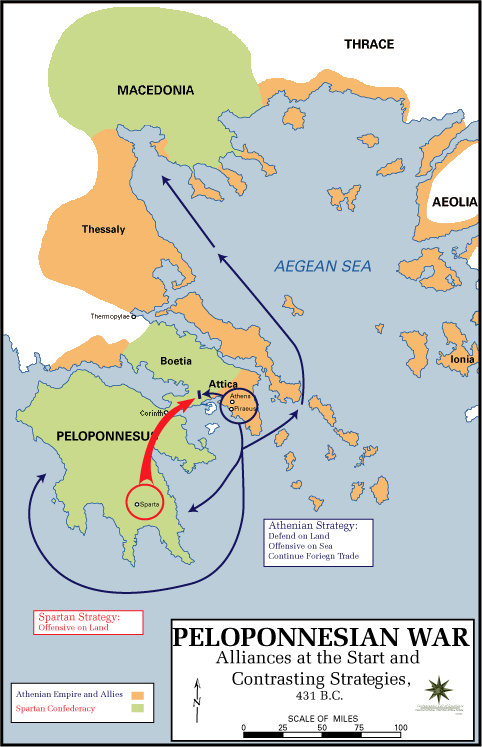
Pericles' initial strategy could well be called the rope-a-dope maneuver.  The Athenian army was no match for the Sparta-led forces, but those forces, in turn, were not powerful enough to assault Athens directly.  So Pericles evacuated the countryside, brought everyone within the city walls, and allowed the Spartans to lay waste to the surrounding country.  He, in turn, sailed the Athenian fleet down to the Peloponnese to lay waste to the countryside there.  Each spring the Spartans would march out and the Athenians sail out.  Each would lay waste to the other's countryside and then go home before winter set in.  Neither could conquer the other in this way.  The Athenians lacked the land power to march any distance inland, and Sparta was fertile enough not to be vulnerable to blockade.  Athens, in the meantime, imported most of its food, but had unassailable Long Walls to its port and was also invulnerable to blockade so long as it ruled the seas.

The city walls kept out invading armies, but they were powerless against the "invisible armies" that so often accompany war.  Bringing all the country people into Athens created crowded, squalid conditions and soon led to a plague and general breakdown in morale.  The Athenians sought to negotiate a peace but did not receive any satisfactory offer.  The Athenians turned against Pericles, but ultimately did not more that assess a fine against him, and reelected him shortly afterward.  Not long afterward, Pericles also came down with the plague and died, about two and a half years into the war.

The plague did not prevent the Athenians from continuing their siege of Potidea ultimately starving it into submission (430-429 BC).  The Potideans were forced to leave with no more than a single garment for men and two for women and a fixed sum of money, to take refuge with neighboring cities.  One can only assume that this increased hatred of the Athenians in the Chalcidice.  The plague may have kept the Athenians from coming to the aid of beleaguered Platea when the Peloponnesians joined the Thebans in laying siege to it (429 BC).  Nor did the plague stop the Athenians from winning naval victories.  Even when outnumbered, their superior skill triumphed over the inexperienced Peloponnesians.

In 428 BC, not long after the naval victories, the island of Lesbos on the east side of the Aegean, led by the city of Mytilene, revolted.  Lesbos had more autonomy than most Athenian allies -- it contributed ships and sailors to the alliance instead of paying tribute and was allowed to run its own government as it pleased, and it pleased an oligarchy.  The most probable reason for the revolt was that Mytilene, the largest city on the island, wanted to be local hegemon and the Athenians disagreed.  The democratic city of Mythemna (also on Lesbos) resisted Mytilene hegemony and called on Athens for help.  The Mytilenes called on Sparta to protect them from the bigger hegemon of Athens.  (This is one of many examples showing how pointless it is to try to sort out good guys from bad guys).  The Athenians blockaded Mytilene to starve it into submission (the usual tactic of a naval power conducting a siege).  The Spartans slipped a general into Mytilene and, despite their recent naval defeat, sent a fleet to Mytilene's relief.  But the fleet took its time.  In the meantime, the Spartan general, desperate provided heavy arms to the common people.  The people promptly demanded an equal share of the city's dwindling rations or they would revolt and make their own peace.  The authorities then surrendered, the only condition being that they would not be harmed until the Athenian Assembly decided their fate.  The Athenian general sent the Spartan general and the leaders of the revolt to Athens.  Meanwhile, the Spartan fleet had taken its time, but eventually crossed the Aegean, only to learn that it was too late.  The fleet commander passed up an opportunity to stir up a revolt, and alienated some potential allies by taking unwary visitors prisoner and executing them. Then, upon hearing that two elite Athenian ships were in the area looking for the Spartans, they turned and fled.

Despite the Spartan fleet's underwhelming performance, the Athenians were alarmed that their enemies had proven themselves capable of crossing the Aegean.  It did not bode well for the future. In their fear and alarm the Athenians had the Spartan general executed, despite his promises to lift the siege of Platea if he were spared.  They then voted to kill all the Mytilenian men and sell the women and children as slaves, in the theory that only the most extreme measures would deter future revolts. The next day, though, the Assembly relented, persuaded by the argument that (1) a more merciful policy would encourage hostile cities to surrender, and (2) the democratic element everywhere was a natural ally, unless the Athenians alienated them by such indiscriminate slaughter.  These arguments narrowly won the day.  But the Athenians still treated this rebellious ally with unprecedented severity.  They executed the "ring leaders" sent to Athens, 1,000 in all (probably the entire Mytilene oligarchic party) and turned all the land on Lesbos over the Athenian owners, with the local population as tenants.**  If this was "mercy," then things had fallen very far indeed.

As for the Spartan general who offered to lift the siege of Platea if he were spared, it soon became clear that the Athenians should have accepted his offer.  Shortly afterward, the Plateans surrendered on the assurance that they would be treated fairly.  Instead the Spartans, urged on by the Thebans still angry at the Plateans for having killed captured Thebans, executed all the men for the "crime" of opposing Sparta in the war.  The remaining women were sold as slaves and the city destroyed.  Thucydides attributes the Spartans' severity to their desire to stay on good terms with Thebes.  But it seems likely that the Spartans were also angry over the execution of their general and ready to take it out on whoever was closest at hand.  Presumably if he were alive and in Athenian hands, the Spartans would have restrained their Theban allies so they could trade the Plateans for their general.  Two other points should be made about the massacre as Platea.  First, bad as it was, it was simply not on the scale of what the Athenians has proposed in Mytilene.  Mytilene was the largest city in Lesbos.  Platea was tiny.  The Athenians had evacuated most of the non-combatants, and about half of the combatants had escaped, while the women sold as slaves may well have been slaves from the start.  Second, the Athenians were not blameless here either.  Before beginning the siege, the Spartans proposed that the Plateans leave their city and it would be returned to then after the war.  The Plateans refused upon Athenian assurances of protection.  The Athenians should have kept their promises if they were able, or not made them in the first place.

__________________________________________
*How long is "very long"?  I would classify of war of six months or less as short, of six months to two years as fairly short, of three to six years as medium, of more than six years as long, and more then twelve or fifteen years (not sure where to draw the line) as very long.
**Some (presumably pro-Athenians) commentators believe that the number is in error and that the actual figure was much smaller.  They also suggest that Mytilene oligarchs owned all the land anyhow, so the people were just swapping one set of overlords for another.  But presumably given the choice, the Mytilenians would prefer local to foreign overlords.

Sunday, May 17, 2015

Leadup to the Peloponnesian War

The Athenian Empire
I will now take my own advice and attempt to explain the Peloponnesian War only with the help of maps.*  As the linked map makes clear, the Athenian Empire was very much a naval empire.  It consisted of the Greek islands and coastal Greek colonies surrounding the Aegean Sea, extending as far east as Byzantium.**  It included mostly Ionian colonies liberated from the Persians and did not cover most of Greece proper, or inland areas, nor did it extend to the western Greek colonies.  Athens did not actually conquer and subjugate these areas unless they revolted against its rule, but it did collect tribute and interfere with their sovereignty in ways that gave offense and bred rebellion.

Thucydides was the first historian to distinguish between the underlying and immediate causes of a war.  He describes the underlying cause of the war as the growing power of the Athenian Empire and Sparta's fear of it.  He also strongly implies that the other cause was the allies' resentment of Athenian domination, their eagerness to shake off the Athenian yoke, and Sparta as the main counterweight to turn to.  Yet Sparta, lacking serious naval power, had little assistance to offer these other city-states.

The Athenian Empire and Peloponnesian League had made a thirty-year truce in 446/445 B.C.  This truce did not actually mean peace for Greece as a whole.  It only meant that the two major powers were not at war with each other.  There were numerous other wars by smaller city states, and the great powers often intervened or fought their own wars.  They simply refrained from war with each other, rather as the US and Soviet Union never exchanged a shot during the Cold War, yet managed to fight many wars by proxy.

It was the escalation of these proxy wars that was the immediate cause of the war between the great powers.  None would have had the logic of bringing about war between the major Greek powers if it had not been for the underlying balance-of-power issue.   The main naval powers besides Athens were Corinth (moderate oligarchy, major commercial rival of Athens and member of the Peloponnesian League) and Corcyra (democracy, island on the western side of the Greek peninsula, modern Corfu, and colony of Corinth).  These two powers between them founded the colony of Epidamnos, far north on the western side of the Greek peninsula.  Around 435 B.C., civil war broke out between the democratic and oligarchic factions. Corinth, though an oligarchy, intervened on the democratic side and Corcyra, though a democracy, intervened on the oligarchic side, proving once again that ideology takes a second place to self-interest.  Corinth and Corcyra were soon at war with each other.  Both sides approached Athens, Corcyra to appeal for help, and Corinth to convince Athens to stay out.  The Cornithians argued that it was a member of the Peloponnesian League, Athens had a truce with the Peloponnesian League, and that to side with Corcyra would therefore breach the treaty.  Athens, fearing the naval might of Corinth if it were to conquer Corcyra, made a defensive pact with Corcyra that, unsurprisingly, soon escalated into war with Corinth.  This must have looked alarming to the Spartan because it was the first time that Athens had extended its power to the western side of the Greek peninsula, and suggested further imperial ambitions.

Flash Points in the Lead-up to War
Conflict with Corinth soon led to conflict with another Corinthian colony, Potidea.  Potidea was in an area on the east side of Greece know as the Chalcidice, on the north side of the Aegean, a city on a long peninsula and a part of the Athenian Empire.  In 432 B.C. the Athenians, fearing that Potidea would side with its mother country, began issuing a series of outrageous ultimatums to Potidea, demanding that it disarm and sever relations with Corinth.  The Potideans revolted after receiving assurance of Corinthian naval support and a Spartan promise to invade Athens if it attacked (recall that Sparta, as a land power, had little direct assistance to offer).  Athens proceeded to besiege Potidea.

As the attached map makes clear, these two events took place on opposite sides of the Greek peninsula and were not directly related, except that both involved conflict between Athens and Corinth, an ally of Sparta.  But Athens' alliance with Corcyra must have looked like an alarming imperial design on the west, and its behavior toward Potidea like little more than wanton aggression. Corinth.  Furthermore, Athens had a trade embargo on Spartan ally Megara (a factor most modern historians consider a good deal more important than Thucydides gives credit for).  Corinth began agitating the Peloponnesian League for war.  Athens and Sparta soon began exchanging the sort of dueling ultimatums that countries exchange when the want to go to war but each wants the other to look like the aggressor.

Yet interestingly enough, it was not an imperial act by Athens that finally convinced the Spartans to go to war, but a completely defensive and justified one.  The nearest major power to Athens was Thebes, an oligarchy and Spartan ally.  Only about eight miles from Thebes lay the small town of Platea, a democracy that had aligned itself with Athens to seek protection from Theban hegemony. Athens regarded Platea as its most cherished ally because Platea was the only city to come to Athens' assistance at the Battle of Marathon.  One dark night in 432 B.C., Platean oligarchs invited about 300 Theban troops into Platea to bring them into alliance with Thebes.  The oligarchs wanted the Thebans to kill the leaders of the democratic faction and take over by force.  Instead, the Thebans called the Platean assembly into session and tried to persuade them.  That Plateans were at first intimidated into submission but, realizing the Theban force was small, attacked.  Women and children joined the attack by climbing up on the rooftops and pelting them with rocks and tiles.  Some of the Thebans escaped, some were killed, and some were captured.  That Plateans persuaded any forces outside the walls not to attack the rural dwellers by threatening to kill the capture forces.  They sent to Athens for instructions on what to do.  The Athenians warned the Plateans not to harm their captives, but the Plateans had already killed them.***  The Athenians presumably knew that this meant certain war with Thebes, and apparently doubted their ability to protect their ally because they evacuated most of the non-combatants, leaving only a garrison of 400 men, backed by 80 Athenians, and 110 women to provide support functions such as cooking.

This episode was apparently considered by both sides as the final breach of the truce and grounds for war.  War was formally joined in 431 B.C. It continued for ten years, ending in a short-lived peace in 421 B.C.  My next much of those next ten years as I can fit in.

________________________________________
*This is good advice for any war.  There is a reason why military men are so fond of maps.
**There were also Greek colonies east of Byzantium, surrounding the Black Sea, but Athenian hegemony did not extend that far.
***Presumably the Plateans lacked facilities for keeping so many prisoners, while the Athenians had them.

Saturday, May 16, 2015

Thucydides and the Peloponnesian War

And now for the (in)famous Peloponnesian War, recounted in such (dull) detail by Thucydides.  It was supposedly said of the great Athenian tragic poets that Sophocles portrayed human nature as it should be, and Euripides portrayed human nature as it is.  Something similar can be said of their contemporaries, the great historians.  Herodotus portrayed the Greeks as they should have been, and Thucydides as they were.  Herodotus tells the heroic story of sovereign and independent city states standing together for their mutual liberty against the Persian Empire.  Athens is a bright shining beacon of freedom and democracy, inspiring to all.  Sparta is a land of brave and honorable warriors who will fight to the last rather than yield.  Together they overcome the odds and turn back the vastly greater Persian forces.

Then you turn to Thucydides and learn that sovereign and independent city-states are forever at war with each other, habitually treacherous in their alliances, always undermining and subverting each other, and riddled with traitors eager to open the gates to the enemy.  The Athenians are a bunch of imperialist warmongers, trampling on the liberties of weaker city-states, and treating anyone who defies them with appalling cruelty and brutality.  The mighty Spartan war machine is vastly overrated, constantly weakened by domestic security problems, and exists mostly to hold down the helots, who it treats with appalling cruelty and brutality.

And then you turn back to Herodotus and realize that you can see all the same things there as well.

The Athenian Empire
Thucydides portrays the war as being strictly a power struggle between the two strongest city-states and downplays the ideological nature of the war, but it doesn't take too long for the ideological nature to come out.  Athens sought to install democracies in its allies; Sparta sought to install oligarchies. Thus the international war between the great powers occurred side by side with civil wars in many of the contested cities, with a pro-Athenian democratic faction and a pro-Spartan oligarchic faction.  And, of course, everyone was prepared to set aside ideological principles when self-interest was at stake.  Certainly I recall from my high school and college freshman history classes that it was a war between a land power (Sparta) and a naval power (Athens).  Not so much emphasized -- when a land power and a sea power contest an empire that essentially consists of islands and a ring around the sea, the naval power has a natural advantage because of its greater mobility.  Cities chafing under Athenian domination and calling on Sparta to liberate them had a problem on their hands.  Aside from the dubious nature of Sparta as liberator, what sort of aid could it offer with no way to reach them? Another point not much emphasized -- city walls and defenses at the time were strong enough that cities were rarely stormed by force.  When a city was conquered, it was usually blockaded and starved into submission, or else traitors within opened the gates.

It is right that I should describe the Peloponnesian War because it ultimately (at least temporarily) brought down Athenian democracy.  However, I will go into more detail than necessary because I am still struggling to understand the war myself.  By way of advice, I would recommend that anyone wanting to read Thucydides have a map handy. He makes no sense unless you can actually see those places he is talking about.  A shorter outline of the war is also useful.  These following posts are my attempt to present maps and outlines in an attempt to make the war comprehensible -- first and foremost to myself.

Monday, May 11, 2015

Sparta, Its Admirers, and Moral Foundations, Part II

To continue, in Sparta, as in any militaristic society, the foundations of authority and group loyalty were very important.  No doubt that had a lot of appeal for people who saw them as undermined in their own society.

Authority:  Haidt defines this foundation as respect for (legitimate) authority and tradition.  This was thoroughly inculcated in Spartans from boyhood.  I have already recounted the importance of authority in Sparta.  Boys were placed under the authority of a youth warden, backed by young men with whips. To ensure that boys were never without authority in the absence of the warden and his supporters, any Spartiate man could punish any boy he saw misbehave.  And even if no grown man was present, each group of boys was required to have a formal leader.  Apparently most Greeks fathers outside of Sparta, upon hearing that some stranger had taken it upon himself to discipline their son, would respond by leaping to the boy's defense, or at least inquiring whether the punishment was justified. That is implied when Xenophon says that Spartans have such trust in each other that all are confident that no one punish unjustly and so if a father hears that another man hit his son, he always adds his own punishment.  To which I can only say that maybe Spartans had such a fine-tuned sense of justice that they could be entrusted with unaccountable power and never abuse it.  But to the modern reader this sounds more like simple authoritarianism -- that belief that all authorities, just or unjust, must be obeyed simply because they are authority.

Other things reinforce this impression.  Accordingly to Plutarch (admittedly less reliable than Xenophon), young men were routinely questioned by older men were routinely asked where they were going and for what and rebuked if they did not give a satisfactory answer.  Failure to rebuke was itself grounds for rebuke.  Shaming punishments were widely used.  And any show of resentment over any of this was particularly shameful.  Xenophon approves of giving the Ephors quasi-despotic power to punish any minor offense on the spot without further ado.  Certainly, there was an important curb on their arbitrary power in that Ephors served only a single, one-year term and then returned to the general citizen body.  And, again, maybe Spartans had such a fine-tuned sense of justice that they could be entrusted with despotic powers (albeit temporarily) and not abuse them.  But somehow Plutarch (if he is to be believed) is not very reassuring.  Aside from disallowing any extra strings in a harp, one hears of the Ephors expelling a visiting orator for talking too much, reprimanding a youth for knowing too much about "the road to Pylaea" (presumably a disreputable area), fining a man because he was "wronged by many" (presumably either on the theory that he must have provoked it or because he wasn't man enough to stand up for himself), and punishing a man wearing very coarse clothing for inserting a border.  Plutarch also reports that the Spartans regularly prayed to be able to submit to injustice, which rather suggests their order of priorities.  And, for what it is worth, Aristotle regarded the Ephors as too powerful, corrupt, and arbitrary.  But he was speaking of Sparta in its dotage.  They may have behaved better in its heyday.

But if all of this seems unappealing to us, consider how it must have looked to Athenian aristocrats who saw their own power lost to democracy and feared this as heralding the end of all authority, all hierarchy, and all order.  Once again Plato expresses these fears:
“And this anarchical temper,” said I, “my friend, must penetrate into private homes and finally enter into the very animals.” “Just what do we mean by that?” he said. “Why,” I said, “the father habitually tries to resemble the child and is afraid of his sons, and the son likens himself to the father and feels no awe or fear of his parents, so that he may be forsooth a free man. And the resident alien feels himself equal to the citizen and the citizen to him, and the foreigner likewise.” “Yes, these things do happen,” he said. “They do,” said I, “and such other trifles as these. The teacher in such case fears and fawns upon the pupils, and the pupils pay no heed to the teacher or to their overseers either. And in general the young ape their elders and vie with them in speech and action, while the old, accommodating themselves to the young, are full of pleasantry and graciousness, imitating the young for fear they may be thought disagreeable and authoritative.” “By all means,” he said. “And the climax of popular liberty, my friend,” I said, “is attained in such a city when the purchased slaves, male and female, are no less free than the owners who paid for them. And I almost forgot to mention the spirit of freedom and equal rights in the relation of men to women and women to men.”
The reference to equality between men and women is the ultimate proof that these fears are exaggerated and unrealistic.  Athens kept its women secluded.  But unrealistic as such fears were, they were no less real for it.

Group loyalty:  Loyalty to one's own is of course one of the primary military virtues.  Indeed, the greatest attraction of the military is the sense of tightly-knit friendship and camaraderie that it offers. Even Robert Altemeyer concedes one virtue to his "authoritarians" -- their loyalty to friends.  The Spartans were fiercely loyal to their own, even to the extent of letting it undermine military efficacy. Thus Thucydides reports that when a Spartan force was trapped and besieged on an island, the authorities became so frantic that they agreed to an armistice and sought to end the war altogether. When the Athenians captured Spartan troops and threatened them with execution unless the invasions of Attica ceased, the Spartans stopped their invasions and made reclaiming their captured forces an absolute top priority.

There is a tradeoff between breadth and depth of social ties.  It is doubtless an oversimplification to say that liberals opt for breadth in the social tie and conservatives for depth, but I think there is something to it.  The Spartans opted for depth, and it was this much deeper social tie that accounts for much of their appeal.  Hence one reads of great admiration of Sparta as a society in which the whole citizen body is one great family, all citizen men are addressed as father and have the right to discipline an errant boy, and everyone shares what is needed and helps when wanted, as in a family.

Against this attractive depth of social tie is its narrowness.  The Spartans had a small citizen body and scant regard for the rights of anyone outside of it. Classical commentators could admire the depth of Sparta's social ties while being untroubled by their narrowness because they shared that narrowness. But I believe that something else is at work here, something even more foreign to our outlook -- a view of the narrowness of the Spartan social tie not just as a regrettable companion to their depth, but as a good in itself because it fosters another classical ideal -- the full-time professional citizen.

Aristotle's Politics is revealing.  He favors some type of mixed government, combining elements of rule by the many and the few.  He praises Sparta as a good balance between rule of the many, few, and one, even as he mentions the citizen body having fallen to a mere thousand participants, which gives us some interesting insight into what he means by "many."  And ultimately, despite Aristotle's talk of balancing the "many" and the "few," he would exclude from citizenship any who lead a "mechanic or mercantile life" because such a life is "ignoble and inimicable to virtue."  True citizens must possess enough leisure to devote themselves full-time to the business of governing and have enough wealth to support their leisure.  This, Aristotle says, best preserves the well-being of the state.  But since tillers of the soil and artisans have "no share in the state," it is by no means clear that Aristotle thinks that their well-being matters.  And this clearly comes out in his talk of helots.  He considers them necessary: "[A] state that is to be well governed must be provided with leisure from menial occupations."  Just how little people responsible for "menial occupations" matter to Aristotle becomes clear with the comment:
[T]he mere necessity of policing a serf class is an irksome burden—the problem of how intercourse with them is to be carried on: if allowed freedom they grow insolent and claim equal rights with their masters, and if made to live a hard life they plot against them and hate them.
He has no answer, except to say that Spartans have not found the right balance.  Alas, we do not have Aristotle's work in which he discusses the crypteia killing off potentially troublesome helots, or the Ephors declaring "war" so that such actions would not offend against religion, so we do not know whether he considers such an institution to be good, bad, or indifferent.

Plutarch, on the other hand, is a humane man who is troubled by these things, but introduces them as a sort of an afterthought, a minor blemish on an otherwise excellent system.  But it is his biography of Solon that is most revealing what he (and so many ancients) thought of the proper citizen body:
[2] It was well enough for Lycurgus, whose city was free from swarms of strangers, and whose country was, in the words of Euripides,
             For many large, for twice as many more than large,
and because, above all, that country was flooded with a multitude of Helots, whom it was better not to leave in idleness, but to keep down by continual hardships and toil,—it was well enough for him to set his citizens free from laborious and mechanical occupations and confine their thoughts to arms, giving them this one trade to learn and practice. [3] But Solon, adapting his laws to the situation, rather than the situation to his laws, and observing that the land could give but a mere subsistence to those who tilled it, and was incapable of supporting an unoccupied and leisured multitude, gave dignity to all the trades, and ordered the council of the Areiopagus to examine into every man's means of livelihood, and chastise those who had no occupation.
In short, the upper and intellectual classes generally assumed that being a citizen should be a full-time job, and that people who had to work for a living had no place in affairs of state.  It is far from clear whether it was assumed that working people would be better off if government were left to their betters, or if no one outside this leisured class was presumed to matter at all.  Suffice it to say that ruling classes (to this day) have a remarkable talent for confusing their privileges with the common good.

Spartan toughness, austerity, courage, respect for authority, and close social ties had great appeal, especially for people who did not have a broader sense of humanity.  They continue to appeal to many people to this day.  But in the end, contrary to any romantic notions, people do not impose such burdens on themselves as the Spartans did because they are virtuous or because they are incorruptible or public-spirited -- or because they are masochists, for that matter.  People impose the sort of barracks existence on themselves that the Spartans did because they are faced with dangers that require it.  The danger of hostile neighbors?  Certainly Sparta had plenty of those, but all city-states were constantly at war with their neighbors and most did not adopt the barracks life of the Spartans.  Rather, the relentlessly unromantic Thucydides understood best, "Most of the Lacedaemonian [Spartan] institutions were specially intended to secure them against this source of danger [helots]." Spartans lived the life of circling the wagons, with all the appeal of close camaraderie, cooperation, and purpose inherent in life directed against an external enemy.  But it was also a source of immense weakness to them.  It meant that many resources had to be diverted to internal security.

Wednesday, May 6, 2015

Sparta, Its Admirers, and Moral Foundations

I recall a Doonesbury comic strip in which the air-headed Boopsie had joined Jane Fonda's workout group.  She talks about fitness and social consciousness.  Her boyfriend B.D. scornfully answers, "Were the Spartans socially conscious?  Are the Cincinnati Bengals?  The only people who take fitness seriously are all conservative."

So do the Spartans rate as conservative?  One can see many ways in which, by modern standards, they do not.  Even if we grant that modern libertarian conservatism, basing itself around strict individualism and hostility to all government regulation is specifically a product of modern capitalism and should not be applied in other societies.  But one normally expects to see regard for the sanctity of private property to be conservative in all societies, since ruling classes usually have a lot of it. The Spartans, however, are often described as communists, who placed all land and helots in the hands of the state, to be parceled in equal sized lots to the citizens, as well as banning money and even seeking an equal redistribution of movables.  Spartans also gave greater liberty to women (at least of the elite) to a degree that shocked the rest of antiquity, and had much freer sexual mores.  Nor, contrary to their reputation, do they seem to have sought out war and foreign conquest.  By what right, then are the Spartans considered conservative (or right wing)?

But I think that Sparta is fairly described as conservative if we go back to our old friend Jonathan Haidt and his six foundations of morality, with the important qualification that these are not, in fact, discrete categories, and that many things overlap.  These, I think, help explain both why Sparta is properly described as conservative, and what so many writers in classical times, and some even since have found it attractive.

Harm/Care:  Haidt argues that liberals have an unbalanced morality in elevating this particular value above all others.  If so, I can only assume that the ancients were more balanced than we are, because they clearly did not hold this value as highly as we do today.  The most obvious things that the ancients admired in Spartans was their uncorrupted, austere lifestyle, their courage in battle, their endurance for hardship and so forth.  That these were achieved by very harsh treatment of Spartan boys just draws praise for the Spartans' refusal to spoil their sons.  Many praises of Sparta by classical authors seem shocking to modern humanitarians.  Plato's Laws has the Spartan boast of:
[T]he training, widely prevalent amongst us, in hardy endurance of pain, by means both of manual contests and of robberies carried out every time at the risk of a sound drubbing; moreover, the “Crypteia,” as it is called, affords a wonderfully severe training in hardihood, as the men go bare-foot in winter and sleep without coverlets and have no attendants, but wait on themselves and rove through the whole countryside both by night and by day.
Plato's only criticism of the foregoing is that it is too limited in its outlook, emphasizing only physical courage.  Xenophon sees it as most excellent to underfeed boys to teach them to steal, and to beat them if caught, to teach them to steal better and to endure pain. It is Plutarch's Life of Lycurgus that speaks so admiringly of the Spartan boy who hid a fox under his cloak and allowed it to claw him to death rather than suffer the shame of letting it escape.  Even Isocrates, writing genuine anti-Spartan propaganda condemns the practice, not because it is cruel to starve boys to drive them to theft and then beat them for it, but because encouraging theft degrades the character.

But the ultimate prize has to go to Plutarch's Customs of the Spartans (not for the squeamish!) Reading through its grim parade boys half-starved to teach them to steal, boys beaten to test their endurance for pain, prayers to be able to submit to injustice, arbitrary punishments by the Ephors for trivial "offenses" and the like, it is easy for the modern reader to mistake this for hostile propaganda when it is actually praise.*  The author even considers it praiseworthy that, when boys are flogged as a contest to see who can endure the most pain, some endure beating to the death rather than yield! And, significantly, Sparta's modern admirers downplay or deny such things. Have we become a bunch of humanitarian wimps, unable to appreciate real toughness?  And if we do want to set aside our preconceptions and face Sparta (and Classical values in general) with an open mind, just how far do we go before we say enough is too much?

Justice:  Haidt postulates that liberals value justice-as-maximum utility and conservatives value justice-as-just deserts, or justice-as-karma.  Certainly, many classical sources praise the Spartan's sense of justice, but none of them really explain what they mean by the term.  They simply say that the Spartans are so virtuous and so just that authorities can be entrusted with arbitrary power and never abuse it.  Xenophon, for instance, boasts that any Spartiate man may hit a boy he sees misbehave, and that the boy's father, upon finding out, will hit his son as well, confident that the punishment was never delivered unjustly.  Looking for something more tangible there is the matter reported by Thucydides in which General Pausanias, hero of the Persian War, was suspected of treasonable correspondence with the Persians and plotting a helot revolt.  But the Ephors proceeded cautiously because they did not like to take irrevocable action against a citizen without incontestable proof.  That speaks well of their sense of justice.  Even upon seeing his correspondence, they wanted further proof and arranged for a co-conspirator to discuss the plan in a place where they could overhear it.  That also counts in favor of their sense of justice.  But, Thucydides reports, it is said that when the Ephors went to arrest him, one of them tipped him off and he fled to sanctuary.  If true, that does not speak so well for their sense of justice. Plutarch says that the supervisors in charge of teaching boys were often watched in their discipline and made to correct it if they were either too harsh or too mild.  On the whole, though, I do not think this gives us a good sense of how the Spartans defined justice.

Freedom:  This is probably the area where our own concepts apply least.  Haidt proposes that conservatives value negative liberty -- the absence of formal constraints on the individual -- while liberals value positive liberty -- absence of formal constraints is meaningless without power to fulfill one's potential. This is only the liberal-conservative distinction in a society where laissez faire capitalism is the dominant ideology, which was not the case in classical antiquity. Furthermore, the whole negative liberty/positive liberty distinction is incomplete because it ignores the underlying similarity between the two views.  Both equate freedom with individualism.

But the whole concept of freedom = individualism is a modern one.  By any standard that equates freedom with individualism, whether of positive or negative liberty, the Spartans don't seem very free at all.  Yet they saw themselves as free and were seen as so by their contemporaries.  Indeed, it was even said, "In Sparta the freeman is more a freeman than anywhere else in the world, and the slave more a slave."  It will take a better scholar than me to reconstruct the concept of liberty at work here, but I am reminded of Albion's Seed, which commented that the four British American cultures all cherished their freedom, but all saw it in different ways.  To the Puritans, freedom was collective rather than individual and meant, not the absence of constraints on the individual, but membership in a self-governing community that imposed the constraints without outside interference.  To Virginia cavaliers, freedom was a zero-sum game, defined as being the dominator rather than the dominated. My guess is that classical philosophers in general, and Spartans in particular, saw freedom in something much closer to those terms.

But something else was at work, I think.  The extreme libertarian view of freedom as individualism to the point of atomization, and the absence of any social obligation beyond refraining from force or fraud was not a concept in classical times.  Even the notion of freedom as drawing a reasonable balance between the rights of the individual and to good of the community seemed alarmingly individualistic.  But in Athens one does see some very early stirrings of more individualistic notions of freedom.  And I think these early stirrings scared the hell out of a lot of philosophers and political scientists of the day.  There early stirrings of freedom as individualism must have simply looked like anarchy or selfishness.  Consider for instance Plato's description:
And the freedom from all compulsion to hold office in such a city, even if you are qualified,1 or again, to submit to rule, unless you please, or to make war when the rest are at war,2 or to keep the peace when the others do so, unless you desire peace; and again, the liberty, in defiance of any law that forbids you, to hold office and sit on juries none the less, if it occurs to you to do so, is not all that a heavenly and delicious entertainment1 for the time being
And his warning:
And they themselves prevail in the conflict, and naming reverence and awe ‘folly’ thrust it forth, a dishonored fugitive. And temperance they call ‘want of manhood’ and banish it with contumely, and they teach that moderation and orderly expenditure are ‘rusticity’ and ‘illiberality,’ and they combine with a gang of unprofitable and harmful appetites to drive them over the border.
So I suppose I was wrong in saying the classical Greeks had no concept of freedom as individualism when the saw it with their own eyes.  But they lacked an concept of individualism being an appropriate expression of freedom.  And they saw the danger of individualism getting out of hand. But they lacked a fine sense of finding the difficult balance between the rights of the individual and the good of the community.  Instead, the tendency was to idealize Sparta as a place where citizens set aside the selfishness of individualism and devoted themselves instead wholly to the unselfish service of the community, sharing everything that was needed and treating the entire citizen body as one big, happy family.

Purity/Sanctity:  Clearly in one sense at least this was not the case.  The Spartans did not share the other Greeks' notions of female modesty and chastity.  But as I understand it, purity/sanctity means more than just sex.  It refers in general to mastery over one's lower (physical) nature and reverence for the sacred.  This would not doubt have a good deal of appeal to an older Athenian aristocrat who had seen his country become much richer since the Persian War (or a younger aristocrat who heard stories of the simply life before the Persian War) and sees his sons (or his contemporaries), with too much money and time on their hands, living in decadent luxury and engaging in the usual excesses of drinking, fighting and fraternizing that young aristocratic men all too often do.  The austere, disciplined Spartans start to look appealing by comparison.  Father threatens to ship his wastrel son off to military school or, in classical times, to Sparta.  Alternately, some young, aristocratic men were not living lives of decadent luxury.  Some were hanging out with philosophers and getting a lot of new-fangled ideas, especially ideas leading them to question traditional religion.  The Spartans, now, they stuck to the traditional religion and never questioned it.

And this, too, is part of the appeal of Sparta that is largely lost to us, and one that is certainly conservative.  The Greeks did not have a concept of the "march of progress," i.e., of things getting better all the time.  Many did not even accept the inevitability of change in a neutral way.  Instead, the assumption was that there was one right way to do things, and that any change must be degeneration. Spartans held change at bay.  Plutarch, for instance, reports that when a much-respected harper added an extra string to his instrument, the Ephors confiscated it and nailed it to the wall.  Another harper who added extra strings was forced to cut them out himself.  Such resistance to change and degeneration must be admirable.  (How conservative can you get?)

But this post is getting overly long.  I will address the other two foundations -- authority and group loyalty -- in my next post.
______________________________________________
*Then again, there is some dispute whether the work is actually by Plutarch, so I suppose it could be hostile propaganda masquerading as praise.
**To be fair to the Spartans, some modern scholars note that the extreme scourging that Plutarch describes is not mentioned in any source during the Spartans' actual heyday, and may have been added later as an imagined imitation of ancient custom.

Saturday, May 2, 2015

Our Sources About Sparta

The obvious question is whether the foregoing description of Sparta is fair.  The Spartans kept little in the way of records and did not write their own history.  It is sometimes alleged that all we know about them comes from hostile propaganda.

That is, at best, half-true.  It is true that Spartans did not give a written account of themselves, so we know them only by outside sources.  But it is not true that all those sources are hostile.  No doubt our knowledge of Sparta does include some hostile propaganda.*  But most of our sources are either favorable or neutral.  The foregoing description was based on two friendly sources. Xenophon's Polity of the Lacedamonians, which praises the wisdom of Spartan institutions in a sober and realistic manner by one who has lived in Sparta and seen its institutions in action.  Plutarch's Life of Lycurgus, on the other hand, was written long after the fact and presents so romantic and idealized a portrait of Sparta as to be beyond credibility.  To our favorable sources we should probably add Plato, who did not say much about Sparta as such, but whose ideal societies tended to be based on Sparta and to be almost caricatures of the real thing.

Less worshipful is the account of Herodotus.  He lets us see Sparta's internal politics and finds them highly factional, with selfish leaders promoting their own interests without regard to the common good and doing each other down.  Of course, the Spartans are no worse in this than anyone else, just not any better.  Indeed, it would hardly be worth mentioning if Plutarch had not portrayed Spartans as a sort of superior breed, above all selfish concerns.  Furthermore, despite the Spartans' heroic stand at Thermopylae, in naval warfare they are constantly on the verge of panic and desertion.  They bear the brunt of the fighting at the decisive Battle of Platea, but only by accident.  The Athenians, as the only Greeks who had actually fought the Persians (at Marathon) were to be positioned against the Persians, but the Persians found out and attacked before the maneuver could be completed.  (The Spartans' maneuvering was also delayed by a stubborn battalion commander who refused to retreat).  Still, Herodotus clearly sees Spartans as part of the "good guys" fighting for Greek freedom against Persian conquest, and vividly portrays their heroism at Thermopylae.  He is best considered a neutral source.

Thucydides is less flattering still.  He portrays the mighty Spartan war machine (at least in the first part of the Peloponnesian War) as vastly overrated -- unequaled in head-to-head clashes between heavy infantry, but constantly weakened by domestic security concerns, inexperienced in naval warfare, siege warfare, hit-and-run attacks by light forces, and (despite their emphasis on living off the land) guerrilla warfare.  The Spartans' fear of helot revolt becomes so extreme that they offer freedom to the helots who can establish that they have done most service to the state and then mysteriously slaughter some 2,000 who come forward, believing that any helot spirited enough to come forward are the greatest security risk.  He also mentions that well before the war, Spartans promised safety to some helots who had taken refuge at the altar of Poseidon, only to kill them.  Nonetheless, he is by no means writing anti-Spartan propaganda.  In fact, he makes every effort to be neutral and objective.  He is equally unflinching in describing Athenian atrocities, and he accepts the basic assumption of the Athenian Empire as oppressive and Spartans as liberators, although facts were almost certainly more complicated.  Thucydides, too, is best seen as a neutral source.

Our other main neutral source is Aristotle. His Politics he praises Sparta as a good example of a mixed government.  But he has many criticisms as welllarge and small, but above all:
The entire system of the laws is directed towards one part of virtue only, military valor, because this is serviceable for conquest. Owing to this they remained secure while at war, but began to decline when they had won an empire, because they did not know how to live a life of leisure, and had been trained in no other form of training more important than the art of war.
Plutarch, at least, is aware of accusations against the helots and makes some attempt to address them as a sort of afterthought.  At no time does he claim that these accusations are hostile propaganda. Furthermore, this is the best compilation of such accusations, and our best opportunity to assess them. Plutarch cites Thucydides as his source on the massacre (described above)  In Thucydides, we have an account of the massacre we know to have come from a source that is neutral, reliable, contemporary, and extant today.  In other words, highly reliable.

Plutarch attributes the Plato (favorable) and Aristotle (neutral) information on the crypteia, or secret society.  Plutarch described the crypteia as young men armed with daggers sent out into the countryside and kill helots caught out at night, or particularly strong ones out working in the fields. As for Plato, his only known mention of the crypteia does not say anything about killing helots, but only describes men roving the countryside, alone, barefoot and without blankets in winter, by day and by night.  Aristotle's Politics makes no mention whatever of the crypteia.  This has led some modern historians to question whether the crypteia was actually a secret police suppressing helots, and suggested that it might be something more benign, like an elite team of army rangers trained in living off the land, or simply a rite of passage into manhood.

On the other hand Aristotle, besides writing the extent Athenian Constitution is credited 170 such works, describing the history, society and government of other city-states.**  Presumably he wrote another such work about Sparta, in which he may have described the crypteia killing helots.  Plutarch also attributes to Aristotle the allegation that the Ephors, upon being inaugurated, would declare war on the helots so they could be killed without offending the gods. Once again, we have no existing source for this claim, but I would again guess that it comes from a lost Constitution.  In other words, Plutarch attributes the crypteia killing helots and the declaration of war that allowed such killings to a neutral source, written when Sparta was in decline, and lost to modern times so that we do not know what it said. This is not as good a source as Thucydides, but it is not hostile propaganda either.

Finally, and less dramatically, Plutarch says that Spartans would force helots to get drunk and brought them drunk into mess halls to show how shameful drunkenness was.  He does not give any source for this claim, nor has any account I have read cited one.  I can only assume from this that the source is unknown, so we cannot rule out hostile propaganda.  On the other hand, I have my suspicion.  The Athenian scholar Critias, a contemporary of Thucydides, is known to have written a Constitution of the Lacedamonians which has been lost except for a few quotes in other sources.  It is known to have been favorable to Sparta.  From the few remaining fragments he says:
Apart from these things, (to come to) the smallest matters of daily life: Spartan shoes are the best, their cloaks the pleasantest and most convenient to wear; the Spartan goblet is the most suitable for war and the easiest to carry in one's wallet.
 The main surviving part of it we have describes Spartan drinking customs.  Naturally, Critias praises the Spartans for their temperance and contrasts them with the "uncontrolled natures" of slaves. So Critias might be the source for Plutarch's comment on getting helots drunk.  Certainly, Critias was well aware that the Spartans had serious domestic security problems.  He is the source of the information that when Spartans drilled helots for war, they took the handles from their shields before allowing helots to take their shields home, and that this could not be done during war, but that the Spartans did not give spears to helots during war and ranged about them, on the lookout for mutiny. He also mentions that Spartans had strong bolts on their doors to keep out helots.***

In short, these accounts of cruelty and brutality are not easily dismissed as hostile propaganda. Alternately, Sparta's admirer's suggest that these acts were a late development.  Plutarch believes they began after 464 B.C. (about 30 years before the Peloponnesian War), when Sparta suffered a devastating earthquake and the helots took advantage of the confusion to revolt.  Others have attributed it to brutalization during the Peloponnesian War or to the corruption of wealth and a shrinking citizen body after the war or to nationalistic hostility in Messenia, while Laconian helots remained loyal.

But I think there is a clue to the contrary in the other atrocity Thucydides mentions.  He says that some helots took refuge in the Temple of Poseidon at Cape Taenarus.  The Spartans, after persuading them to leave by promising them safety, then killed them.  He reports that the Spartans believed that this act so angered Poseidon that he punished the with the earthquake that so devastated their city and led to the helot uprising.  He does not explain why the helots were seeking refuge in the temple, or what led the Spartans to risk the anger of the gods by killing them. This makes clear that the killings took place before the earthquake.  Wikipedia also points out that due to the location, the helots in question must have been supposedly loyal Laconians.  We do not know any details, only that even before the earthquake, and even in Laconia, the Spartans apparently feared at least some helots more than they feared the anger of the gods.  Slightly earlier, the Spartans risked the anger of the gods by violating another sanctuary, this time in the case of General Pausanias, hero of the Battle of Platea, wanted for the crimes of treasonable correspondence with the Persians -- and plotting a helot revolt. And there is Plutarch's quote from Aristotle's lost work, saying that the crypteia was part of the system from the start.

In short, most of our information about Sparta is from either favorable or neutral sources, not from hostile propaganda.  Much of it shocks us.  And in my next post, I intend to address what so many people found attractive about such a society.

____________________________________________________
*Eurpides' Andromache in particular is often described as anti-Spartan propaganda.
**Of course, he did not prepare all of them single-handedly.  His students are presumed to have done much of the groundwork.
***Keep an eye on Critias.  We will be seeing him again.