Could you please drop the obsession. Same sex marriage is not the be-all and end-all of all issues out there. There are plenty of others at least as important and probably more. And stop being so damn self-righteous about it. People's views on same sex marriage are not the one and only measure of their status as good people. Plenty of honorable, decent people disagree in good faith. Do not write people out of all decent company because they disagree with you on this one issue.
PS: The same message applies to the other side as well.
Friday, February 14, 2014

Wednesday, February 12, 2014
If Republicans Do Win the Triple Crown
Right now, Republicans winning all three branches of government in 2016 is being treated as almost a foregone conclusion. I think that prediction is a bit premature, but let us suppose that it turns out that way. What would I think?
Well, on the plus side, presumably the fever would finally break. Republicans would be forced to come up with a governing strategy and would presumably recognize that insanity is not a good governing strategy and would hurt their future prospects. I could even hope that once a Democrat is no longer in the White House, Republicans might even rediscovery the value of sanity at the state and local levels and stop trying to destroy the public school systems and so forth. Why, it is even possible private armies in the woods would disband and seeking the violent overthrow of the federal government would stop seeming patriotic.
But I can think of at least two really bad things that would result. One would be that Republicans would now have their perfect hostage strategy -- give us control of the government or we will go insane and make the country ungovernable. I don't want to encourage hostage taking, so as long as Republicans remain unwilling to recognize the legitimacy of a Democratic President, I want them kept out of power.
The other is the matter of civil liberties. Their current outrage about NSA snooping is a bit rich, considering how quick they were to defend such things when George Bush was in the White House. People even warned them at the time that sooner or later the spy apparatus they were creating would end up in the hands of a Democrat and then what would they think. At the time they dismissed such fears as foolish. We are hearing a different tune now. But make no mistake. As soon as a Republican returns to the White House, Republicans will lose all interest in curbing the national security state. I want a Democrat in the White House to keep the right wing in a lather of paranoia until that goal is achieved.
Well, on the plus side, presumably the fever would finally break. Republicans would be forced to come up with a governing strategy and would presumably recognize that insanity is not a good governing strategy and would hurt their future prospects. I could even hope that once a Democrat is no longer in the White House, Republicans might even rediscovery the value of sanity at the state and local levels and stop trying to destroy the public school systems and so forth. Why, it is even possible private armies in the woods would disband and seeking the violent overthrow of the federal government would stop seeming patriotic.
But I can think of at least two really bad things that would result. One would be that Republicans would now have their perfect hostage strategy -- give us control of the government or we will go insane and make the country ungovernable. I don't want to encourage hostage taking, so as long as Republicans remain unwilling to recognize the legitimacy of a Democratic President, I want them kept out of power.
The other is the matter of civil liberties. Their current outrage about NSA snooping is a bit rich, considering how quick they were to defend such things when George Bush was in the White House. People even warned them at the time that sooner or later the spy apparatus they were creating would end up in the hands of a Democrat and then what would they think. At the time they dismissed such fears as foolish. We are hearing a different tune now. But make no mistake. As soon as a Republican returns to the White House, Republicans will lose all interest in curbing the national security state. I want a Democrat in the White House to keep the right wing in a lather of paranoia until that goal is achieved.
Second Amendment and the First in the 18th Century
And now back to the topic of armed rebellion and one I have touched on before -- the relationship between the First Amendment and the Second. There is relatively little formal interpretation of the Second Amendment compared with the First. Obviously, the two are not connected. But people's attitude toward freedom of the press, especially when it criticized the government tells us something about how people see the relationship between the individual and the state. In turn, how people see the relationship between the individual and the state may tell us something about their opinion on forming private armies dedicated to the possible violent overthrow of the government.
The outstanding historian I know of the First Amendment is Leonard Levy. This is probably the best linkable form I have for his writing, although of course it is only an abbreviation. In brief, our principle of freedom of the press began with John Milton's Areopagitica. Its arguments are much the same as the arguments for freedom of speech and the press today -- no one can be trusted with the power of deciding what is legitimate to be read, even the worst books can be useful in demonstrating their error, people must be trusted to decide for themselves what is worth reading and believing, and there is always more truth to be learned. But if the arguments are similar to ours, the underlying concept of freedom of the press is not. To Milton, freedom of the press only meant freedom from prior restraints, i.e., from licensing and censorship. It did not place any constraints on prosecution after publication. The boldest thinkers of the 17th Century did not move beyond Milton. Roger Williams, champion of that radical notion that no religious ideas were dangerous enough to suppress, hastened to add that this rule did not extend to criticisms of the civil magistrate. John Locke likewise saw freedom of the press in terms of freedom from prior restraint. Freedom of the press was considered compatible with seditious libel laws, criminalizing any publication tending to bring government into "hatred or contempt." Truth was not a defense. Quite the contrary, the accepted rule was, "the greater the truth, the greater the libel" because because a statement proven true would bring greater hatred or contempt on the government than one proven false. Furthermore, the judge decided whether the publication was libelous or not. The jury only determined publication (an issue usually not in much dispute).
This was also the law in the American colonies in the 18th Century, although it was often not enforced. The famous Peter Zenger trial established truth as a defense to seditious libel, and allowed the jury to determine whether the publication was libelous.
Such was the state of affairs when the First Amendment was enacted. As everyone knows, the First Amendment begins, "Congress shall make no law." This limited the scope of the Amendment in one obvious way and another way that was less clear. Most obviously, the First Amendment did not apply to the states, which were free to restrict the press as they pleased. The other, less clear limit on the scope was that, although it forbade Congress from passing a statute limiting freedom of the press, it was not clear whether common law (judge-made) restrictions, such as the common law of seditious libel, still applied. But the general assumption appears to have been that "Congress" could be treated as roughly synonymous with the federal government and that what was forbidden to Congress was forbidden to the federal government in general.
The article I linked prefers to leave it at that. Since the First Amendment did not apply to states, one should leave that as decisive and simply assume that anything was allowed to the states. They dismiss as irrelevant Levy's attempt to determine what was allowed the states. But Levy's point is sound. Although under the Constitution anything was allowed to the states, even prior restraints, in the eyes of elite and public opinion (and in many state constitutions), there was a range of opinion on what was appropriate. Everyone agreed that prior restraints were not to be allowed. Everyone agreed that prosecution after the fact was allowed, including for seditious libel. What was not agreed upon was whether truth should be a defense to seditious libel, and whether the jury should be allowed to determine truth.
Consider the language of state bills or rights on the subject (following the contemporary practice of listing states geographically from north to south):
New Hampshire: XXII. The Liberty of the Press is essential to the security of freedom in a state; it ought, therefore, to be inviolably preserved.
Massachusetts: XVI.--The liberty of the press is essential to the security of freedom in a state: it ought not, therefore, to be restrained in this Commonwealth.
[Connecticut and Rhode Island were still operating under their colonial charters and are therefore excluded].
New York: Not addressed.
New Jersey: Not addressed.
Pennsylvania, 1776 Constitution: XII. That the people have a right to freedom of speech, and of writing, and publishing their sentiments; therefore the freedom of the press ought not to be restrained. A new Constitution was adopted in 1790 that provided:
Maryland: Art. 40. That the liberty of the press ought to be inviolably preserved; that every citizen of the State ought to be allowed to speak, write and publish his sentiments on all subjects, being responsible for the abuse of that privilege.
Virginia: Section 12. That the freedom of the press is one of the great bulwarks of liberty, and can never be restrained but by despotic governments.
North Carolina: XV. That the freedom of the press is one of the great bulwarks of liberty, and therefore ought never to he restrained.
South Carolina Constitution of 1776: No bill of rights.
South Carolina Constitution of 1778: XLIII. That the liberty of the press be inviolably preserved.
Georgia: ART. LXI. Freedom of the press and trial by jury to remain inviolate forever.
Clearly, then, although most states guaranteed freedom of the press, they were notably vague in their language whether anything was promised except for freedom from prior restraint. Maryland expressly reserved the authority to prosecute after the fact. Only Pennsylvania (after 1790) guaranteed the defense of truth in public matters, and the right of the jury to decide truth.
Although not among the original 13 states, two others had been admitted at the time the Alien and Sedition Acts brought the issue to a head.
Vermont Constitution of 1777: XIV. That the people have a right to freedom of speech, and of writing and publishing their sentiments, therefore, the freedom of the press ought not to be restrained.
Vermont Constitution of 1793: That the people have a right to freedom of speech, and of writing and publishing their sentiments, concerning the transactions of government, and therefore the freedom of the press ought not to be restrained.
Kentucky: Printing presses shall be free to every person who undertakes to examine the proceedings of the General Assembly or any branch of government, and no law shall ever be made to restrain the right thereof. Every person may freely and fully speak, write and print on any subject, being responsible for the abuse of that liberty.
Tennessee:
Such was the state of affairs in 1798, when the Alien and Sedition Acts were passed. These federal statutes outlawed the publication of any "false, scandalous and malicious" writing against the government. In this, Levy emphasizes, the Alien and Sedition Acts allowed considerably greater latitude than the common law. The writing must be "false, scandalous and [not or] malicious." Truth was thus a defense, and some sort of evil motive had to be shown. In short, as Levy comments, the Alien and Sedition Acts were considerably less harsh than the common law of seditious libel. They met the strongest standards of protection of press freedom up to that date. And they were seen as outrages.
It is certainly possible that one reason the Alien and Sedition Acts were seen as outrages was not that criticisms of government were being prosecuted, but that the federal government, rather than the states,
The constitutionality of the Alien and Sedition Act was never tested in federal court, because it was no secret at the time that the federal courts were stuffed with Federalist judges who put loyalty to party ahead of fidelity to the Constitution, and even if they had been struck down, the states would not have been affected. Nonetheless, in the court of public opinion, the Alien and Sedition Acts were clearly found unconstitutional and the whole idea of seditious libel rejected, whether at the federal or state level. Not until over a century later, during WWI did the Supreme Court actually address the First Amendment and, indeed, find that truth was a constitutional defense, and that government's authority to prosecute seditious speech was extremely limited.
What, one may ask, does this have to do with the Second Amendment? Directly, not much. But it does show something about how the state was viewed at the time. At common law, writings bringing government into "hatred and contempt," even if true, could be prosecuted. So it is fair to ask, if it was generally accepted at the time the Bill of Rights was enacted that writings that brought government into "hatred and contempt" could be prosecuted, and the only controversy was whether truth should be a defense, how likely is it that private armies dedicated to the possible violent overthrow of the government were seen as perfectly acceptable?
________________________________________
*Lies about any individual could still be civilly actionable as ordinary libel.
The outstanding historian I know of the First Amendment is Leonard Levy. This is probably the best linkable form I have for his writing, although of course it is only an abbreviation. In brief, our principle of freedom of the press began with John Milton's Areopagitica. Its arguments are much the same as the arguments for freedom of speech and the press today -- no one can be trusted with the power of deciding what is legitimate to be read, even the worst books can be useful in demonstrating their error, people must be trusted to decide for themselves what is worth reading and believing, and there is always more truth to be learned. But if the arguments are similar to ours, the underlying concept of freedom of the press is not. To Milton, freedom of the press only meant freedom from prior restraints, i.e., from licensing and censorship. It did not place any constraints on prosecution after publication. The boldest thinkers of the 17th Century did not move beyond Milton. Roger Williams, champion of that radical notion that no religious ideas were dangerous enough to suppress, hastened to add that this rule did not extend to criticisms of the civil magistrate. John Locke likewise saw freedom of the press in terms of freedom from prior restraint. Freedom of the press was considered compatible with seditious libel laws, criminalizing any publication tending to bring government into "hatred or contempt." Truth was not a defense. Quite the contrary, the accepted rule was, "the greater the truth, the greater the libel" because because a statement proven true would bring greater hatred or contempt on the government than one proven false. Furthermore, the judge decided whether the publication was libelous or not. The jury only determined publication (an issue usually not in much dispute).
This was also the law in the American colonies in the 18th Century, although it was often not enforced. The famous Peter Zenger trial established truth as a defense to seditious libel, and allowed the jury to determine whether the publication was libelous.
Such was the state of affairs when the First Amendment was enacted. As everyone knows, the First Amendment begins, "Congress shall make no law." This limited the scope of the Amendment in one obvious way and another way that was less clear. Most obviously, the First Amendment did not apply to the states, which were free to restrict the press as they pleased. The other, less clear limit on the scope was that, although it forbade Congress from passing a statute limiting freedom of the press, it was not clear whether common law (judge-made) restrictions, such as the common law of seditious libel, still applied. But the general assumption appears to have been that "Congress" could be treated as roughly synonymous with the federal government and that what was forbidden to Congress was forbidden to the federal government in general.
The article I linked prefers to leave it at that. Since the First Amendment did not apply to states, one should leave that as decisive and simply assume that anything was allowed to the states. They dismiss as irrelevant Levy's attempt to determine what was allowed the states. But Levy's point is sound. Although under the Constitution anything was allowed to the states, even prior restraints, in the eyes of elite and public opinion (and in many state constitutions), there was a range of opinion on what was appropriate. Everyone agreed that prior restraints were not to be allowed. Everyone agreed that prosecution after the fact was allowed, including for seditious libel. What was not agreed upon was whether truth should be a defense to seditious libel, and whether the jury should be allowed to determine truth.
Consider the language of state bills or rights on the subject (following the contemporary practice of listing states geographically from north to south):
New Hampshire: XXII. The Liberty of the Press is essential to the security of freedom in a state; it ought, therefore, to be inviolably preserved.
Massachusetts: XVI.--The liberty of the press is essential to the security of freedom in a state: it ought not, therefore, to be restrained in this Commonwealth.
[Connecticut and Rhode Island were still operating under their colonial charters and are therefore excluded].
New York: Not addressed.
New Jersey: Not addressed.
Pennsylvania, 1776 Constitution: XII. That the people have a right to freedom of speech, and of writing, and publishing their sentiments; therefore the freedom of the press ought not to be restrained. A new Constitution was adopted in 1790 that provided:
Sect. VII. That the printing presses shall be free to every person who undertakes to examine the proceedings of the legislature, or any branch of government: And no law shall ever be made to restrain the right thereof. The free communication of thoughts and opinions is one of the invaluable rights of man; and every citizen may freely speak, write and print on any subject, being responsible for the abuse of that liberty. In prosecutions for the publication of papers, investigating the official conduct of officers, or men in a public capacity, or where the matter published is proper for public information, the truth thereof may be given in evidence: And, in all indictments for libels, the jury shall have a right to determine the law and the facts, under the direction of the court, as in other cases.Delaware: Sect. 23. That the liberty of the press ought to be inviolably preserved.
Maryland: Art. 40. That the liberty of the press ought to be inviolably preserved; that every citizen of the State ought to be allowed to speak, write and publish his sentiments on all subjects, being responsible for the abuse of that privilege.
Virginia: Section 12. That the freedom of the press is one of the great bulwarks of liberty, and can never be restrained but by despotic governments.
North Carolina: XV. That the freedom of the press is one of the great bulwarks of liberty, and therefore ought never to he restrained.
South Carolina Constitution of 1776: No bill of rights.
South Carolina Constitution of 1778: XLIII. That the liberty of the press be inviolably preserved.
Georgia: ART. LXI. Freedom of the press and trial by jury to remain inviolate forever.
Clearly, then, although most states guaranteed freedom of the press, they were notably vague in their language whether anything was promised except for freedom from prior restraint. Maryland expressly reserved the authority to prosecute after the fact. Only Pennsylvania (after 1790) guaranteed the defense of truth in public matters, and the right of the jury to decide truth.
Although not among the original 13 states, two others had been admitted at the time the Alien and Sedition Acts brought the issue to a head.
Vermont Constitution of 1777: XIV. That the people have a right to freedom of speech, and of writing and publishing their sentiments, therefore, the freedom of the press ought not to be restrained.
Vermont Constitution of 1793: That the people have a right to freedom of speech, and of writing and publishing their sentiments, concerning the transactions of government, and therefore the freedom of the press ought not to be restrained.
Kentucky: Printing presses shall be free to every person who undertakes to examine the proceedings of the General Assembly or any branch of government, and no law shall ever be made to restrain the right thereof. Every person may freely and fully speak, write and print on any subject, being responsible for the abuse of that liberty.
Tennessee:
Section 19. That the printing press shall be free to every person to examine the proceedings of the Legislature; or of any branch or officer of the government, and no law shall ever be made to restrain the right thereof. The free communication of thoughts and opinions, is one of the invaluable rights of man and every citizen may freely speak, write, and print on any subject, being responsible for the abuse of that liberty. But in prosecutions for the publication of papers investigating the official conduct of officers, or men in public capacity, the truth thereof may be given in evidence; and in all indictments for libel, the jury shall have a right to determine the law and the facts, under the direction of the court, as in other criminal cases.Of these other three states, then, Vermont is hopelessly vague, Kentucky, like Maryland, expressly reserves the right to prosecute after the fact, and Tennessee, like Pennsylvania, expressly allows truth as a defense to seditious libel and the jury to determine truth.
Such was the state of affairs in 1798, when the Alien and Sedition Acts were passed. These federal statutes outlawed the publication of any "false, scandalous and malicious" writing against the government. In this, Levy emphasizes, the Alien and Sedition Acts allowed considerably greater latitude than the common law. The writing must be "false, scandalous and [not or] malicious." Truth was thus a defense, and some sort of evil motive had to be shown. In short, as Levy comments, the Alien and Sedition Acts were considerably less harsh than the common law of seditious libel. They met the strongest standards of protection of press freedom up to that date. And they were seen as outrages.
It is certainly possible that one reason the Alien and Sedition Acts were seen as outrages was not that criticisms of government were being prosecuted, but that the federal government, rather than the states,
The constitutionality of the Alien and Sedition Act was never tested in federal court, because it was no secret at the time that the federal courts were stuffed with Federalist judges who put loyalty to party ahead of fidelity to the Constitution, and even if they had been struck down, the states would not have been affected. Nonetheless, in the court of public opinion, the Alien and Sedition Acts were clearly found unconstitutional and the whole idea of seditious libel rejected, whether at the federal or state level. Not until over a century later, during WWI did the Supreme Court actually address the First Amendment and, indeed, find that truth was a constitutional defense, and that government's authority to prosecute seditious speech was extremely limited.
What, one may ask, does this have to do with the Second Amendment? Directly, not much. But it does show something about how the state was viewed at the time. At common law, writings bringing government into "hatred and contempt," even if true, could be prosecuted. So it is fair to ask, if it was generally accepted at the time the Bill of Rights was enacted that writings that brought government into "hatred and contempt" could be prosecuted, and the only controversy was whether truth should be a defense, how likely is it that private armies dedicated to the possible violent overthrow of the government were seen as perfectly acceptable?
________________________________________
*Lies about any individual could still be civilly actionable as ordinary libel.
The Only Thing That Could Break the Fever
So, the Republicans allowed a clean debt ceiling increase to pass. Is this a sign that the fever has finally broken? I would say yes and no. Ultimately, only one thing was ever going to break the fever -- return to power. Once Republicans return to power, two things will happen. First, the electorate will hold them responsible if they do anything too nutty. Second, the natural order will be restored and they won't have to panic and set out to destroy government because they will now be confident that it will never fall into the hands of the Democrats again. Right now, Republicans see the mid-terms as theirs to lose. They will run against Obamacare and coast to victory, barring spectacularly self-destructive behavior, and they fully expect to win the triple crown in 2016. So right now they are holding the nuttiness in check until after the election.
So, what happens after the 2014 midterms (assuming Republicans are right and they retake the Senate)? To they look ahead to the 2016 election and maintain discipline until then, or do they sigh with relief and set out to destroy the Kenyan Muslim socialist anti-colonialist and his monstrous Obamacare once and for all? In other words, having put off any debt ceiling confrontations until after the next election, will they then promptly come out swinging and push for the biggest ransom demand yet?
I am not a Republican, so I cannot answer. But I see a definite risk in a strategy of all-out confrontation, or root-and-branch opposition to Obamacare. It is one thing to run for election by denouncing Obamacare, blaming it for every disruption in insurance that has happened since its implementation, and calling for its repeal. It is quite another to actually undo the disruptions that have happened (whether related to Obamacare or not) and to refrain from causing any more. Put differently, running on a platform of anger over Obamacare is one thing. Any actual attempt to repeal it is another. At least one commentator believes that Republicans will be willing to vote to repeal the Medicaid expansion and strip millions of their health insurance from anyone on their states, or anyone who would vote Republican, so why not. But Obama would presumably veto any such measure passed in the ordinary course of legislation, so they would have to resort to a debt ceiling confrontation to actually pass it. Lather, rinse, repeat. Most other attempts to end Obamacare will mean shutting down exchanges where some portion of the population buys insurance, stripping people of subsidies, seeking to raise rates and cut benefits, and other measures that will not be popular. In the meantime, further disruptions may or may not occur in late 2014, but it seems a safe assumption that more people will also sign up. And by 2015 and 2016, most of the worst disruptions will be past, and repeal will be more disruptive than letting the status quo remain.
In short, running against Obamacare in 2014 may well be a winning issue. Spending the next two years trying to shut down exchanges, strip people of insurance or subsidies, raise premiums, and cause general disruption, and pledging in 2016 to finish the job is unlikely to succeed.
Nonetheless, I see no reason to doubt the conventional wisdom that says the Republican will take the Senate in November. Forecast: two very rough years ahead.
So, what happens after the 2014 midterms (assuming Republicans are right and they retake the Senate)? To they look ahead to the 2016 election and maintain discipline until then, or do they sigh with relief and set out to destroy the Kenyan Muslim socialist anti-colonialist and his monstrous Obamacare once and for all? In other words, having put off any debt ceiling confrontations until after the next election, will they then promptly come out swinging and push for the biggest ransom demand yet?
I am not a Republican, so I cannot answer. But I see a definite risk in a strategy of all-out confrontation, or root-and-branch opposition to Obamacare. It is one thing to run for election by denouncing Obamacare, blaming it for every disruption in insurance that has happened since its implementation, and calling for its repeal. It is quite another to actually undo the disruptions that have happened (whether related to Obamacare or not) and to refrain from causing any more. Put differently, running on a platform of anger over Obamacare is one thing. Any actual attempt to repeal it is another. At least one commentator believes that Republicans will be willing to vote to repeal the Medicaid expansion and strip millions of their health insurance from anyone on their states, or anyone who would vote Republican, so why not. But Obama would presumably veto any such measure passed in the ordinary course of legislation, so they would have to resort to a debt ceiling confrontation to actually pass it. Lather, rinse, repeat. Most other attempts to end Obamacare will mean shutting down exchanges where some portion of the population buys insurance, stripping people of subsidies, seeking to raise rates and cut benefits, and other measures that will not be popular. In the meantime, further disruptions may or may not occur in late 2014, but it seems a safe assumption that more people will also sign up. And by 2015 and 2016, most of the worst disruptions will be past, and repeal will be more disruptive than letting the status quo remain.
In short, running against Obamacare in 2014 may well be a winning issue. Spending the next two years trying to shut down exchanges, strip people of insurance or subsidies, raise premiums, and cause general disruption, and pledging in 2016 to finish the job is unlikely to succeed.
Nonetheless, I see no reason to doubt the conventional wisdom that says the Republican will take the Senate in November. Forecast: two very rough years ahead.
Thursday, February 6, 2014
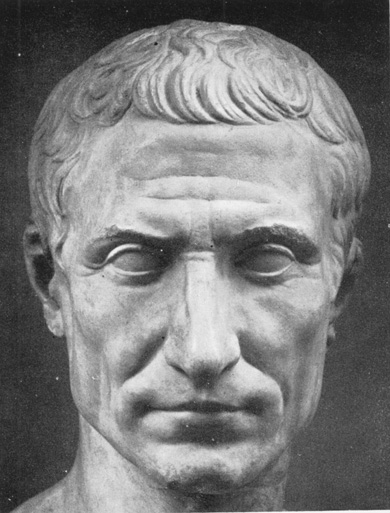
Julius Caesar
 |
| Julius Caesar |
Caesar is a controversial figure and has long been so. On the one hand, he was a dictator who crushed the Roman Republic and heaped himself with honors that reflected a grossly inflated ego. On the other hand, he was a brilliant general and administrator, a champion of the common people, and a generous victor who sought reconciliation rather than slaughtering his enemies (as was the custom by then).
The controversy continues to this day, and is reflected in our group. Some members are appalled at the honors he heaped upon himself, up to even renaming the month of his birth from Quintillus (fifth month; the year began with March) to July (as in Julius). Others see him as admirable in many ways. One even said -- with great unease because what he was proposing was grossly immoral -- that Caesar's real mistake was in not slaughtering his enemies the way everyone else did because it gave them the opportunity to slaughter him instead. But of course, if Caesar were to slaughter his enemies, then what would there be to distinguish him from anyone else, or make him admirable?
In any event, the title of the play is misleading. Caesar is a fairly minor character and is killed at the beginning of the third act (out of five). The play really should be called Marcus Brutus because Brutus is the real hero of the play, but that would not be as impressive a title. Brutus is an even more controversial figure than Caesar. He took part in Caesar's assassination although he was Caesar's best friend and even rumored to be his illegitimate son. So was this a noble act, placing the freedom of Rome ahead of all personal feelings and ties, or was it a vile act of treachery? The play takes the former view, although many of Shakespeare's other plays refer to Caesar as a hero and Brutus as a vile traitor. And our champion of Caesar made further arguments against Brutus. While Caesar's enemy Cato fought him to the last and committed suicide rather than accept his forgiveness, Brutus begged Caesar's mercy for fighting against him and received it, only to plot his murder. From the standpoint of personal relationships alone, Brutus is contemptible! The question is whether that was outweighed by the greater good of Rome and that, in turn, ultimately depends on what one thinks of Caesar.
But it convinces me that, although Shakespeare's tragedy should be entitled Marcus Brutus, one could certainly write a tragedy about Julius Caesar. Tragedy has many forms and many analyses, and I do not know of any single definition. But certainly one form of tragedy is one in which the hero is placed in an confronted with an impossible dilemma, in which any decision he makes will be wrong. The hero, being a tragic hero, does not shrink from what circumstances demand of him -- he makes the choice that his character demands of him and fearlessly faces the consequences that Fate does not spare, even though he had not choice but to choose wrong. There are other forms of tragedy, I realize. This is just the easiest to do. A tragedy of Caesar, then, is that he is placed in an impossible dilemma -- destroy his enemies, just the same as everyone else has done, and cease to be any different from anyone else, or else spare them and end up being destroyed by them. Caesar will make his choice -- be Caesar and what makes him unique, no matter what the cost -- and be destroyed as a result.
I have tried my hand at writing plays once or twice before. Maybe I will write that one some day.
Sunday, February 2, 2014
The Ultimate Answer to Coincidence
And on the subject of conspiracies, what does one say to people who say something is just too far-fetched to be a coincidence; there just has to be a conspiracy? And I will grant them, some things really are too far-fetched to be coincidences. Some seeming coincidences do turn out to have an underlying plan. But sometimes a coincidence is just a coincidence. And as the ultimate argument that something really can happen just by chance, let us consult our old friend, the Mad Revisionist, denying the existence of the moon. One of the Mad Revisionist's correspondents pointed out the obvious reason the moon cannot exist -- eclipses of the sun:
So if this can be just a coincidence, well then --
1. The Moon is the EXACT SAME apparent diameter as the SunAnd when you think about it, this really is an extraordinarily far-fetched coincidence. The moon is, indeed, much smaller than the sun, but also closer to the earth. As a result, because of the way we perceive objects as smaller in the distance, the disk of the sun and the disk of the moon do, indeed, appear exactly the same size, and the moon even occasionally passes between the earth and the sun and exactly covers the sun, causing an eclipse. This does, indeed, seem like a remarkably strange confluence of events; much to convenient to be just a coincidence, so how could it be a natural phenomenon? And yet it is a natural phenomenon. It really is just a coincidence and no one (so far as I know) disputes it.
In my opinion this is the single greatest argument in favour of the Moon being artificial. The Moon, of course, is supposedly millions of times smaller than the sun - but because of various alleged coincidences of distance, trigonometry, apparent sizes, and all that orthodox junk, we are supposed to believe that the Moon JUST HAPPENS TO LOOK THE SAME SIZE AS THE SUN FROM HERE!
Think about it! During solar eclipses (which I personally believe to be some sort of mass-hypnosis), the moon EXACTLY covers the diameter of the sun! HOW BIG A COINCIDENCE IS THAT?
No of course it's not a coincidence. THE MOON IS FAKE!!!
So if this can be just a coincidence, well then --
Saturday, February 1, 2014
Fake Snow and the Silver Glass

Apparently this began when someone tried to melt it with a butane lighter (something that had never occurred to most people to do) and instead of melting, it sizzled and developed black soot. Conclusion -- it must be fake. Whoever came up with this idea then filmed it and put it onto You-Tube and inspired countless imitators who discovered the same thing.
So, people find an unusual physical phenomenon that goes against most people's intuition and expectation and instead of looking for a natural explanation, they assume a sinister government conspiracy. A few centuries back, they would have assumed either witchcraft or a miracle. Several sites have presented explanations that this is a normal phenomenon and not a sign that anything is wrong with the snow. Fox News (once again showing it is mainstream) has been among them.
Given all the other nuttiness we have been seeing, why does this particular story get to me so much? I suppose it goes back to a childhood memory -- well, an adolescent memory. Around age 13 or 14, while washing some dishes, I held a glass under water upside down, with air in it, I observed an extraordinary phenomenon. Suddenly the glass turned silver, mirror-like. If I reached a finger inside it, it was not visible at all. But if the glass filled with water, the silver mirror vanished. I was astonished. I had never seen anything like that before. Centuries ago, I would no doubt have regarded it as either a miracle or something sinister. And some people these days would probably see a government conspiracy, run by the Illuminati, the shape-shifting lizards or some other villain, at work. In my innocence, I assumed it was a natural phenomenon at work, though I could not imagine what. In high school physics, when we learned about the refraction of light, I asked about it and was told it was the result of light being refracted to the point of reflecting back altogether. At the end of the year, we were all required to do a physics project, and everyone else built something, some of them quite impressive. (A parabola to reflect light onto a single spot and melt a can of snow there is the one I remember best). Instead of building something, I set out to calculate the angle of total internal reflection. It seemed like a miserable, meager thing compared to the impressive things everyone else built, but the teacher nonetheless gave me an A for it, which I took to mean he was a very easy grader. Several years later, my father met with him for some other reason, and the teacher congratulated him on my excellent project and said that, although it was less flashy than the rest, it was more scientific.
So I suppose that was why this particular story has gotten to me so much. Because conspiracy theories have deprived people of the chance to find the scientific answer to real but surprising and counter-intuitive phenomenon. Just like by silver glass.
Subscribe to:
Posts (Atom)