Current conventional wisdom has it that Obama is toast, that the unpopularity of Obamacare proves that the Democrats can never be trusted with power again, and that the Republicans will sweep the 2014 and 2016 elections, and that the program is already in a terminal death spiral. Of course, conventional wisdom a month ago was that the Republicans were toast, that the Democrats would sweep the 2014 and 2016 elections, and that the shutdown proved the Republicans could never be trusted with power again. Welcome to the fickle world of news cycles.
So far as I can tell, the websites problems did not dent Obama's popularity and actually enhanced the popularity of the program, probably because most people thought a website for the uninsured to buy insurance was a good idea, and that malfunctions could be fixed. Cancelled policies have seriously hurt both the program and Obama. Even if only a relative few have lost coverage, they make compelling stories, and besides, once policies start cancelling, no one feels safe. Besides, Obama promised that no policies would be cancelled, so his credibility has taken a hit.
But notice another thing. Republicans are no longer pushing for outright repeal. After all, now outright repeal would mean shutting down the exchanges where non-trivial numbers of people have shopped or want to shop for insurance, stripping at least some people of insurance, and killing a system which is working in at least some states. Instead, they are trying in various ways to discourage young and healthy people from shopping on the exchanges -- by permanently legalizing bare bones policies, and by seeking a delay of the individual mandate. They are hoping that these things will induce a death spiral and cause the system to crash and all the older and sicker people who bought insurance on the exchanges to lose their coverage. (Hurray! Wait a minute, why did we want that?)
Looking at the future of the act, I see one main danger that could truly kill it.
It is not the malfunctioning website. That will be fixed. It will probably not be fixed by November 30, and Obama should start admitting as much, lest his credibility take yet another hit. But I expect it to be reasonably functional well before the end of March.
It is not the cancelled policies. They are more problematic, but they can be replaced once the connections to insurance companies start functioning. Besides, cancelled polices (replaced, though sometimes at higher rates) are a start up cost that will not be repeated. They may be a big issue in the 2014 election (or they may not), but they are unlikely to be anyone's top worry by 2016.
It is not even that some cancelled policies will not be replaced by December 15 and will lead to a few weeks' lapse. For healthy people (and buying individual policies is difficult if you are not healthy), it will be just another start-up cost -- something people may still be angry about by the 2014 elections, but not by 2016. Something does need to be done for people with serious medical problems for whom even a few weeks' lapse could be disastrous. We need more publicity for this matter in order to force Congress and the President to do something. But even that is a starting up cost that will be a one-time event.
It is not, as some people have suggested, the second rate shock that will hit when people learn about the deductibles and copays on the policies. I could be wrong here, but I do not expect that to be such a big issue for the simple reason that the American people are used to deductibles and copays. Besides, the Platinum, Gold, Silver and Bronze plans make clear that they are ranked by deductible.
It is not the prospect of a death spiral, at least not yet. This is a real danger over the long run, but there are built-in safeguards to keep it from happening as a result of anything in the first year, or even two or three. Government is backstopping the insurance companies for the first three years so that if they do not get enough healthy enrollees at first, they will not have to raise their rates right away. A death spiral is a long-term danger if the system ends up not working, but it is not at hand any time soon.
It is not even the prospect of a second government shutdown and threatened debt ceiling breach, although I do see some danger there. Republicans backed down last time because public opinion was clearly against them. Depending on how well the system is working by next January 15 (and whether news coverage has moved on to something else), public opinion will probably be less clear-cut next time around. Granted, public opinion is unlikely to support a shutdown for the sake of shutting down the exchanges and stripping people of insurance they bought through them. But it might support the Republicans on various modifications that will undermine the system over the long run, such as indefinitely allowing bare bones plans, or delaying the individual mandate.
And that is where I see the real danger -- rate shock when the individual mandate hits. The individual mandate has always been the least popular part of the law. (Really, the only unpopular part when surveyed by itself). Indeed, Obamacare is less popular with the uninsured than the public at large* precisely because they fear being penalized for being uninsured. The whole idea of forcing people to buy a product they don't want strikes many people as outrageously un-American. So far, the concept has been mostly an abstraction, but starting next year it will become real. And, what is worse, contrary to what many people believe, the fine is not $95. It is $95 or 1% of adjusted gross income, whichever is more. That means that a lot of people will be dismissively expecting to pay a $95 fine, not too concerned and will get quite a shock when it turns out to be hundreds of dollars.** A President already facing credibility problems over promising people they can keep their insurance, and that the site will be fixed by the end of November, will take another hit, a big one. And unlike the website malfunctions and the cancelled policies, this one is not going away. Indeed, the fine for not buying health insurance will go up the next two years, and people will be angry. And if the Republicans propose legislation, and perhaps threaten to shut down the government and default on the debt in order to force a delay or repeal of the fines, public opinion is apt to back them and be very hard to resist. If they run on a repeal of the individual mandate in 2014, or 2016, they will have a popular issue, one that will not go away. And one that could very well induce the death spiral Republicans so desperately crave to kill the program.
________________________________________________
*Can't find link
**I assume the number of people with six figure incomes and no health insurance is very small.
Sunday, November 17, 2013

Saturday, November 16, 2013
So, What Are the Prospects of Fixing Obamacare?
So, granted that Obamacare's prospects for survival depend on it being repaired, what are the prospects of it being repaired? Conventional wisdom clearly has it that the problems will not be repaired by the end of November, and it will be a serious blow to Obama's already damaged credibility. But what does it mean to say that it won't be fixed by then? I still don't have a clear answer.
A few things can be cleared up at least. The exchange has two parts, the Hub and the Marketplace. The Hub is where customers create an account and apply for financial assistance. The Marketplace is where they browse for insurance and sign up. After being an initial mess, the Hub appears to be working reasonably well. People can reliable start accounts and at least semi-reliably apply for financial assistance. I had wondered if the applications were getting processed, and apparently they are. People determined to be eligible for Medicaid/S-CHIP can then sign up without trouble.
The Marketplace appears to be working okay so far as browsing goes. However, in terms of signing up, it is a disaster. The information is coming through "garbled, misclassified, or missing." Until the connections are repaired, submitting an application is worse than useless; it is actively harmful because it often required the applicant to start a whole new account with a new e-mail address. In short, don't do it until the connection is repaired. It is this problem that has led to a mere 27,000 people actually signing up for insurance on the federal exchange. My own estimate is that if this feature had been working properly, the number would be closer to 147,000.
So, when people repairing the site report that it can only handle 20,000 to 30,000 users at a time, about half the intended capacity, do they mean the Hub can only handle that many, or that the Marketplace can only handle that many? The distinction is crucial because it is the difference between the Marketplace being creaky and problematic, versus the Marketplace not working at all. It is an important distinction! One means that it is best to avoid submitting an insurance application during peak hours, or that one may have to submit more than once to get through. The other says not to submit at all on penalty of having to start a whole new account.*
In the meantime, the recommendation is to create an account, apply for financial assistance, browse, and apply directly with the insurance company. Here again, federal statistics are revealing. About 27% of all applicants are eligible for Medicaid or S-CHIP and can sign up without trouble** About 51% are not eligible for any financial assistance and can sign up with insurance companies directly without trouble. The real problem is for the 22% buying private insurance, but with a subsidy. Insurance companies are not able to access federal information, so people buying private insurance with federal subsidies are unable to sign up. And here is where the difference lies. If 20,000 capacity limit is in the Marketplace, we can ask people who do not qualify for subsidies please to sign up directly with the insurance companies in order to make room on the exchanges, or to wait until they are truly fixed. Then, if they comply, people who do qualify for subsidies will be able to apply. But if the limit is still in the Hub, then people who do not qualify for subsidies will have no choice but to sign up directly because no other alternative will work. People with subsidies will have no alternative at all, except to wait and hope that some day the system gets fixed.
_________________________________________________
*The statement "The software defects that ware making the Web site unstable with too much volume mean that some people face frozen computer screens when they try to enter information — and then get timeout errors" seems to suggest that the problem is still with the Hub, and that they have not even gotten to the Marketplace problems. If the federal exchanges have taken 519,561 applications over the first month, that averages about 16,760 per day, well within those limits. But presumably the number has been rising.
**Indeed, if the 106,000 figure for people signing up does not include people who signed up directly instead of through the exchange, it could well be an underestimate.
A few things can be cleared up at least. The exchange has two parts, the Hub and the Marketplace. The Hub is where customers create an account and apply for financial assistance. The Marketplace is where they browse for insurance and sign up. After being an initial mess, the Hub appears to be working reasonably well. People can reliable start accounts and at least semi-reliably apply for financial assistance. I had wondered if the applications were getting processed, and apparently they are. People determined to be eligible for Medicaid/S-CHIP can then sign up without trouble.
The Marketplace appears to be working okay so far as browsing goes. However, in terms of signing up, it is a disaster. The information is coming through "garbled, misclassified, or missing." Until the connections are repaired, submitting an application is worse than useless; it is actively harmful because it often required the applicant to start a whole new account with a new e-mail address. In short, don't do it until the connection is repaired. It is this problem that has led to a mere 27,000 people actually signing up for insurance on the federal exchange. My own estimate is that if this feature had been working properly, the number would be closer to 147,000.
So, when people repairing the site report that it can only handle 20,000 to 30,000 users at a time, about half the intended capacity, do they mean the Hub can only handle that many, or that the Marketplace can only handle that many? The distinction is crucial because it is the difference between the Marketplace being creaky and problematic, versus the Marketplace not working at all. It is an important distinction! One means that it is best to avoid submitting an insurance application during peak hours, or that one may have to submit more than once to get through. The other says not to submit at all on penalty of having to start a whole new account.*
In the meantime, the recommendation is to create an account, apply for financial assistance, browse, and apply directly with the insurance company. Here again, federal statistics are revealing. About 27% of all applicants are eligible for Medicaid or S-CHIP and can sign up without trouble** About 51% are not eligible for any financial assistance and can sign up with insurance companies directly without trouble. The real problem is for the 22% buying private insurance, but with a subsidy. Insurance companies are not able to access federal information, so people buying private insurance with federal subsidies are unable to sign up. And here is where the difference lies. If 20,000 capacity limit is in the Marketplace, we can ask people who do not qualify for subsidies please to sign up directly with the insurance companies in order to make room on the exchanges, or to wait until they are truly fixed. Then, if they comply, people who do qualify for subsidies will be able to apply. But if the limit is still in the Hub, then people who do not qualify for subsidies will have no choice but to sign up directly because no other alternative will work. People with subsidies will have no alternative at all, except to wait and hope that some day the system gets fixed.
_________________________________________________
*The statement "The software defects that ware making the Web site unstable with too much volume mean that some people face frozen computer screens when they try to enter information — and then get timeout errors" seems to suggest that the problem is still with the Hub, and that they have not even gotten to the Marketplace problems. If the federal exchanges have taken 519,561 applications over the first month, that averages about 16,760 per day, well within those limits. But presumably the number has been rising.
**Indeed, if the 106,000 figure for people signing up does not include people who signed up directly instead of through the exchange, it could well be an underestimate.
How Disastrous is Obamacare, Part II
All right, amid all the claims that Obamacare is toast, let us look at figures released for the first month by the Department of Health and Human Services (HHS) to see just what is going on. For starters, it is actually somewhat more than a month. The dates are not October 1 through 31, but October 1 through November 2. But then again, the system was essentially non-functional the first few days, so maybe adding those extra two may be treated as compensation. It is also important to remember the goal. The goal most frequently cited is to enroll 7 million people by the end of March. But the actual goal is to enroll 7 million people in private insurance by the end of March, with 9 million in Medicaid. So the total goal is to enroll 16 million people. Likewise, the figure getting the most attention is that only 106,185 people have actually signed up for private insurance, far short of the goal of 500,000 for the first month. The again, the total enrolled is about that many counting the number enrolled in Medicaid. But I have not seen the enrollment goals for Medicaid, and how the actual number matches up.
So, to repeat, there are three stages to enrollment. The first is to create an account. The government report does not include a statistic on the number of accounts created, and probably just as well. Many people created accounts out of curiosity, or browse for prices, and others had to create new accounts when the old ones failed. Creating an account does not, by itself, show an actual commitment to buy insurance.
The next stage is to submit an application for financial assistance. The total number of applications submitted was 846,184. Since many of these were for families with more than one member, the number of individuals represented is 1,508,883. The report boasts that this is 22% of the goal of 7 million people enrolled, but this needs to be severely qualified. If one counts the goal of enrolling 9 million in Medicaid, it is closer to 9.4%. Even if we round up to 10%, clearly we need to step this up if anything close to the goal is to be achieved. Furthermore, the report does not address how many of the applications are duplicates. Many failed applications have had to start a new account with a new e-mail. HHS has apparently sent out 275,000 e-mails asking customers to re-apply. So the total of actual applications might be closer to 571,000, representing an undetermined number of people. Nonetheless, lacking anything better to go by, I will assume that all these applications and the people they represent are the correct number.
I wondered whether the government was successfully processing all these applications, and the answer appears to be yes. Approximately 98%, or 1,477,853 people have been processed. (We are not told how long the typical processing time is). Of these 1,081,592 (73%) have been steered to private plans and 396,261 (27%) to Medicaid or S-CHIP. The assumption appears to be that anyone found eligible for those two programs has actually been enrolled. Of the 1,081,592 people eligible for private insurance, only a distinct minority, or 326,130 have been found to be eligible for financial assistance. That is about 30% of the people sent to private enrollment, and 22% of total applicants.
And now for the figure we have been hearing most about. Out of the people referred to private insurance, only 106,185, or less than 10% have actually signed up for insurance. Of these, 79,391 signed up on state exchanges and only 26,794 on the federal exchanges. As HHS comments, this is about 1.5% of the goal of 7 million. Meanwhile, although HHS has not said so, the signups for Medicaid and S-CHIP are about 4.4% of the goal. HHS defends these numbers as not so different that the percentages at similar stages in Romneycare, S-CHIP, and Medicare D. Romneycare and Medicare D, at least, also had plenty of technical problems at the beginning. What I am not clear on is to what extent those problems were responsible for slow initial sign-ups in those programs.
There are two reasons why sign-up might be faster for Medicaid/S-CHIP than private insurance. One is that there are no choices to be made for Medicaid/S-CHIP; one simply signs up and that is all. The other is the technical problems in connecting to insurance companies to sign up. The best way to guess to what extent each factor is responsible is to compare the federal exchanges, which are having major technical problems linking to private insurance, with state exchanges, which are working much better. I do not have any numbers for relative population of people in states running their own exchanges versus states using the federal exchange. Of 846,184 applications, 61% were from federal exchanges and 39% from state exchanges. People represented skew a little more toward the federal exchanges, at 66% versus 34%. People actually processed break down similarly to applications submitted, at 60% federal versus 40% state. But things change considerably when we get to people signed up. Out of 396,261 people determined to be eligible for Medicaid/S-CHIP, 212,865, or about 54% of the total were from state with their own exchanges, versus 46% from federal exchanges. Another way of looking at these applications is that about 36% of all applicants processed were determined to be eligible for Medicaid/S-CHIP on state exchanges, versus 18.5% in federal exchanges. This may be because many of the states using federal exchanges declined the Medicaid expansion. But the most spectacular difference is in people eligible for private insurance signed up in federal versus state exchanges. The 79,381 people signed up for private insurance on state exchanges are 20.9% of those eligible. The 26,794 eligible in federal exchanges represent a mere 3.8% of those eligible. This difference is presumably the result of defective connections with private insurance companies.* If the connection worked properly, the federal number would presumably be closer to 146,847 (20.9% of 702,619 people eligible). In that case, the total number of people signed up for private insurance would be 226,228. That would be somewhat less than half the goal for this month, and about 3.2% of the goal of 7 million -- behind Medicaid/S-CHIP, but not that far behind.
My ultimate conclusion -- not great, but not as disastrous as conventional wisdom has it. It should be salvageable -- but only if the federal exchange is fixed.
_________________________________________
*If there has been double-counting of some applications on the federal exchanges, this could account for some of the discrepancy as well.
So, to repeat, there are three stages to enrollment. The first is to create an account. The government report does not include a statistic on the number of accounts created, and probably just as well. Many people created accounts out of curiosity, or browse for prices, and others had to create new accounts when the old ones failed. Creating an account does not, by itself, show an actual commitment to buy insurance.
The next stage is to submit an application for financial assistance. The total number of applications submitted was 846,184. Since many of these were for families with more than one member, the number of individuals represented is 1,508,883. The report boasts that this is 22% of the goal of 7 million people enrolled, but this needs to be severely qualified. If one counts the goal of enrolling 9 million in Medicaid, it is closer to 9.4%. Even if we round up to 10%, clearly we need to step this up if anything close to the goal is to be achieved. Furthermore, the report does not address how many of the applications are duplicates. Many failed applications have had to start a new account with a new e-mail. HHS has apparently sent out 275,000 e-mails asking customers to re-apply. So the total of actual applications might be closer to 571,000, representing an undetermined number of people. Nonetheless, lacking anything better to go by, I will assume that all these applications and the people they represent are the correct number.
I wondered whether the government was successfully processing all these applications, and the answer appears to be yes. Approximately 98%, or 1,477,853 people have been processed. (We are not told how long the typical processing time is). Of these 1,081,592 (73%) have been steered to private plans and 396,261 (27%) to Medicaid or S-CHIP. The assumption appears to be that anyone found eligible for those two programs has actually been enrolled. Of the 1,081,592 people eligible for private insurance, only a distinct minority, or 326,130 have been found to be eligible for financial assistance. That is about 30% of the people sent to private enrollment, and 22% of total applicants.
And now for the figure we have been hearing most about. Out of the people referred to private insurance, only 106,185, or less than 10% have actually signed up for insurance. Of these, 79,391 signed up on state exchanges and only 26,794 on the federal exchanges. As HHS comments, this is about 1.5% of the goal of 7 million. Meanwhile, although HHS has not said so, the signups for Medicaid and S-CHIP are about 4.4% of the goal. HHS defends these numbers as not so different that the percentages at similar stages in Romneycare, S-CHIP, and Medicare D. Romneycare and Medicare D, at least, also had plenty of technical problems at the beginning. What I am not clear on is to what extent those problems were responsible for slow initial sign-ups in those programs.
There are two reasons why sign-up might be faster for Medicaid/S-CHIP than private insurance. One is that there are no choices to be made for Medicaid/S-CHIP; one simply signs up and that is all. The other is the technical problems in connecting to insurance companies to sign up. The best way to guess to what extent each factor is responsible is to compare the federal exchanges, which are having major technical problems linking to private insurance, with state exchanges, which are working much better. I do not have any numbers for relative population of people in states running their own exchanges versus states using the federal exchange. Of 846,184 applications, 61% were from federal exchanges and 39% from state exchanges. People represented skew a little more toward the federal exchanges, at 66% versus 34%. People actually processed break down similarly to applications submitted, at 60% federal versus 40% state. But things change considerably when we get to people signed up. Out of 396,261 people determined to be eligible for Medicaid/S-CHIP, 212,865, or about 54% of the total were from state with their own exchanges, versus 46% from federal exchanges. Another way of looking at these applications is that about 36% of all applicants processed were determined to be eligible for Medicaid/S-CHIP on state exchanges, versus 18.5% in federal exchanges. This may be because many of the states using federal exchanges declined the Medicaid expansion. But the most spectacular difference is in people eligible for private insurance signed up in federal versus state exchanges. The 79,381 people signed up for private insurance on state exchanges are 20.9% of those eligible. The 26,794 eligible in federal exchanges represent a mere 3.8% of those eligible. This difference is presumably the result of defective connections with private insurance companies.* If the connection worked properly, the federal number would presumably be closer to 146,847 (20.9% of 702,619 people eligible). In that case, the total number of people signed up for private insurance would be 226,228. That would be somewhat less than half the goal for this month, and about 3.2% of the goal of 7 million -- behind Medicaid/S-CHIP, but not that far behind.
My ultimate conclusion -- not great, but not as disastrous as conventional wisdom has it. It should be salvageable -- but only if the federal exchange is fixed.
_________________________________________
*If there has been double-counting of some applications on the federal exchanges, this could account for some of the discrepancy as well.
Sunday, November 10, 2013
The Republican Dilemma on Obamacare
Actually, there are several. To take the simplest, what are Republicans to make of all these stories about how badly it is going. After all, it is a Republican article of faith the the media have a hopeless liberal bias and would never speak an ill word about Obama. And now they are doing it. This one is a relatively easy dilemma to overcome. You simply conclude that the exchanges are so disastrous that eventheliberalmedia can't ignore them, and that if eventheliberalmedia are reporting problems with Obamacare, think how much worse reality must be. Actually, this shows media bias, all right, but of a different sort. In particular, it shows a bias toward bad news. People signing up and everything going well just isn't much of a story.
Next problem: What to do about it. Yes, it is tempting to gloat over the failed exchanges, but to actually get indignant that the exchanges are not working well is to suggest that you want them to work well. Cancelled policies and increased rates fit well with the narrative of Obamacare being a disaster. Exchanges working badly makes it sound like a basically good idea, badly executed. And if you get too indignant over exchanges not working it leaves another, obvious problem -- what if they do start working. Then what will you do?
And then there are the opponents trying to convince healthy young people not to sign up so as to induce a death spiral. Yes, there are some who warn that the death spiral is inevitable, but plenty of others don't see it as quite so inevitable that they are doing their best to bring it about. In effect, they are urging young people not to buy health insurance so we can bring the whole system crashing down, and all those older and sicker people will lose their health insurance. Hurray! Wait a minute, why did we want all those older and sicker people to lose their health insurance? My guess is that most people wanting to crash the system haven't thought that far ahead and just want to get at Obama. Nonetheless, there are three sort of coherent answers:
Next problem: What to do about it. Yes, it is tempting to gloat over the failed exchanges, but to actually get indignant that the exchanges are not working well is to suggest that you want them to work well. Cancelled policies and increased rates fit well with the narrative of Obamacare being a disaster. Exchanges working badly makes it sound like a basically good idea, badly executed. And if you get too indignant over exchanges not working it leaves another, obvious problem -- what if they do start working. Then what will you do?
And then there are the opponents trying to convince healthy young people not to sign up so as to induce a death spiral. Yes, there are some who warn that the death spiral is inevitable, but plenty of others don't see it as quite so inevitable that they are doing their best to bring it about. In effect, they are urging young people not to buy health insurance so we can bring the whole system crashing down, and all those older and sicker people will lose their health insurance. Hurray! Wait a minute, why did we want all those older and sicker people to lose their health insurance? My guess is that most people wanting to crash the system haven't thought that far ahead and just want to get at Obama. Nonetheless, there are three sort of coherent answers:
- The simply oppose all state-mandated systems of redistribution, in this case, from the healthy to the sick. They want to keep the healthy from being "enslaved" by the sick (i.e., subsidizing them). That it will induce a death spiral is an entirely unintended side effect. Except that enough people have made perfectly clear that they are, indeed, deliberately trying to create a death spiral that this argument is just not convincing.
- They want to avoid all state-mandated redistribution and keep the healthy from being "enslaved" by the sick. That the sick will lose their coverage as a result is simply not a legitimate public policy concern. Only ensuring that there is no state-mandated redistribution is a legitimate public policy concern. The need of any potential recipients is not. But once again, deliberately seeking to engineer a death spiral certainly makes it seem like you want beneficiaries to lose their health insurance.
- People who didn't get health insurance when they were young and healthy have behaved irresponsibly and should suffer the consequences of their bad decisions. Well, this at least explains why you want people to lose their health insurance, but it has other problems. In particular, it means encouraging people who are not young and healthy to engage in irresponsible behavior for which they, too, will eventually have to suffer consequences. Encouraging other people to be irresponsible doesn't seem very responsible to me. I suppose the suffer-the-consequences people would answer that they are all for young people buying health insurance, so long as it is not on the exchanges, but done in some other way that assures it does not subsidize anyone else.
For the most part, though, I think this is driven by blind partisanship more than anything else.
How Disastrous is Obamacare?
The normal description for Obamacare's launch to date is "disastrous." This refers to two things -- badly malfunctioning software, and individual purchasers seeing their policies canceled and replaced by more expensive ones. Yes public opinion on Obamacare either remains unchanged or has shifted slightly in favor of it.
I would say these things are related. In some ways, the start up problems may even have been a public relations advantage. After hearing vague, horrifying rumors about Obamacare, the latest stories are changing it from a mysterious menace to something more concrete -- a website for the uninsured to buy insurance that isn't working very well. Most people's reaction to a website for the uninsured to buy insurance will presumably be that it is good if it works and bad if it doesn't work. As for people seeing their policies cancelled, many if not most will be able to do comparably well on the website, if only it works. People who are able to replace their policies with a perfectly good alternative on the exchange will presumably forgive the inconvenience of having their policies cancelled. But if the site does not start working, they will not forgive.
Anecdotes are flying madly about. I will give my own. When I signed on as early as October 12, the site was sluggish. Each question I answered was followed a most annoying delay. The delays were long enough that I got tired of watching the revolving circle and played a round of solitaire. When I got back from the solitaire, it had always completed its work. Other than its sluggishness, it was not too different from completing any other long internet application. But I did not reach the point of applying for subsidies, mostly because my financial future was too uncertain. I do not know what would have happened if I had applied. It has gone faster on more recent visits, but I still have not known enough about my future to see if I qualify for a subsidy (probably not).
But an anecdote is just that -- one person's experience. The government hopes to sign up 7.5 million people. What matters out of so large a number are the statistics. What do they tell us? So far as I can tell, nothing very encouraging.
There are several stages of applying. One is to create an account. (That was as far as I got). The next is to determine one's eligibility for a subsidy and apply for one. Next, one chooses an insurance plan and submits an application to the insurance company. Finally, one makes an initial payment and is formally enrolled. Not everyone who takes one step necessarily decides to take the next. Some people may open accounts but not apply for subsidies. Some may apply for subsidies but decide not to enroll. This was especially a problem earlier on when people could not anonymously browse for rates, but had to create an account just to look at them. The system has since been modified to allow window shopping without an account.*
The latest statistical account I have seen was for October 25. It reported a 90% success rate in creating accounts, but only a 30% success rate in "completing an application." "Completing an application" means determining eligibility for subsidies. I am not clear whether this means getting the subsidies approved, or merely calculated. Clearly a 90% success rate is nowhere close to acceptable (it means failure 10% of the time, which is much to high), but it can be reasonably described as functional. A 30% success rate means at least three attempts before it works, which can't really be described as functional, but is in the category of seriously dysfunctional, rather than completely non-functional. The number of "applications completed" in the sense of applications for subsidies on October 25 was 700,000, about half of them through federal exchanges. Assuming another 50,000 in the last six days of October (not an unrealistic number given the general rate they were coming in) and the applications completed would be about 10% of the goal in the first month out of six, or about 60% of the way there. That is less than one might hope for but not disastrous.
What is disastrous is the "back end," i.e., connection between the exchange and insurance companies. So far as I can tell, that portion is truly non-functional. The information coming in is so bad that companies are resorting to hand processing, which, of course, cannot handle anything close to the volume hoped for. The number of people actually signed up is negligible. This is what the government hopes to have fixed by the end of November. I do not know enough about tech to know either (1) whether that is in any way realistic, or (2) what sort of error rate the system can tolerate and be considered functional. Stay tuned.
I will note one slightly encouraging thing I learned. My impression was that the December 15 deadline was the deadline to get insurance in 2014, and that any insurance purchased after that date would merely avoid the fine and would not actually take effect until 2015. I did not see the point. People who sign up don't just want to avoid a fine; they want actual insurance. But apparently I was wrong. Applications must be submitted by December 15 to get insurance on January 1, 2014. Sign-ups after that date will provide insurance in 2014; there will merely be a two to six week delay. But this could be truly disastrous for the sickest people of all -- ones in "high risk pools" set to be cancelled at the start of next year when the new insurance is supposed to take effect. These are people who can't afford even a few weeks lapse in coverage. Which makes me wonder. Even assuming the best, and that everything is perfect by November 30, just how much volume can the system handle in those 15 days? Can it truly sign up everyone in a high risk pool in that amount of time? Really, we should be working frantically to extent the high risk pools, just to be sure.
Finally, a bit of supposedly good news from Kentucky, the state with the best functioning exchange, actually strikes me as discouraging. The governor boasts that they are signing up 1000 people a day, and the first month statistic bear that out. Signing up 1000 people a day for the next six months would be a total of 180,000. Kentucky has 640,000 uninsured. Signing up 1000 people a day amounts to about 28% of the total -- a significant dent in the number, but well short of a majority. Even more discouraging are the composition of people signed up. Of the slightly over 30,000 people signed up in the first month in Kentucky, 27,854 signed up for Medicaid. Only 4,631 signed up for private insurance. That does not bode well for the success of the program.
______________________________________________
*Although when I tried to browse for New Mexico, it referred me to the New Mexico site, that did not let me browse.
I would say these things are related. In some ways, the start up problems may even have been a public relations advantage. After hearing vague, horrifying rumors about Obamacare, the latest stories are changing it from a mysterious menace to something more concrete -- a website for the uninsured to buy insurance that isn't working very well. Most people's reaction to a website for the uninsured to buy insurance will presumably be that it is good if it works and bad if it doesn't work. As for people seeing their policies cancelled, many if not most will be able to do comparably well on the website, if only it works. People who are able to replace their policies with a perfectly good alternative on the exchange will presumably forgive the inconvenience of having their policies cancelled. But if the site does not start working, they will not forgive.
Anecdotes are flying madly about. I will give my own. When I signed on as early as October 12, the site was sluggish. Each question I answered was followed a most annoying delay. The delays were long enough that I got tired of watching the revolving circle and played a round of solitaire. When I got back from the solitaire, it had always completed its work. Other than its sluggishness, it was not too different from completing any other long internet application. But I did not reach the point of applying for subsidies, mostly because my financial future was too uncertain. I do not know what would have happened if I had applied. It has gone faster on more recent visits, but I still have not known enough about my future to see if I qualify for a subsidy (probably not).
But an anecdote is just that -- one person's experience. The government hopes to sign up 7.5 million people. What matters out of so large a number are the statistics. What do they tell us? So far as I can tell, nothing very encouraging.
There are several stages of applying. One is to create an account. (That was as far as I got). The next is to determine one's eligibility for a subsidy and apply for one. Next, one chooses an insurance plan and submits an application to the insurance company. Finally, one makes an initial payment and is formally enrolled. Not everyone who takes one step necessarily decides to take the next. Some people may open accounts but not apply for subsidies. Some may apply for subsidies but decide not to enroll. This was especially a problem earlier on when people could not anonymously browse for rates, but had to create an account just to look at them. The system has since been modified to allow window shopping without an account.*
The latest statistical account I have seen was for October 25. It reported a 90% success rate in creating accounts, but only a 30% success rate in "completing an application." "Completing an application" means determining eligibility for subsidies. I am not clear whether this means getting the subsidies approved, or merely calculated. Clearly a 90% success rate is nowhere close to acceptable (it means failure 10% of the time, which is much to high), but it can be reasonably described as functional. A 30% success rate means at least three attempts before it works, which can't really be described as functional, but is in the category of seriously dysfunctional, rather than completely non-functional. The number of "applications completed" in the sense of applications for subsidies on October 25 was 700,000, about half of them through federal exchanges. Assuming another 50,000 in the last six days of October (not an unrealistic number given the general rate they were coming in) and the applications completed would be about 10% of the goal in the first month out of six, or about 60% of the way there. That is less than one might hope for but not disastrous.
What is disastrous is the "back end," i.e., connection between the exchange and insurance companies. So far as I can tell, that portion is truly non-functional. The information coming in is so bad that companies are resorting to hand processing, which, of course, cannot handle anything close to the volume hoped for. The number of people actually signed up is negligible. This is what the government hopes to have fixed by the end of November. I do not know enough about tech to know either (1) whether that is in any way realistic, or (2) what sort of error rate the system can tolerate and be considered functional. Stay tuned.
I will note one slightly encouraging thing I learned. My impression was that the December 15 deadline was the deadline to get insurance in 2014, and that any insurance purchased after that date would merely avoid the fine and would not actually take effect until 2015. I did not see the point. People who sign up don't just want to avoid a fine; they want actual insurance. But apparently I was wrong. Applications must be submitted by December 15 to get insurance on January 1, 2014. Sign-ups after that date will provide insurance in 2014; there will merely be a two to six week delay. But this could be truly disastrous for the sickest people of all -- ones in "high risk pools" set to be cancelled at the start of next year when the new insurance is supposed to take effect. These are people who can't afford even a few weeks lapse in coverage. Which makes me wonder. Even assuming the best, and that everything is perfect by November 30, just how much volume can the system handle in those 15 days? Can it truly sign up everyone in a high risk pool in that amount of time? Really, we should be working frantically to extent the high risk pools, just to be sure.
Finally, a bit of supposedly good news from Kentucky, the state with the best functioning exchange, actually strikes me as discouraging. The governor boasts that they are signing up 1000 people a day, and the first month statistic bear that out. Signing up 1000 people a day for the next six months would be a total of 180,000. Kentucky has 640,000 uninsured. Signing up 1000 people a day amounts to about 28% of the total -- a significant dent in the number, but well short of a majority. Even more discouraging are the composition of people signed up. Of the slightly over 30,000 people signed up in the first month in Kentucky, 27,854 signed up for Medicaid. Only 4,631 signed up for private insurance. That does not bode well for the success of the program.
______________________________________________
*Although when I tried to browse for New Mexico, it referred me to the New Mexico site, that did not let me browse.
Sunday, October 27, 2013
Afterword and Foreword
This post is both an afterword to my last post and a foreword to a series I want to post in a very slow and meandering fashion. I been obsessed for some time with how democratically elected governments fail. I only know much detail about two examples -- Germany and the United States. (And let's face it. When democratic politics fail to resolve the foremost issue of the day, resulting in a civil war with 600,000 dead, that has to be considered a failure of democracy).
At the same time, it is inspired in large party by a comment to a prior post in which I measured the traits professional historians associate with fascism against the Tea Party to see how they match up. My conclusion: The Tea Party has several of fascism's mobilizing passions but lacks a charismatic leader. If it adopts charismatic leader like Ted Cruz, it would meet most of the mobilizing passions. It has two out of three fascist negations, i.e., it is anti-radical and anti-liberal, but not anti-conservative.* But it is not fascistic in its methods (although its methods are alarming in other ways) and it shares none of fascism's ideology and goals. My commenter believed that the Tea Party, although not classically fascist, was still alarming, and that American fascism might not take the same form as classical European fascism.
This brought to my mind my earlier analysis of the Ku Klux Klan and its resemblance to fascism. My conclusion: The Klan shared most of fascism's mobilizing passions except for lacking a charismatic leader; it was also anti-radical and anti-liberal, but not anti-conservative; it was fascistic in its methods except that it lacked a charismatic leader; but it had none of the classical fascist ideology and goals.
Going by my very cursory knowledge about the failure of democracy in countries other than the US and Germany, I have several preliminary hypotheses:
______________________________________________
*I imagine some conservatives would disagree with me and say that making opposition and conflict ends in themselves, shutting down government, and threatening a debt default with untold consequences are not conservative at all. Point taken.
At the same time, it is inspired in large party by a comment to a prior post in which I measured the traits professional historians associate with fascism against the Tea Party to see how they match up. My conclusion: The Tea Party has several of fascism's mobilizing passions but lacks a charismatic leader. If it adopts charismatic leader like Ted Cruz, it would meet most of the mobilizing passions. It has two out of three fascist negations, i.e., it is anti-radical and anti-liberal, but not anti-conservative.* But it is not fascistic in its methods (although its methods are alarming in other ways) and it shares none of fascism's ideology and goals. My commenter believed that the Tea Party, although not classically fascist, was still alarming, and that American fascism might not take the same form as classical European fascism.
This brought to my mind my earlier analysis of the Ku Klux Klan and its resemblance to fascism. My conclusion: The Klan shared most of fascism's mobilizing passions except for lacking a charismatic leader; it was also anti-radical and anti-liberal, but not anti-conservative; it was fascistic in its methods except that it lacked a charismatic leader; but it had none of the classical fascist ideology and goals.
Going by my very cursory knowledge about the failure of democracy in countries other than the US and Germany, I have several preliminary hypotheses:
- Democracies fail as a result of extreme, out-of-control polarization and strife;
- Simultaneous a cause and a symptom of such polarization are parties that abandon all respect for the rules of the game and democratic fair play and pursue victor at all costs;
- Political violence is a very bad sign;
- Although violent revolution from the Left is a real danger under authoritarian governments, the danger to democracy is usually from the Right.
Qualifying this last statement, I would add that a radical anti-democratic Left can certainly exist and add to the polarization, but it is usually the Right that emerges dominant. I would further add that one sign that a right-wing party is dangerous is that it loses its ability to distinguish between the radical Left and the moderate Left that respects democratic fair play. I will further add that sometimes the radical Left does bring down democracy, but most examples I know of fall under two main categories. One is Eastern Europe following WWII, when democratically elective governments fell to the Communists. But whether that would have happened in the absence of the Red Army is an open question. The other is that governments that are formally democratically elective, but have informally degenerated into cozy little oligarchies are vulnerable to left wing, populist dictators, like Julius Caesar, Huey Long, or Hugo Chavez.
Looking at the two examples I know most about, I would say that both the secessionists and the Nazis are properly characterized as right wing. But they are right wing in very different ways. The secessionist of the 1850's (or the Tea Party today) are right wing in the sense of being reactionaries, standing athwart history, yelling stop! The Fascists and Nazis were something different altogether -- right wing, but emphatically not conservative. They won the alliance of conservatives with a promise to crush the Left, but they also aspired to major changes and transformations of society that were not conservative (the fascist ideology and goals).
So I want to look at various democracies that have failed and see both what went wrong and how well the various fascist traits apply to democracy's enemies. It may turn out that the mobilizing passions, negations, and methods of fascism are common among enemies of democracy, but the fascist ideology and goals are an anomaly. Or it may turn out that fascism is more widespread than we realize. I don't know. But I hope to learn a lot.
______________________________________________
*I imagine some conservatives would disagree with me and say that making opposition and conflict ends in themselves, shutting down government, and threatening a debt default with untold consequences are not conservative at all. Point taken.
Tea Party Today: Democrats in the 1850's?
Let me start by stating the obvious. I do not believe that the Tea Party wants to secede, or that there is any danger of secession by red states, or any threat of civil war. So in that sense, the Tea Party is nothing like the Democrats of the 1850's. But in an attempt to find some sort of parallel in our history, I have been looking at books about that fateful decade that was the countdown to the Civil War, and I see a dynamic in Southern Democrats that bears a certain resemblance to the Tea Party today.
To understand the 1850's, one must go back at least to the Missouri Compromise of 1820.
 The northern state dominated the House of Representatives because of their larger population, but Congress made a habit of admitting slave and free states in equal numbers to maintain the balance in the Senate. In 1820, Missouri applied for admission as a slave state, threatening to tip the balance. Some northern Congressmen sought to require Missouri to phase out slavery as a condition of admission. In the end, the sides compromised. They admitted Missouri as a slave state and Maine as a free state, but barred slavery in the Louisiana Purchase south of Missouri's southern border (the 36th parallel).* A look at the map above shows why this could not possibly have been the basis for a stable compromise. The territory closed to slavery was much larger than the territory open to it. Indeed, the only slave state subsequently admitted from the Louisiana Purchase was Arkansas. But the Southern states on the whole expanded territorially faster than the northern states and were always eager to add more territory to the US. The addition of Florida and Texas (and the possibility of breaking Texas into as many as five different slave states) maintained the balance in the Senate for a surprising thirty years.
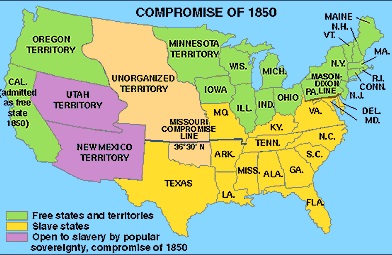 The Union threatened to fray again in 1850 when California applied for admission as a free state, including the portions the were south of the Missouri Compromise Line. This set off a crisis because it would tilt the balance of the Senate permanently in favor of the North. After much wrangling, Congress reached a compromise. California would be admitted as a free state, including the portions south of the 36th parallel. In return, Utah Territory, though north of the line, would be allowed to adopt slavery if it chose. There was not too much resistance to this proposal in the North for at least three reasons: (1) The Missouri Compromise technically only applied to the Louisiana Purchase, so it was not technically violated by allowing slavery north of the line in other territory. (2) No one expected slavery to be established in Utah. (3) Even if by some miracle, slavery were to be established in Utah, Utah was much poorer and less populous than California so the North got decidedly the better end of the bargain. In fact, the Utah for California bargain was so lopsided that the Compromise of 1850 added a tougher fugitive slave act as a sweetener to bring the South along.
 The next crisis occurred in 1854, when Kansas and Nebraska were opened up for settlement and territorial status. Since both territories lay in the Louisiana Purchase north of the Missouri Compromise line, both would normally be closed to slavery, but the South was in no mood to tolerate the admission of any more free states. Stephen Douglas in the Senate therefore cut a deal with the South to repeal the Missouri Compromise line and open these territories to popular sovereignty, i.e., to let the inhabitants decide whether or not to allow slavery. Opening Kansas and Nebraska to slavery set off a much greater uproar in the north than opening Utah to slavery. The Missouri Compromise was widely seen in the north as a sacred compact and its repeal as something monstrous. It was in response to the Kansas-Nebraska Act that the Republican Party was formed, dedicated to preventing any further expansion of slavery. No one expected slavery to have any success in Nebraska, Kansas was right across the border from the slave state of Missouri, and parts of eastern Kansas might have been adaptable to raising tobacco. Many Southerners saw an implied bargain -- Nebraska as a free state for Kansas as a slave state. There was a huge rush of Northern settlers into Kansas -- a minority, mostly from New England, moving there specifically to keep slavery out, and a majority, mostly from the Midwest, seeking a better future, indifferent to slavery as a moral issue, but not wanting slaves as competition. "Border ruffians" crossed over from Missouri to vote in Kansas elections and intimidate settlers, but few who became permanent settlers.
This raises an interesting question. Why did California seek admission as a wholly free state? And why couldn't pro-slavery settlers keep up with the anti-slavery settlers in Kansas? It is commonly said that by 1850, slavery had reached its natural limit because all new land acquired by the US was simply too dry to be good for plantation agriculture. But California today is the US capital of plantation agriculture (in the sense of large-scale, labor-intensive cultivation of cash crops), and at least parts of Kansas were hospitable to tobacco. The answer appears to be that decades of rapid expansion had spread the South thin. It had an abundance of uncultivated land and a shortage of (slave) labor. It simply did not have enough people to keep expanding. The North, by contrast, had a more rapidly growing population because the bulk of immigrants were going there. Parts of its growing population were building cities and industrial development, but other parts were heading west -- and did not want to compete with slaves. In short, slavery had reached its limits, not just because of geography, but because of demography. Much of the South's actions throughout the 1850's might be seen as an attempt to legislate away basic geographic and demographic facts. Needless to say, the attempt was not successful.
At the same time, the South held surprising domination of the federal government by a sort of 19th Century version of the Hastert Rule -- government by the majority of the majority. The South was a minority region, but it held the majority of the Democratic Party, which, in turn, was the majority party. Nonetheless, Northern Democrats were increasingly beginning to chafe under Southern domination. They might not care about slavery as a moral issue, but the Kansas-Nebraska Act had hurt them, and they were becoming restive. This was clearly born out in the Democratic Convention of 1856. Initially, Southerners' favorite candidate was the incumbent President, Franklin Pierce. But Pierce proved unacceptable in the North because of his support for the Kansas-Nebraska Act. Southerners then swung their support to Douglas, who was also widely unacceptable in the North for the same reason. All sides ultimately agreed on James Buchanan, who had played no part in the controversy, and who went on to win the election.
The next crisis occurred almost immediately after Buchanan's inauguration, when the Supreme Court came out with the Dred Scott decision, holding (among other things) that Congress could not exclude slavery from the territories, making the Missouri Compromise unconstitutional. The effect of the ruling was to hold the Republican Party unconstitutional and call for it to disband itself, although of course the decision did not say so in so many words. Needless to say, Republicans were outraged at this overreach and showed no disposition whatever to disband, or to abandon their goals. Dred Scott also posed a potential threat to popular sovereignty because it hinted that a territorial legislature, as a mere creation of the federal government, could not exclude slavery either. This threatened to raise a major rift between northern and southern Democrats, but at the time they were able to paper over the distinction. Douglas -- and many Southern Democrats as well -- argued that, although a territorial legislature could not ban slavery outright, it had no obligation to give any support to slavery and could therefore effectively exclude it.
The potential rift came to head in 1858, when the Missouri-controlled Kansas legislature applied for admission of Kansas as a slave state against the clear wishes of the population. That was a bridge too far for Douglas. He was willing to ignore slavery as a moral issue and treat it as simply another thing to be decided by majority vote, but imposing slavery on the people of Kansas against their will was going too far. Besides, he was up for election later that year, and to admit Kansas as a slave state against the wishes of the population would have been political suicide. Douglas led the fight in Congress to block the admission of Kansas as a slave state (ultimately successful) and thereby made himself as hated in the South as any Republican -- indeed, more, because he was seen as a traitor.
Congress' refusal to admit Kansas as a slave state was followed shortly by the famous Lincoln-Douglas debates. Lincoln pressed Douglas during the debates on how a territory could exclude slavery if Dred Scott forbade such an action. Douglas gave the answer he had been giving for some time -- that a territorial legislature could not ban slavery outright, but it could exclude it by "unfriendly legislation." At about the same time, Jefferson Davis (then a Senator from Mississippi) was giving a speech to New England's dwindling band of Democrats, and assured them that Dred Scott did not mean forcing slavery on a territory against the wishes of the inhabitants since they could always exclude it by failing to pass a slave code. When Douglas learned of this speech, he quickly seized upon it to prove that his opinion was no different from the opinion of the most prominent Southern militant. Wanting to put as much distance as possible between themselves and the hated Douglas, Southern Democrats then began demanding that Congress pass a slave code for the territories -- a thing that was utterly unacceptable to northerners, Democratic or Republican, anti-slavery or indifferent, and which therefore stood no chance whatever of getting through Congress.**
During the 1860 Democratic Convention, the American public was treated to the sight of a major political party committing suicide by self-disembowlment. Southern Democrats made clear that they would not accept Douglas as the nominee under any circumstances, and demanded that the party endorse a slave code for the territories. This demand was utterly unacceptable to Northern Democrats, who rallied behind Douglas. Vicious in-fighting followed, and the Southerners ended up walking out of the convention to nominate their own candidate. The Northern remnant nominated Douglas. The split sealed the Democrats' fate and guaranteed that Lincoln would win as the Republican candidate. Southerners, unwilling to endure a Republican in the White House, seceded.
So what does this depressing story have to do with the Tea Party? Quite simply, it shares the Tea Party's dynamic in several ways. To take the most obvious similarity, the Democrats in the 1850's and the Republicans today were both examples of a party splitting. In both cases, hard liners increasingly came to value combativeness for its own sake above an beyond achieving any sort of outcome. And both came to value ideological purity above electoral success. Of course, there are major differences as well. Most obviously, secession and civil war are not in the cards this time. Nor is the difference this time anything as simple as a sectional split.
But perhaps the most disturbing similarity, I believe, is that the underlying motive is one of fear and despair. Southerners in the 1850's were enjoying a period of unprecedented prosperity and political dominance, but they could read the handwriting on the wall. Geography and demography were stacked against them. They spent a futile decade trying to legislate these facts away. Likewise, much attention has been paid to this survey and its emphasis on fear and despair as the Tea Party's great motives. They, too, fear that their party is doomed and demographic is in hopeless decline. I see despairing comments on blogs that there will never be another Republican President. My response is to say that such fears are foolish of course there will be another Republican President. He (or she) will just have to adapt to changing times. But they Tea Party are people who do not want to adapt to changing times; they want times not to change and do not know how to achieve it.
And that is how the Tea Party is most like the secessionists -- they are both standing athwart history, shouting stop!
____________________________________
*Actually, 36 degrees, 30 minutes.
**Many accounts today, wanting to maximize Lincoln's role, claim that it was Douglas' answer during the debates that made him unacceptable to the South. I highly recommend Don Fehrenbacher's The Dred Scott Case and Stephen Oates' The Approaching Fury (and no doubt many other detailed histories of the period). By giving a detailed chronology of events, they make clear the it was Douglas opposition to the admission of Kansas as a slave state that made him unacceptable in the South, and that anything he said in the Lincoln-Douglas debates was simply an excuse to hate him more.
To understand the 1850's, one must go back at least to the Missouri Compromise of 1820.
This raises an interesting question. Why did California seek admission as a wholly free state? And why couldn't pro-slavery settlers keep up with the anti-slavery settlers in Kansas? It is commonly said that by 1850, slavery had reached its natural limit because all new land acquired by the US was simply too dry to be good for plantation agriculture. But California today is the US capital of plantation agriculture (in the sense of large-scale, labor-intensive cultivation of cash crops), and at least parts of Kansas were hospitable to tobacco. The answer appears to be that decades of rapid expansion had spread the South thin. It had an abundance of uncultivated land and a shortage of (slave) labor. It simply did not have enough people to keep expanding. The North, by contrast, had a more rapidly growing population because the bulk of immigrants were going there. Parts of its growing population were building cities and industrial development, but other parts were heading west -- and did not want to compete with slaves. In short, slavery had reached its limits, not just because of geography, but because of demography. Much of the South's actions throughout the 1850's might be seen as an attempt to legislate away basic geographic and demographic facts. Needless to say, the attempt was not successful.
At the same time, the South held surprising domination of the federal government by a sort of 19th Century version of the Hastert Rule -- government by the majority of the majority. The South was a minority region, but it held the majority of the Democratic Party, which, in turn, was the majority party. Nonetheless, Northern Democrats were increasingly beginning to chafe under Southern domination. They might not care about slavery as a moral issue, but the Kansas-Nebraska Act had hurt them, and they were becoming restive. This was clearly born out in the Democratic Convention of 1856. Initially, Southerners' favorite candidate was the incumbent President, Franklin Pierce. But Pierce proved unacceptable in the North because of his support for the Kansas-Nebraska Act. Southerners then swung their support to Douglas, who was also widely unacceptable in the North for the same reason. All sides ultimately agreed on James Buchanan, who had played no part in the controversy, and who went on to win the election.
The next crisis occurred almost immediately after Buchanan's inauguration, when the Supreme Court came out with the Dred Scott decision, holding (among other things) that Congress could not exclude slavery from the territories, making the Missouri Compromise unconstitutional. The effect of the ruling was to hold the Republican Party unconstitutional and call for it to disband itself, although of course the decision did not say so in so many words. Needless to say, Republicans were outraged at this overreach and showed no disposition whatever to disband, or to abandon their goals. Dred Scott also posed a potential threat to popular sovereignty because it hinted that a territorial legislature, as a mere creation of the federal government, could not exclude slavery either. This threatened to raise a major rift between northern and southern Democrats, but at the time they were able to paper over the distinction. Douglas -- and many Southern Democrats as well -- argued that, although a territorial legislature could not ban slavery outright, it had no obligation to give any support to slavery and could therefore effectively exclude it.
The potential rift came to head in 1858, when the Missouri-controlled Kansas legislature applied for admission of Kansas as a slave state against the clear wishes of the population. That was a bridge too far for Douglas. He was willing to ignore slavery as a moral issue and treat it as simply another thing to be decided by majority vote, but imposing slavery on the people of Kansas against their will was going too far. Besides, he was up for election later that year, and to admit Kansas as a slave state against the wishes of the population would have been political suicide. Douglas led the fight in Congress to block the admission of Kansas as a slave state (ultimately successful) and thereby made himself as hated in the South as any Republican -- indeed, more, because he was seen as a traitor.
Congress' refusal to admit Kansas as a slave state was followed shortly by the famous Lincoln-Douglas debates. Lincoln pressed Douglas during the debates on how a territory could exclude slavery if Dred Scott forbade such an action. Douglas gave the answer he had been giving for some time -- that a territorial legislature could not ban slavery outright, but it could exclude it by "unfriendly legislation." At about the same time, Jefferson Davis (then a Senator from Mississippi) was giving a speech to New England's dwindling band of Democrats, and assured them that Dred Scott did not mean forcing slavery on a territory against the wishes of the inhabitants since they could always exclude it by failing to pass a slave code. When Douglas learned of this speech, he quickly seized upon it to prove that his opinion was no different from the opinion of the most prominent Southern militant. Wanting to put as much distance as possible between themselves and the hated Douglas, Southern Democrats then began demanding that Congress pass a slave code for the territories -- a thing that was utterly unacceptable to northerners, Democratic or Republican, anti-slavery or indifferent, and which therefore stood no chance whatever of getting through Congress.**
During the 1860 Democratic Convention, the American public was treated to the sight of a major political party committing suicide by self-disembowlment. Southern Democrats made clear that they would not accept Douglas as the nominee under any circumstances, and demanded that the party endorse a slave code for the territories. This demand was utterly unacceptable to Northern Democrats, who rallied behind Douglas. Vicious in-fighting followed, and the Southerners ended up walking out of the convention to nominate their own candidate. The Northern remnant nominated Douglas. The split sealed the Democrats' fate and guaranteed that Lincoln would win as the Republican candidate. Southerners, unwilling to endure a Republican in the White House, seceded.
So what does this depressing story have to do with the Tea Party? Quite simply, it shares the Tea Party's dynamic in several ways. To take the most obvious similarity, the Democrats in the 1850's and the Republicans today were both examples of a party splitting. In both cases, hard liners increasingly came to value combativeness for its own sake above an beyond achieving any sort of outcome. And both came to value ideological purity above electoral success. Of course, there are major differences as well. Most obviously, secession and civil war are not in the cards this time. Nor is the difference this time anything as simple as a sectional split.
But perhaps the most disturbing similarity, I believe, is that the underlying motive is one of fear and despair. Southerners in the 1850's were enjoying a period of unprecedented prosperity and political dominance, but they could read the handwriting on the wall. Geography and demography were stacked against them. They spent a futile decade trying to legislate these facts away. Likewise, much attention has been paid to this survey and its emphasis on fear and despair as the Tea Party's great motives. They, too, fear that their party is doomed and demographic is in hopeless decline. I see despairing comments on blogs that there will never be another Republican President. My response is to say that such fears are foolish of course there will be another Republican President. He (or she) will just have to adapt to changing times. But they Tea Party are people who do not want to adapt to changing times; they want times not to change and do not know how to achieve it.
And that is how the Tea Party is most like the secessionists -- they are both standing athwart history, shouting stop!
____________________________________
*Actually, 36 degrees, 30 minutes.
**Many accounts today, wanting to maximize Lincoln's role, claim that it was Douglas' answer during the debates that made him unacceptable to the South. I highly recommend Don Fehrenbacher's The Dred Scott Case and Stephen Oates' The Approaching Fury (and no doubt many other detailed histories of the period). By giving a detailed chronology of events, they make clear the it was Douglas opposition to the admission of Kansas as a slave state that made him unacceptable in the South, and that anything he said in the Lincoln-Douglas debates was simply an excuse to hate him more.
Subscribe to:
Posts (Atom)