So, what is modern conservatism? I will start with two comments. One is that I am no scholar of modern conservatism. I have not read Edmund Burke, Friedrich Hayek, Russell Kirk, or other conservative philosophers. But secondly, I do not think being a scholar of modern conservatism is necessary to comment present day right wing politics. Few of our politicians are scholars of any ideology and few still (proportionately) of the voting public. I do not believe, therefore, that any more than the crudest approximation of modern conservative ideology is necessary to discuss practical politics.
With that out of the way, I would define modern conservatism in comparison and contrast to pre-Enlightenment conservatism.
Modern conservatism is secular:
Modern conservatives individually may be either believers or non-believers. Even the non-believers may encourage religion as necessary to promote good behavior. But modern conservatives do not believe that God has decreed any one social order. Modern conservatism began as a critique of classical liberalism, but it has adopted at least one classical liberal premise -- "Because God said so" is not a sufficient argument. When modern conservatives want to argue for a particular institution, policy or tradition, they make their argument in secular terms.
Modern conservatism upholds the status quo:
Generally speaking, modern conservatism rejects not only revolution, but reform as illegitimate. Social engineering is a dirty word to modern conservatives, while the Law of Unintended Consequences is almost sacred. Modern conservatives do not see society as a static unit ordained by God, but they do see it as the product of a long process of development, a set of organic traditions, a spontaneous order, the workings of the free market, or similarly complicated process. What they do not see society as is a rational construct that is the product of conscious decisions by individual social planners. Or, put differently, God did not say, "Let there be a specific social order," and neither did any human actor. The social order, in one form or another, is seen as a complex, fragile, tightly interdependent whole. Tampering with any part of it may have unforeseen and possible devastating consequences to other, far-flung parts of the whole.
At the same time, modern conservatism recognizes the necessity and inevitability of change:
While modern conservatives distrust all reforms as "liberal social engineering," they also realize that change is inevitable, and that any attempt to freeze society in amber is itself a form of social engineering. Modern conservatives are therefore most accepting of change if it happens on its own without anyone specifically intending it. The proper mechanism depends on the branch of modern conservatism. Perhaps an organic tradition may develop slowly or a spontaneous order emerge on its own. To a libertarian, a mass of atomized actors may all individually decide they want something new and convey that change through the mechanism of the market. Or a brilliant entrepreneur may come up with a new invention that has far-ranging social consequences. For instance, when Henry Ford invented the assembly line and changed cars from a rich man's luxury to a product available to the general public, this invention had far-ranging consequences. It broke the power of the railroad companies which once had such a stranglehold on commerce and travel. Making travel much faster from any point to any other had complex effects on residential density. And (rumor has it) easy access to cars worked a loosening of sexual mores. But Henry Ford did not intend any of these far-ranging social effects; he was just making cars.
All of this illustrates an obvious reason why pre-Enlightenment conservatism is no longer viable in the modern age. Before the Industrial Revolution, one might realistically fantasize about a static, unchanging society. Since the Industrial Revolution, it has become obvious the technological change is with us to stay. And to expect technological change not to bring about social change is simply unrealistic. And yet some Republicans are doing just that these days. That will be the subject of my next post.
Friday, November 23, 2012

Pre-Enlightenment Conservatism
Conservatism in its modern form is a relatively recent phenomenon, generally attributed to Edmund Burke. But conservatism in the sense of upholding the status quo of power is presumably as old as status quos of power that require upholding. But older forms of conservatism -- what I can pre-Enlightenment conservatism -- have certain traits that are really not viable in any modern society.
 To offer a concrete example, let me express gratitude to Albion's Seed for its description of the Puritans as excellent examples of reformist-to-revolutionary pre-Enlightenment conservatives. The Puritans certainly offered many radical challenges to the contemporary English social order. They challenged primogeniture (the rule that all family land goes to the oldest son), entailment (limiting land to a particular family), escheat (the rule that if the owner of land dies without an heir, all land reverts to his feudal lord) and various taxes and burdens on inheritance. They called the English family into question, permitting divorce if the conditions of a marriage were not kept, forbidding husbands from beating their wives, and protecting wives, children, servants and slaves from the "unnatural severity" of the head of household. They challenged the authority of the king and nobility, built a society with no hereditary aristocracy, and built a government in New England in which authority rested on election by the people. In England, what began as a movement seeking reforms to "purify" the church and state ended up becoming a revolution which overthrew the monarchy and beheaded the King for treason almost 150 years before the French made such things fashionable.
Yet the Puritans were also pre-Enlightenment conservatives in the sense that they believed that there was only one right social order, ordained by God, and that once a proper Christian commonwealth was established any change was degeneration and deviation from God's will. "New," "novelty" and "innovation" were all used as perjoratives, to indicate falling from the Truth. "Change of any sort seemed to be cultural disintegration."* If the Puritans were not conservative about contemporary England, they were conservative in believing in perfection, not progress, that God intended one social order and only one, and that no changes were to be tolerated.
By contrast, the Royalists who colonized Virginia were conservative to reactionary pre-Enlightenment conservatives. Initially, they were conservative conservatives, seeking to uphold the status quo in contemporary England from Puritan challenge. When the Puritans seized power in England, Royalists migrated in large numbers to Virginia, now as reactionary conservatives, seeking to re-create the social order as it had existed in England before the Puritans came to power. Either way, they, too, saw "new," "novelty," "innovation" and "modern" as perjoratives and any change as disastrous.
It was in the late 17th Century that the early stirrings of the Enlightenment began and a radical new ideology arose -- the ideology of classical liberalism. This bold new ideology denied that God intended any particular social order. God gave people individual rights, no more. The social order was no more than a set of institutions rationally created by the people to safeguard their individual rights. If at some future time, the people decided that other institutions or a different social order would safeguard their rights better, they were free to make changes, or even to overthrow the whole system. This new ideology of classical liberalism was brought to America by Quakers in the later 17th Century. It was adopted by the Virginia Royalists. It was widely held on both sides of the Atlantic throughout the 18th Century. It was the ideology of the American Revolution, the Declaration of Independence, and the Constitution.
Classical liberalism was also the ideology of the French Revolution, where it proved to be capable of dangerous excesses. When all social institutions are regarded as optional, as artificial constructs that can be cast aside when they are no longer rationally seen as useful, it turned out that serious social breakdown and upheaval can ensue when someone takes this ideology too seriously. It was in response to this danger that modern conservatism arose. Modern conservatism was a reaction against classical liberalism, but also influenced by it.
It will be the subject of my next post.
_______________________________________________
*Albion's Seed, page 56.
Pre-Enlightenment conservatism assumes a social order decreed by God:
This is what I mean by politics or policy as theology. Such an outlook treats any challenge to God's ordained social order as a challenge to God Himself. The danger of such an outlook to democratic politics, or any sort of normal politics, should be obviousl
Pre-Enlightenment conservatism calls for social stasis:
As we say in twelve-step organizations, progress, not perfection. Indeed, progress and perfection are essentially incompatible. Consider: progress means improvement; perfection means there is no room for improvement. To anyone who believes that a certain social order is decreed by God, that social order is presumably not perfect because it is made up of flawed and sinful individuals. But if all people followed their proper roles, has God intended, then such a society is as perfect as anything that can be achieved in this sinful world, and any change in the social order will necessarily be for the worse. The most anyone intent on improving society can do is denounce people's individual sins and call on them to live up to the proper (social) roles God intended for them. But any sort of reform -- not just in an attempt to improve society, but even to adjust to changing conditions -- is degeneration and, indeed, blasphemy.
Pre-Enlightenment conservatism can be conservative, reactionary, revolutionary, and perhaps even reformist, but never liberal or progressive:
An important qualification is in order here. Pre-Enlightenment conservatives are all conservative in the sense of believing that there is a certain social order that must be conserved against all change. But they are not necessarily conservative in the sense of believing that that order is the social order as it exists today. Certainly a pre-Enlightenment conservative can be conservative in the sense of defending the current status quo of power, and than any flaws are simply the result of individual sin. Conservatives of this type are most likely to arise when the current social order is being challenged, in order to uphold it against challenges. Alternately, pre-Enlightenment conservatism may be reactionary, seeking to return to a social order of the (recent and remembered) past. From this perspective, the true, proper social order ordained by God existed until recently, and present-day society is acting in defiance of it. This type of conservatism is most likely to occur when society has undergone recent, disruptive changes and many people long for a recent past before the changes happened. But sometimes pre-Enlightenment conservatism takes a more radical view -- perhaps reformist, perhaps revolutionary, perhaps even millenarian. Such a viewpoint sees society as radically out of synch with the social order that God intended, and in need of major changes to bring it into conformity with God's will.
What pre-Enlightenment conservative can never be is liberal or progressive because these are ideologies that embrace continual change and improvement.
What pre-Enlightenment conservative can never be is liberal or progressive because these are ideologies that embrace continual change and improvement.
To offer a concrete example, let me express gratitude to Albion's Seed for its description of the Puritans as excellent examples of reformist-to-revolutionary pre-Enlightenment conservatives. The Puritans certainly offered many radical challenges to the contemporary English social order. They challenged primogeniture (the rule that all family land goes to the oldest son), entailment (limiting land to a particular family), escheat (the rule that if the owner of land dies without an heir, all land reverts to his feudal lord) and various taxes and burdens on inheritance. They called the English family into question, permitting divorce if the conditions of a marriage were not kept, forbidding husbands from beating their wives, and protecting wives, children, servants and slaves from the "unnatural severity" of the head of household. They challenged the authority of the king and nobility, built a society with no hereditary aristocracy, and built a government in New England in which authority rested on election by the people. In England, what began as a movement seeking reforms to "purify" the church and state ended up becoming a revolution which overthrew the monarchy and beheaded the King for treason almost 150 years before the French made such things fashionable. Yet the Puritans were also pre-Enlightenment conservatives in the sense that they believed that there was only one right social order, ordained by God, and that once a proper Christian commonwealth was established any change was degeneration and deviation from God's will. "New," "novelty" and "innovation" were all used as perjoratives, to indicate falling from the Truth. "Change of any sort seemed to be cultural disintegration."* If the Puritans were not conservative about contemporary England, they were conservative in believing in perfection, not progress, that God intended one social order and only one, and that no changes were to be tolerated.
By contrast, the Royalists who colonized Virginia were conservative to reactionary pre-Enlightenment conservatives. Initially, they were conservative conservatives, seeking to uphold the status quo in contemporary England from Puritan challenge. When the Puritans seized power in England, Royalists migrated in large numbers to Virginia, now as reactionary conservatives, seeking to re-create the social order as it had existed in England before the Puritans came to power. Either way, they, too, saw "new," "novelty," "innovation" and "modern" as perjoratives and any change as disastrous.
It was in the late 17th Century that the early stirrings of the Enlightenment began and a radical new ideology arose -- the ideology of classical liberalism. This bold new ideology denied that God intended any particular social order. God gave people individual rights, no more. The social order was no more than a set of institutions rationally created by the people to safeguard their individual rights. If at some future time, the people decided that other institutions or a different social order would safeguard their rights better, they were free to make changes, or even to overthrow the whole system. This new ideology of classical liberalism was brought to America by Quakers in the later 17th Century. It was adopted by the Virginia Royalists. It was widely held on both sides of the Atlantic throughout the 18th Century. It was the ideology of the American Revolution, the Declaration of Independence, and the Constitution.
Classical liberalism was also the ideology of the French Revolution, where it proved to be capable of dangerous excesses. When all social institutions are regarded as optional, as artificial constructs that can be cast aside when they are no longer rationally seen as useful, it turned out that serious social breakdown and upheaval can ensue when someone takes this ideology too seriously. It was in response to this danger that modern conservatism arose. Modern conservatism was a reaction against classical liberalism, but also influenced by it.
It will be the subject of my next post.
_______________________________________________
*Albion's Seed, page 56.
The Republican Party and Politics as Theology
If I were to attempt to define what went wrong with the Republican Party, it would be that they abandoned modern conservatism in favor of pre-Enlightenment conservatism and began treating politics and policy as a branch of theology. I do not know what will restore the fortunes of the Republican Party. But I know that until they stop treating politics as a branch of theology and embrace modern conservatism, health will not return to our democracy.
Needless to say, after making such a statement, it is only right that I define my terms.
POLITICS/POLICY AS THEOLOGY:
Theology technically means the study of God. But in fact, theology covers more than seeking to understand the nature of God. It also means seeking to understand God's will, particularly God's will for us humans, and how we should obey God's will. This what is known as moral theology, or Christian ethics. It faces the constant difficulty of distinguishing between what is actually God's will (or a serious moral issue) and what is mere social convention. C.S. Lewis addresses this issue beautifully on the subject of sexual ethics. All Christians in all societies, he argues, should dress modestly and not provocatively, and may be straightforward in their speech, but not prurient. But how to tell modest from immodest dress, or direct from prurient speech, is extremely culture-bound. His advice is to follow the accepted mores of one's culture, regardless of what they are. This can be particularly difficult when they are rapidly changing. In that case, he recommends assuming the best about others so long as such an assumption is sustainable. If Lewis were to look at the Religious Right today, he would presumably agree with them in condemning sex outside of marriage, and regarding homosexuality as a perversion. But he would disagree that these goals can be achieved only by specific social conventions.
But if discerning God's will in individual conduct is difficult and dangerous, in politics and public policy it is vastly more so. Again, any religious conservative would do well to heed C.S. Lewis on this. Christianity does not endorse any particular political program, nor are the clergy the best specialists in coming up with one. His own proposal for what a Christian society would look like would be one in which everyone worked for a living, making something useful, and there was no conspicuous consumption or status goods. It would be hierarchical, with everyone obeying and deferring to their natural superiors. And it would be joyful, rejecting worry or anxiety. One can argue with him on any of these, but his basic point -- that Christian social policy is about general goals of what society should look like, no any particular concrete step to achieve them -- is sound. Too often, today's religious conservatives assume that certain policies -- or worse, certain politicians -- are either wholly good or wholly evil, either the work of God or the Devil. This leaves no room for the normal business of politics -- negotiation and compromise, often on matters of little or no intrinsic moral significance.
It is the assumption that God intends a certain social order or, worse, specific policies or politicians, that is what I mean by treating politics or policy as a branch of theology.
Next: Pre-Enlightenment Conservatism
Needless to say, after making such a statement, it is only right that I define my terms.
POLITICS/POLICY AS THEOLOGY:
Theology technically means the study of God. But in fact, theology covers more than seeking to understand the nature of God. It also means seeking to understand God's will, particularly God's will for us humans, and how we should obey God's will. This what is known as moral theology, or Christian ethics. It faces the constant difficulty of distinguishing between what is actually God's will (or a serious moral issue) and what is mere social convention. C.S. Lewis addresses this issue beautifully on the subject of sexual ethics. All Christians in all societies, he argues, should dress modestly and not provocatively, and may be straightforward in their speech, but not prurient. But how to tell modest from immodest dress, or direct from prurient speech, is extremely culture-bound. His advice is to follow the accepted mores of one's culture, regardless of what they are. This can be particularly difficult when they are rapidly changing. In that case, he recommends assuming the best about others so long as such an assumption is sustainable. If Lewis were to look at the Religious Right today, he would presumably agree with them in condemning sex outside of marriage, and regarding homosexuality as a perversion. But he would disagree that these goals can be achieved only by specific social conventions.
But if discerning God's will in individual conduct is difficult and dangerous, in politics and public policy it is vastly more so. Again, any religious conservative would do well to heed C.S. Lewis on this. Christianity does not endorse any particular political program, nor are the clergy the best specialists in coming up with one. His own proposal for what a Christian society would look like would be one in which everyone worked for a living, making something useful, and there was no conspicuous consumption or status goods. It would be hierarchical, with everyone obeying and deferring to their natural superiors. And it would be joyful, rejecting worry or anxiety. One can argue with him on any of these, but his basic point -- that Christian social policy is about general goals of what society should look like, no any particular concrete step to achieve them -- is sound. Too often, today's religious conservatives assume that certain policies -- or worse, certain politicians -- are either wholly good or wholly evil, either the work of God or the Devil. This leaves no room for the normal business of politics -- negotiation and compromise, often on matters of little or no intrinsic moral significance.
It is the assumption that God intends a certain social order or, worse, specific policies or politicians, that is what I mean by treating politics or policy as a branch of theology.
Next: Pre-Enlightenment Conservatism
Sunday, November 18, 2012
False Memory, pp. 466-540 (with intervals)
So, as I suggested in my last post on the subject, I omitted the Ahriman parts because they deserve their own section. Up till now Koontz's portrayal of Ahriman has been mostly annoying. Certainly we need some scenes from Ahriman's perspective to explain how his brainwashing works and what he is up to. Koontz does this to some extent, but ultimately leaves a lot of clues dangling and unexplained. Instead, he wastes a lot of precious time and energy showcasing how evil Ahriman is. Apparently exercising mind control over patients, implanting phobias to torment them, raping female patients and subjecting them to unspeakable depravities, and driving some patients to suicide and spectacular just isn't evil enough for Koontz. He has to flash back to Ahriman's past and show him killing both parents, burning down their houses to cover the evidence, dissecting live animals, and so forth. He also makes him part of a sinister plot to take over the world.
The sinister plot to take over the world does have one advantage, though. It means that Ahriman is no longer the puppet master in control of everything, in fact, he is no longer any more than a bit player. And with Ahriman no longer in control, he can be used for comic relief. There is always an obvious risk in the comic villain, of course. Laughter is generally incompatible with either hate or fear, so a comic villain tends not to be so menacing or so truly evil as a serious one. But then again, Ahriman has already established his evil to everyone's satisfaction, and seeing the puppet master lose control can be the best revenge. This is the first time reading about Ahriman has actually been fun, so let us savor it for a change.
Ahriman has a new patient with a most creative and original phobia that Ahriman had no role in creating. She is the wife of one of those entrepreneurs who were rampant in the 1990's who made a half billion dollar fortune sellingdesigner toilet paper internet stock. She was was once a huge Keanu Reeves fan, but has now developed an uncontrollable fear of him.
Interestingly to note, her name is never given. She is simply referred to as the Keanuphobe or, later, when our heroes see her in a pink suit, as the pink lady. Her lack of a name is striking. Normally, Koontz gives even very minor characters names. For instance, all personnel at the New Life Clinic have names. The nurses who attend Skeet, the doctor on call, the security guard who makes a total of two short appearances, and even the head nurse, whose single appearance takes a single page, has a name. The lab tech who draws Martie's blood for testing has a name. The police who respond to Susan's suicide have names. A few waiters, sales people, and the security guard in the gated community where Skeet attempts suicide do not have names, and that makes sense. They are seen only from the perspective of Dusty (or Ahriman). Since the person seeing them does not know their name, it is not given. Thus far the only other character whose name is known to a POV (point of view) character whose name is not given is the unnamed Famous Actor who Ahriman programs to bite the President's nose off. Koontz unwillingness to name the Famous Actor (other than to say he is not Keanu Reeve) is understandable. It he actually identified a real famous actor, calling him a drug addict and as stupid as the character is portrayed, he might get in trouble with the actor's lawyers. And if he made up a name, people would complain that for such a famous actor, they have never heard of him. But in any case, Famous Actor is a minor character. We lose very little by not knowing his name. The Keanuphobe (as we shall see) plays a major, indeed, critical, role in the story. Are Internet con men so famous that Koontz couldn't make up a name for one and his wife?
In any event, while shopping and eating lunch, Ahriman notices a red-faced man driving a beat-up old camper truck seems to be watching him. Furthermore, wherever he drives, the beat-up truck follows. The man's name is not given because Ahriman does not know it. But we do. The truck has two very strange antennae on it, and the red-faced man has a passenger -- Skeet. Ahriman has his manservant take his other car to the parking lot next door. He then has his secretary, Jennifer, drive his car to the dealership for maintenance and trails the two men trailing him. Once Jennifer drops off the car, she takes off walking because she is a health and fitness nut. Skeet and Fig follow her. Comic scenes ensue. Ahriman knows that, as a health and fitness nut, Jennifer will eat at Green Acres, a health food restaurant. His own tastes run more to sweets, as unhealthy as possible, so we get an entertaining scene of him looking around the counter for something he would be willing to eat. There are actually some chocolate coconut bars "no butter, margarine, or hydrogenated vegetable shortening," but he takes them anyhow, at a discount because the hostess is so relieved to be rid of them. He also makes comical observations about Skeet and Fig's poor surveillance technique and increasingly starts thinking of Jennifer as a horse, given her taste in food. He wonders if Skeet and Fig are gay lovers, and if he could endure the sight of them in action while shooting them. And he notices a white Rolls Royce at Green Acres and wonders how anyone with the wealth and taste to drive such a car could eat at such a place. (Any guesses what unnamed character that is?).
Fig and Skeet follow Jennifer home and are followed by Ahriman. When she goes in and nothing further happens, they take the dog out, let him poop, and then collect it in a blue bag and throw it in the trash. Ahriman retrieves it, not knowing yet what he intends to do with it. (This, too, will be significant and comical). He trails Fig and Skeet to the beach. They wade out into the ocean with their electronic gear, trying to contact UFO's. Ahriman is baffled, but doesn't have time to figure it out. Instead, he shoots them in the chest. "Your mother's a whore, your father's a fraud, and your stepfather's got pig shit for brains," says Ahriman to Skeet. And this, on page 527, is our first hint that this particular family may be more than random victims to Ahriman. Just as he is about to shoot the dog, he notices that it is barking at someone behind him. He turns around and sees the unnamed Keanuphobe. Yes, the white Rolls Royce was hers, and while Fig and Skeet were following Jennifer and Ahriman was following Fig and Skeet, the Keanuphobe was following Ahriman. Oops! She turns and runs and Ahriman, slowed by wading through sand, is unable to catch up. She makes her escape.
Killing directly, with a witness present, has Ahriman in a most vulnerable position, the more so because he does not have mind control over the Keanuphobe and therefore cannot erase her memory. She is also rich enough to afford security and prominent enough that killing her would attract a great deal of attention. But Ahriman has one advantage -- she is a paranoid, and he has a psychological training to manipulate her. Although he has not used his psychological training much, preferring to use mind control, it is real, and he knows what to do with it. The patient has watched every Keanu Reeves movie many times over. So Ahriman calls her and convinces her that The Matrix is real. (The Matrix had just come out when the book was written). Really we are all living in pods in a false reality controlled by an evil computer. Needless to say, this would have been totally ineffective against any normal person, but dealing with a paranoid, it is perfect.
The sinister plot to take over the world does have one advantage, though. It means that Ahriman is no longer the puppet master in control of everything, in fact, he is no longer any more than a bit player. And with Ahriman no longer in control, he can be used for comic relief. There is always an obvious risk in the comic villain, of course. Laughter is generally incompatible with either hate or fear, so a comic villain tends not to be so menacing or so truly evil as a serious one. But then again, Ahriman has already established his evil to everyone's satisfaction, and seeing the puppet master lose control can be the best revenge. This is the first time reading about Ahriman has actually been fun, so let us savor it for a change.
Ahriman has a new patient with a most creative and original phobia that Ahriman had no role in creating. She is the wife of one of those entrepreneurs who were rampant in the 1990's who made a half billion dollar fortune selling
Interestingly to note, her name is never given. She is simply referred to as the Keanuphobe or, later, when our heroes see her in a pink suit, as the pink lady. Her lack of a name is striking. Normally, Koontz gives even very minor characters names. For instance, all personnel at the New Life Clinic have names. The nurses who attend Skeet, the doctor on call, the security guard who makes a total of two short appearances, and even the head nurse, whose single appearance takes a single page, has a name. The lab tech who draws Martie's blood for testing has a name. The police who respond to Susan's suicide have names. A few waiters, sales people, and the security guard in the gated community where Skeet attempts suicide do not have names, and that makes sense. They are seen only from the perspective of Dusty (or Ahriman). Since the person seeing them does not know their name, it is not given. Thus far the only other character whose name is known to a POV (point of view) character whose name is not given is the unnamed Famous Actor who Ahriman programs to bite the President's nose off. Koontz unwillingness to name the Famous Actor (other than to say he is not Keanu Reeve) is understandable. It he actually identified a real famous actor, calling him a drug addict and as stupid as the character is portrayed, he might get in trouble with the actor's lawyers. And if he made up a name, people would complain that for such a famous actor, they have never heard of him. But in any case, Famous Actor is a minor character. We lose very little by not knowing his name. The Keanuphobe (as we shall see) plays a major, indeed, critical, role in the story. Are Internet con men so famous that Koontz couldn't make up a name for one and his wife?
In any event, while shopping and eating lunch, Ahriman notices a red-faced man driving a beat-up old camper truck seems to be watching him. Furthermore, wherever he drives, the beat-up truck follows. The man's name is not given because Ahriman does not know it. But we do. The truck has two very strange antennae on it, and the red-faced man has a passenger -- Skeet. Ahriman has his manservant take his other car to the parking lot next door. He then has his secretary, Jennifer, drive his car to the dealership for maintenance and trails the two men trailing him. Once Jennifer drops off the car, she takes off walking because she is a health and fitness nut. Skeet and Fig follow her. Comic scenes ensue. Ahriman knows that, as a health and fitness nut, Jennifer will eat at Green Acres, a health food restaurant. His own tastes run more to sweets, as unhealthy as possible, so we get an entertaining scene of him looking around the counter for something he would be willing to eat. There are actually some chocolate coconut bars "no butter, margarine, or hydrogenated vegetable shortening," but he takes them anyhow, at a discount because the hostess is so relieved to be rid of them. He also makes comical observations about Skeet and Fig's poor surveillance technique and increasingly starts thinking of Jennifer as a horse, given her taste in food. He wonders if Skeet and Fig are gay lovers, and if he could endure the sight of them in action while shooting them. And he notices a white Rolls Royce at Green Acres and wonders how anyone with the wealth and taste to drive such a car could eat at such a place. (Any guesses what unnamed character that is?).
Fig and Skeet follow Jennifer home and are followed by Ahriman. When she goes in and nothing further happens, they take the dog out, let him poop, and then collect it in a blue bag and throw it in the trash. Ahriman retrieves it, not knowing yet what he intends to do with it. (This, too, will be significant and comical). He trails Fig and Skeet to the beach. They wade out into the ocean with their electronic gear, trying to contact UFO's. Ahriman is baffled, but doesn't have time to figure it out. Instead, he shoots them in the chest. "Your mother's a whore, your father's a fraud, and your stepfather's got pig shit for brains," says Ahriman to Skeet. And this, on page 527, is our first hint that this particular family may be more than random victims to Ahriman. Just as he is about to shoot the dog, he notices that it is barking at someone behind him. He turns around and sees the unnamed Keanuphobe. Yes, the white Rolls Royce was hers, and while Fig and Skeet were following Jennifer and Ahriman was following Fig and Skeet, the Keanuphobe was following Ahriman. Oops! She turns and runs and Ahriman, slowed by wading through sand, is unable to catch up. She makes her escape.
Killing directly, with a witness present, has Ahriman in a most vulnerable position, the more so because he does not have mind control over the Keanuphobe and therefore cannot erase her memory. She is also rich enough to afford security and prominent enough that killing her would attract a great deal of attention. But Ahriman has one advantage -- she is a paranoid, and he has a psychological training to manipulate her. Although he has not used his psychological training much, preferring to use mind control, it is real, and he knows what to do with it. The patient has watched every Keanu Reeves movie many times over. So Ahriman calls her and convinces her that The Matrix is real. (The Matrix had just come out when the book was written). Really we are all living in pods in a false reality controlled by an evil computer. Needless to say, this would have been totally ineffective against any normal person, but dealing with a paranoid, it is perfect.
Previously she had sensed enemies on all side,s with numerous, often inexplicable, and frequently conflicting motives, whereas now she had one enemy to focus upon: the giant, evil world-dominating computer and its drone machines. . . . As a paranoid, she was convinced that reality as the mass of humanity accepted it was a sham, that the truth was stranger and more fearsome than the false reality that most people accepted, and now the doctor was confirming her suspicions. He was offering paranoia with a logical format and a comforting sense of order, which ought to be irresistible.At the same time, Ahriman has to be aware that he is losing control of the situation. He is talking the most outrageous nonsense to a crazy person and becoming aware that he is starting to sound (and feel) crazy himself. His goal is to get the Keanuphobe to come to his office so that he can program her and make the problem go away. He is hopeful.
Saturday, November 17, 2012
One Reality Republicans May Take Away from This Election
I would also like to add one little second thought on whether this election will force Republicans to face unpleasant facts. Last time I was skeptical, believing that while reality is extremely difficult to deny when it comes to election outcomes, more complex and remote realities will remain deniable. But I am beginning to think that was too glib. I personally would not put too much stock in people who direly warn that Republicans have lost the popular vote in five of the last six elections. Quite simply, the popular vote from 1992 onward has been fairly close. But I think Republicans are finally beginning to face facts and realize that their glory days of 1980 to 1988 are not coming back.
It was never any mystery to me why Republicans hated Bill Clinton so much. He was a Democrat and he was President. Nothing more was needed.
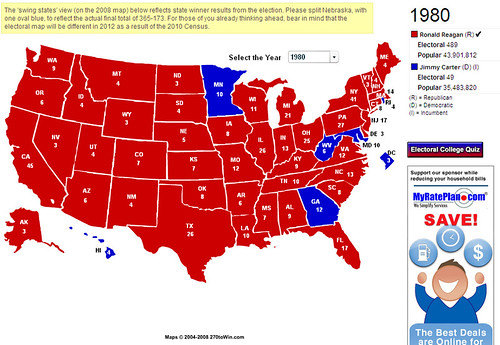
In 1980, Ronald Reagan won an electoral college landslide over Jimmy Carter of 489 to 49.

In 1984, Reagan won an even greater landslide against Walter Mondale, 525 electoral votes to 13.
 1988 was less overwhelming, but the senior Bush nonetheless won over Michael Dukakis by the the comfortable margin of 426 electoral votes to 112. Democrats were developing the reputation (in the words of David Barry) of not being qualified to plug in an electric blanket, let alone win the Presidency. And Republicans developed what every conservative professes to hate the most -- a sense of entitlement. In particular, they developed a sense of entitlement to the Presidency and to assume that the sorts of electoral landslides that had gotten as a matter of routine in the 1980's would be theirs forever. This sense was strengthened when the senior Bush fought the Gulf War, 1990-1991 against the advice of many Democrats, made a quick and easy victory, and seemed invulnerable going into the 1992. Then a recession hit and the Democrats won.
It should be noted, by the way, that what brought Ronald Reagan to power was the stagflation of the 1970's -- a combination of a weak economy and double digit inflation. Reagan agreed to back Paul Volcker of the Federal Reserve in the painful but necessary measure necessary to break the inflationary spiral -- tightening the money supply, no matter how painful, until inflation cried uncle. With Reagan's backing, Volcker put the squeeze on the economy, raising interest rates as high as 20%, and throwing the economy into a severe recession. But the inflationary spiral was broken. As soon as Volcker was satisfied that inflation was under control, he let up on the brakes, and the economy quickly rebounded. It was at the very peak of growth (returning to capacity) at the time of the 1984 election. I recall well at the time that George Will mocked overly enthusiastic Republicans who thought that Reagan has repealed the laws of business cycles and that we would have prosperity forever. And, indeed, no one came right out and said so, but certainly the implied promise was that, after suffering so severe a recession in 1981-1982, we would be rewarded by never experiencing one again. As long as this appeared to be the case, Republicans continued to win the Presidency by landslides. But inevitably, recession reared its ugly head again, people were shocked to realize that the business cycle was still with us, and Clinton won. Republicans dismissed his victory as an anomaly because Ross Perot was running a third party candidacy. Republicans presumed that every vote for Perot would otherwise have gone to a Republican and were therefore able to dismiss Clinton's victories in 1992 and 1996 as illegitimate, because he never won a popular majority.

In 2000, the junior Bush won a razor-thin electoral majority of 271-267 and actually narrowly lost the popular vote. But because the states that went for Bush were less densely populated than the ones that voted for Gore, they were geographically larger, and electoral maps created a misleading impression of a strong Bush majority.
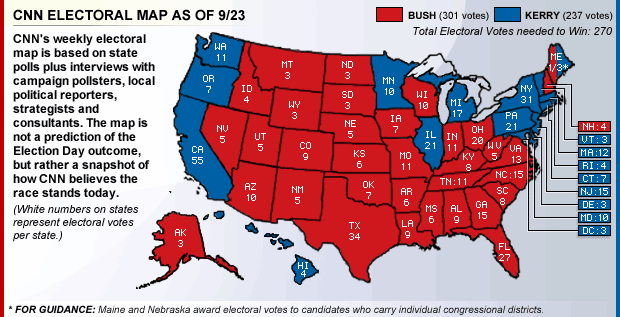 In 2004, Bush did win the popular vote and had a more comfortable electoral margin of 301-237. But, once again, geography was misleading, and his advantage in rural areas made his margin of victory look much wider than it really was. Thus, although Republicans should have recognized that their glory days of the 1980's were long gone, they looked at the electoral map and saw a landslide.
 In 2008, the country suffered its worst financial crisis since the Great Depression, and, unsurprisingly, the incumbent party lost. Obama got an absolute popular majority a strong electoral college victory of 375-163. The peculiarities of geography made this victory appear less than it was, but the impression of an overwhelming red state majority was no longer possible to maintain. Republicans still refused to accept the results. Just as the 1990's wins of Bill Clinton could be dismissed as anomalies because Ross Perot's third party candidacy skewed the results, Obama's 2008 victory could be dismissed as an anomaly because of an economic crisis and unrealistic expectations as to what he could do about it. Republicans assumed that if they only held the line for four years, the natural order would reassert itself, and the would once again hold the White House, as was their right. They could still dismiss three of the last five Presidential elections a anomalies that would not be repeated.
 Then 2012 struck. This election was not so easy to dismiss as an anomaly. This time there was no third party candidate to skew the results. The economy was lackluster. And yet, the Democrat won once again. Furthermore, the electoral map was vary similar to the last one, suggesting that a stable coalition was in place. The contrast to what certain Republican pollsters had been predicting was stunning.
What happened, so far as I can tell, was that the Democrats won an election under unfavorable circumstances, one that cannot be explained away by a third party candidate or an economic crisis. And suddenly Republicans are beginning to recognized that their landslides of the 1980's are over for the foreseeable future. Worse yet, they are beginning to come to grips with the fact that the presence of a Democrat in the White House is not some sort of bizarre anomaly, or an outrage against the natural order, but a normal occurrence.
If they are able to assimilate that into the world view, then we may, indeed, begin to see the beginning of the decline of the madness. At least I can hope.
It was never any mystery to me why Republicans hated Bill Clinton so much. He was a Democrat and he was President. Nothing more was needed.
In 1980, Ronald Reagan won an electoral college landslide over Jimmy Carter of 489 to 49.
In 1984, Reagan won an even greater landslide against Walter Mondale, 525 electoral votes to 13.
It should be noted, by the way, that what brought Ronald Reagan to power was the stagflation of the 1970's -- a combination of a weak economy and double digit inflation. Reagan agreed to back Paul Volcker of the Federal Reserve in the painful but necessary measure necessary to break the inflationary spiral -- tightening the money supply, no matter how painful, until inflation cried uncle. With Reagan's backing, Volcker put the squeeze on the economy, raising interest rates as high as 20%, and throwing the economy into a severe recession. But the inflationary spiral was broken. As soon as Volcker was satisfied that inflation was under control, he let up on the brakes, and the economy quickly rebounded. It was at the very peak of growth (returning to capacity) at the time of the 1984 election. I recall well at the time that George Will mocked overly enthusiastic Republicans who thought that Reagan has repealed the laws of business cycles and that we would have prosperity forever. And, indeed, no one came right out and said so, but certainly the implied promise was that, after suffering so severe a recession in 1981-1982, we would be rewarded by never experiencing one again. As long as this appeared to be the case, Republicans continued to win the Presidency by landslides. But inevitably, recession reared its ugly head again, people were shocked to realize that the business cycle was still with us, and Clinton won. Republicans dismissed his victory as an anomaly because Ross Perot was running a third party candidacy. Republicans presumed that every vote for Perot would otherwise have gone to a Republican and were therefore able to dismiss Clinton's victories in 1992 and 1996 as illegitimate, because he never won a popular majority.
In 2000, the junior Bush won a razor-thin electoral majority of 271-267 and actually narrowly lost the popular vote. But because the states that went for Bush were less densely populated than the ones that voted for Gore, they were geographically larger, and electoral maps created a misleading impression of a strong Bush majority.
 Electoral map by the Examiner, predicting a Romney landslide
What happened, so far as I can tell, was that the Democrats won an election under unfavorable circumstances, one that cannot be explained away by a third party candidate or an economic crisis. And suddenly Republicans are beginning to recognized that their landslides of the 1980's are over for the foreseeable future. Worse yet, they are beginning to come to grips with the fact that the presence of a Democrat in the White House is not some sort of bizarre anomaly, or an outrage against the natural order, but a normal occurrence.
If they are able to assimilate that into the world view, then we may, indeed, begin to see the beginning of the decline of the madness. At least I can hope.
Since I Can't Get Away from my Favorite Topic
Well, I said I had done my last post on the election, but it just won't go away. The latest: Mitt Romney's teleconference with donors in which he said that people voted for Obama because they were bribed. As many have commented, this bears a remarkable resemblance to his earlier comment to donors that 47% of the population would never take personal responsibility and care for their lives. The general assumption seems to be that saying it once might just be pandering to donors, but now Romney has said it twice, so he must really mean it.
I will make two comments on this. One is that although I will not presume to say what (if anything) Romney does or does not believe, obviously he thinks this is what Republican donors want to hear. Given Romney's closeness to the Republican donor class, it seems safe to assume that his belief is accurate. The other is that he makes at least some attempt to explain normal people to his donors. So I suppose this counts a little in his favor. In any event, regardless of what Romney thinks, this appears to be what Republican donors think. I don't want to give power to any party beholden to donors who hold so many of their countrymen in such contempt.
I will make two comments on this. One is that although I will not presume to say what (if anything) Romney does or does not believe, obviously he thinks this is what Republican donors want to hear. Given Romney's closeness to the Republican donor class, it seems safe to assume that his belief is accurate. The other is that he makes at least some attempt to explain normal people to his donors. So I suppose this counts a little in his favor. In any event, regardless of what Romney thinks, this appears to be what Republican donors think. I don't want to give power to any party beholden to donors who hold so many of their countrymen in such contempt.
Sunday, November 11, 2012
Back to False Memory, pp, 416-543 (with omissions)
But enough distractions with trivial matters like the election. It it time to turn back to more important things like False Memory. When we last left our heroes, Dusty and Martie, they had just rushed Dusty's younger brother, Skeet, out of the New Life Clinic before the evil Dr. Ahriman had the opportunity to program him to commit suicide. Ahriman saw their car speeding away and recognized from the look on Dusty's face that he knew what was going on.
Dusty and Martie take Skeet to stay with Foster (Fig) Newton, weird misfit who also paints houses for Dusty.* Fig says very little, but goes around all day plugged into a radio like an "electronic IV bottle" listening to radio shows about "UFO's, alien abductions telephone messages from the dead, fourth-dimensional beings and Big Foot." His trailer has a satellite dish to pick up UFO signals. Inside, it is full of TV and computer screens full of mysterious data, tracking equipment, and charts. He keeps a bedroom stacked with books about all the sorts of things Skeptical Inquirer likes debunking. In short, Fig is too paranoid even for Dean Koontz. This makes him the perfect choice to babysit Skeet. Granted, when Dusty first says Skeet may be in danger, Fig jumps to the rational conclusion that some drug dealer is after him. But he has no trouble at all believing their stories about brain washing and mind control. He is only disappointed that the villains are not aliens, cross-dimensional beings, or even government. But he guesses right the fourth time, that it is the American Psychological Association. When they ask you he guessed, he says there are only five possible suspects. The fifth is Bill Gates.**
Dusty tells Fig not to bother going to work, since everything is soaked from the rain anyhow, just keep Skeet and Valet the dog safe and out of sight. (Presumably Dusty will pay Fig for his babysitting services). Dusty and Martie are going to Santa Fe to talk to Dr. Ahriman's victims there. They deprogram Skeet, leaving him with only one program -- stop taking drugs! Fig looks on, not in the least surprised by what he sees. He also gives them a toy truck to hide their gun in so they can get it past airport security.
Dusty and Martie check into a hotel near the airport, read over Closterman's file on Ahriman's Santa Fe victims, deprogram each other, and make love. Oddly enough, although no graphic details were given, I really didn't want to know about that last. I am not sure why. Dusty and Martie are husband and wife, after all. Presumably they have relations quite regularly. So why don't I want to know about it? Maybe I just want to give them some privacy. Maybe because what we have seen about their marriage makes clear that it is about so much more than sex. Or maybe it is because thus far sex has only entered the story in the form of rape and various depravities, so that I have trouble even processing the idea of regular sex anymore.
Meanwhile, Dr. Ahriman, who has made a duplicate key to their house, goes over to see how they figured out what was going on. He sees the note from Closterman and hears Susan's message identifying him as her rapist. Their phone also has a message from the travel company, confirming their reservations to Santa Fe. He destroys the tape, calls an unnamed person under his control, who is activated by the name "Ed Mavole" and gives instructions to burn the house down. (Tum dum dum! Watch this mysterious person. This will not be the last). He also notifies his backers in Santa Fe that Dusty and Martie will be out and investigating, and to let them go if they don't uncover anything, but kill them if they Get Too Close. Here we get to hear the details that Ahriman is part of a larger conspiracy, that he perfected mind control techniques for the others and taught it to them, that the conspiracy exercises power behind the scenes, and that it allows Ahriman to use his mind control powers for personal entertainment, while others are forbidden from doing so on pain of being fed to the crocodiles (in Santa Fe?!). We also learn that Ahriman is worried that his backers might find out just how far he is carrying his private games and be displeased. Whether this is a crocodiles-level displeasure or not is not made clear. We also get to see more senseless and extraneous preening and posturing about how evil he is, that i once again omit.
I will add here that I really don't understand the purpose of the institute in Santa Fe and what it is supposed to add to the story. We have been dealing with Ahriman alone up until Closterman mentioned being intimidated by thugs that reeked of authority. The institute is about to play a major part in Dusty and Martie's adventures in Santa Fe, and then disappear again as we return to a private feud with Ahriman. I am not sure why Koontz bothered at all, except perhaps to add a few standard action-adventure scenes to pad the story out. If I were rewriting the book, I would be inclined to leave them out altogether and focus solely on the characters and their very personal conflict with Ahriman.
Anyhow, Dusty and Martie fly to Santa Fe in the winter with their gun-in-truck smuggled in in their carryon. (This was before 9-11, but after airport security had been ramped up due to terrorist attacks in other countries). They interview various Ahriman victims. One of them shows them the Bellon-Tockland Institute, Ahriman's backer. It is a mysterious, super-secret, highly fortified compound, with the stated mission of "Applying the latest discoveries in psychology and psychoparmacology to design more equitable and stable structural models for government, business, culture, and society as a whole, which will contribute to a clean environment a more reliable system of justice, the fulfillment of human potential, and world peace." To Dusty, this sounds a lot like brainwashing.
Obviously, they are Getting Too Close, so some Bellon-Tockland thugs put down a spike strip in a remote area to cut their tires, and take them captive for a "hump and dump" operation. They throw Dusty in the trunk, but keep Martie in the back seat because she is the prospective humpee. The dump will take place at an old, abandoned Indian well. When they reach their destination, Martie pulls the gun they smuggled in the truck. She tries to talk her way out without killing anyone, but the thugs reach for their machine pistols, so Martie has no choice but to shoot and kill them. She and Dusty drop the bodies down the well, bury the gun, and drive to Albuquerque, where they park the car in a quiet side street, drop the keys down the storm sewer, and check into a cheap motel that accepts cash. They buy sandwich materials and beer, to help them sleep. (Again with the alcohol! But this is its last appearance in the book). They take long showers, and don't make love. (And, once again, I really don't want to hear about it). They discuss whether they are willing to kill Ahriman, and whether the Bellon-Tockland Institute would come after them. But in the end, they are not ready to kill him, not yet.
I have breezed through this part quickly, particularly the adventures in Santa Fe, because it does not fit very well. The B-T Institute, the secret conspiracy, the hired thugs and so forth don't really feel like part of the story at all. The proper story is about Ahriman and his victims. This part is a detour that the story on the whole would be better without. It does serve one useful purpose, however. It gets Dusty and Martie out of the picture long enough to allow a comic and entertaining section, with Ahriman changing roles from shadowy figure or annoyingly excessive villain to a comic villain. That can be kind of fun, as we will see in my next post on the subject.
Dusty and Martie take Skeet to stay with Foster (Fig) Newton, weird misfit who also paints houses for Dusty.* Fig says very little, but goes around all day plugged into a radio like an "electronic IV bottle" listening to radio shows about "UFO's, alien abductions telephone messages from the dead, fourth-dimensional beings and Big Foot." His trailer has a satellite dish to pick up UFO signals. Inside, it is full of TV and computer screens full of mysterious data, tracking equipment, and charts. He keeps a bedroom stacked with books about all the sorts of things Skeptical Inquirer likes debunking. In short, Fig is too paranoid even for Dean Koontz. This makes him the perfect choice to babysit Skeet. Granted, when Dusty first says Skeet may be in danger, Fig jumps to the rational conclusion that some drug dealer is after him. But he has no trouble at all believing their stories about brain washing and mind control. He is only disappointed that the villains are not aliens, cross-dimensional beings, or even government. But he guesses right the fourth time, that it is the American Psychological Association. When they ask you he guessed, he says there are only five possible suspects. The fifth is Bill Gates.**
Dusty tells Fig not to bother going to work, since everything is soaked from the rain anyhow, just keep Skeet and Valet the dog safe and out of sight. (Presumably Dusty will pay Fig for his babysitting services). Dusty and Martie are going to Santa Fe to talk to Dr. Ahriman's victims there. They deprogram Skeet, leaving him with only one program -- stop taking drugs! Fig looks on, not in the least surprised by what he sees. He also gives them a toy truck to hide their gun in so they can get it past airport security.
Dusty and Martie check into a hotel near the airport, read over Closterman's file on Ahriman's Santa Fe victims, deprogram each other, and make love. Oddly enough, although no graphic details were given, I really didn't want to know about that last. I am not sure why. Dusty and Martie are husband and wife, after all. Presumably they have relations quite regularly. So why don't I want to know about it? Maybe I just want to give them some privacy. Maybe because what we have seen about their marriage makes clear that it is about so much more than sex. Or maybe it is because thus far sex has only entered the story in the form of rape and various depravities, so that I have trouble even processing the idea of regular sex anymore.
Meanwhile, Dr. Ahriman, who has made a duplicate key to their house, goes over to see how they figured out what was going on. He sees the note from Closterman and hears Susan's message identifying him as her rapist. Their phone also has a message from the travel company, confirming their reservations to Santa Fe. He destroys the tape, calls an unnamed person under his control, who is activated by the name "Ed Mavole" and gives instructions to burn the house down. (Tum dum dum! Watch this mysterious person. This will not be the last). He also notifies his backers in Santa Fe that Dusty and Martie will be out and investigating, and to let them go if they don't uncover anything, but kill them if they Get Too Close. Here we get to hear the details that Ahriman is part of a larger conspiracy, that he perfected mind control techniques for the others and taught it to them, that the conspiracy exercises power behind the scenes, and that it allows Ahriman to use his mind control powers for personal entertainment, while others are forbidden from doing so on pain of being fed to the crocodiles (in Santa Fe?!). We also learn that Ahriman is worried that his backers might find out just how far he is carrying his private games and be displeased. Whether this is a crocodiles-level displeasure or not is not made clear. We also get to see more senseless and extraneous preening and posturing about how evil he is, that i once again omit.
I will add here that I really don't understand the purpose of the institute in Santa Fe and what it is supposed to add to the story. We have been dealing with Ahriman alone up until Closterman mentioned being intimidated by thugs that reeked of authority. The institute is about to play a major part in Dusty and Martie's adventures in Santa Fe, and then disappear again as we return to a private feud with Ahriman. I am not sure why Koontz bothered at all, except perhaps to add a few standard action-adventure scenes to pad the story out. If I were rewriting the book, I would be inclined to leave them out altogether and focus solely on the characters and their very personal conflict with Ahriman.
Anyhow, Dusty and Martie fly to Santa Fe in the winter with their gun-in-truck smuggled in in their carryon. (This was before 9-11, but after airport security had been ramped up due to terrorist attacks in other countries). They interview various Ahriman victims. One of them shows them the Bellon-Tockland Institute, Ahriman's backer. It is a mysterious, super-secret, highly fortified compound, with the stated mission of "Applying the latest discoveries in psychology and psychoparmacology to design more equitable and stable structural models for government, business, culture, and society as a whole, which will contribute to a clean environment a more reliable system of justice, the fulfillment of human potential, and world peace." To Dusty, this sounds a lot like brainwashing.
Obviously, they are Getting Too Close, so some Bellon-Tockland thugs put down a spike strip in a remote area to cut their tires, and take them captive for a "hump and dump" operation. They throw Dusty in the trunk, but keep Martie in the back seat because she is the prospective humpee. The dump will take place at an old, abandoned Indian well. When they reach their destination, Martie pulls the gun they smuggled in the truck. She tries to talk her way out without killing anyone, but the thugs reach for their machine pistols, so Martie has no choice but to shoot and kill them. She and Dusty drop the bodies down the well, bury the gun, and drive to Albuquerque, where they park the car in a quiet side street, drop the keys down the storm sewer, and check into a cheap motel that accepts cash. They buy sandwich materials and beer, to help them sleep. (Again with the alcohol! But this is its last appearance in the book). They take long showers, and don't make love. (And, once again, I really don't want to hear about it). They discuss whether they are willing to kill Ahriman, and whether the Bellon-Tockland Institute would come after them. But in the end, they are not ready to kill him, not yet.
I have breezed through this part quickly, particularly the adventures in Santa Fe, because it does not fit very well. The B-T Institute, the secret conspiracy, the hired thugs and so forth don't really feel like part of the story at all. The proper story is about Ahriman and his victims. This part is a detour that the story on the whole would be better without. It does serve one useful purpose, however. It gets Dusty and Martie out of the picture long enough to allow a comic and entertaining section, with Ahriman changing roles from shadowy figure or annoyingly excessive villain to a comic villain. That can be kind of fun, as we will see in my next post on the subject.
Subscribe to:
Posts (Atom)