Well, I said I had done my last post on the election, but it just won't go away. The latest: Mitt Romney's teleconference with donors in which he said that people voted for Obama because they were bribed. As many have commented, this bears a remarkable resemblance to his earlier comment to donors that 47% of the population would never take personal responsibility and care for their lives. The general assumption seems to be that saying it once might just be pandering to donors, but now Romney has said it twice, so he must really mean it.
I will make two comments on this. One is that although I will not presume to say what (if anything) Romney does or does not believe, obviously he thinks this is what Republican donors want to hear. Given Romney's closeness to the Republican donor class, it seems safe to assume that his belief is accurate. The other is that he makes at least some attempt to explain normal people to his donors. So I suppose this counts a little in his favor. In any event, regardless of what Romney thinks, this appears to be what Republican donors think. I don't want to give power to any party beholden to donors who hold so many of their countrymen in such contempt.
Saturday, November 17, 2012

Sunday, November 11, 2012
Back to False Memory, pp, 416-543 (with omissions)
But enough distractions with trivial matters like the election. It it time to turn back to more important things like False Memory. When we last left our heroes, Dusty and Martie, they had just rushed Dusty's younger brother, Skeet, out of the New Life Clinic before the evil Dr. Ahriman had the opportunity to program him to commit suicide. Ahriman saw their car speeding away and recognized from the look on Dusty's face that he knew what was going on.
Dusty and Martie take Skeet to stay with Foster (Fig) Newton, weird misfit who also paints houses for Dusty.* Fig says very little, but goes around all day plugged into a radio like an "electronic IV bottle" listening to radio shows about "UFO's, alien abductions telephone messages from the dead, fourth-dimensional beings and Big Foot." His trailer has a satellite dish to pick up UFO signals. Inside, it is full of TV and computer screens full of mysterious data, tracking equipment, and charts. He keeps a bedroom stacked with books about all the sorts of things Skeptical Inquirer likes debunking. In short, Fig is too paranoid even for Dean Koontz. This makes him the perfect choice to babysit Skeet. Granted, when Dusty first says Skeet may be in danger, Fig jumps to the rational conclusion that some drug dealer is after him. But he has no trouble at all believing their stories about brain washing and mind control. He is only disappointed that the villains are not aliens, cross-dimensional beings, or even government. But he guesses right the fourth time, that it is the American Psychological Association. When they ask you he guessed, he says there are only five possible suspects. The fifth is Bill Gates.**
Dusty tells Fig not to bother going to work, since everything is soaked from the rain anyhow, just keep Skeet and Valet the dog safe and out of sight. (Presumably Dusty will pay Fig for his babysitting services). Dusty and Martie are going to Santa Fe to talk to Dr. Ahriman's victims there. They deprogram Skeet, leaving him with only one program -- stop taking drugs! Fig looks on, not in the least surprised by what he sees. He also gives them a toy truck to hide their gun in so they can get it past airport security.
Dusty and Martie check into a hotel near the airport, read over Closterman's file on Ahriman's Santa Fe victims, deprogram each other, and make love. Oddly enough, although no graphic details were given, I really didn't want to know about that last. I am not sure why. Dusty and Martie are husband and wife, after all. Presumably they have relations quite regularly. So why don't I want to know about it? Maybe I just want to give them some privacy. Maybe because what we have seen about their marriage makes clear that it is about so much more than sex. Or maybe it is because thus far sex has only entered the story in the form of rape and various depravities, so that I have trouble even processing the idea of regular sex anymore.
Meanwhile, Dr. Ahriman, who has made a duplicate key to their house, goes over to see how they figured out what was going on. He sees the note from Closterman and hears Susan's message identifying him as her rapist. Their phone also has a message from the travel company, confirming their reservations to Santa Fe. He destroys the tape, calls an unnamed person under his control, who is activated by the name "Ed Mavole" and gives instructions to burn the house down. (Tum dum dum! Watch this mysterious person. This will not be the last). He also notifies his backers in Santa Fe that Dusty and Martie will be out and investigating, and to let them go if they don't uncover anything, but kill them if they Get Too Close. Here we get to hear the details that Ahriman is part of a larger conspiracy, that he perfected mind control techniques for the others and taught it to them, that the conspiracy exercises power behind the scenes, and that it allows Ahriman to use his mind control powers for personal entertainment, while others are forbidden from doing so on pain of being fed to the crocodiles (in Santa Fe?!). We also learn that Ahriman is worried that his backers might find out just how far he is carrying his private games and be displeased. Whether this is a crocodiles-level displeasure or not is not made clear. We also get to see more senseless and extraneous preening and posturing about how evil he is, that i once again omit.
I will add here that I really don't understand the purpose of the institute in Santa Fe and what it is supposed to add to the story. We have been dealing with Ahriman alone up until Closterman mentioned being intimidated by thugs that reeked of authority. The institute is about to play a major part in Dusty and Martie's adventures in Santa Fe, and then disappear again as we return to a private feud with Ahriman. I am not sure why Koontz bothered at all, except perhaps to add a few standard action-adventure scenes to pad the story out. If I were rewriting the book, I would be inclined to leave them out altogether and focus solely on the characters and their very personal conflict with Ahriman.
Anyhow, Dusty and Martie fly to Santa Fe in the winter with their gun-in-truck smuggled in in their carryon. (This was before 9-11, but after airport security had been ramped up due to terrorist attacks in other countries). They interview various Ahriman victims. One of them shows them the Bellon-Tockland Institute, Ahriman's backer. It is a mysterious, super-secret, highly fortified compound, with the stated mission of "Applying the latest discoveries in psychology and psychoparmacology to design more equitable and stable structural models for government, business, culture, and society as a whole, which will contribute to a clean environment a more reliable system of justice, the fulfillment of human potential, and world peace." To Dusty, this sounds a lot like brainwashing.
Obviously, they are Getting Too Close, so some Bellon-Tockland thugs put down a spike strip in a remote area to cut their tires, and take them captive for a "hump and dump" operation. They throw Dusty in the trunk, but keep Martie in the back seat because she is the prospective humpee. The dump will take place at an old, abandoned Indian well. When they reach their destination, Martie pulls the gun they smuggled in the truck. She tries to talk her way out without killing anyone, but the thugs reach for their machine pistols, so Martie has no choice but to shoot and kill them. She and Dusty drop the bodies down the well, bury the gun, and drive to Albuquerque, where they park the car in a quiet side street, drop the keys down the storm sewer, and check into a cheap motel that accepts cash. They buy sandwich materials and beer, to help them sleep. (Again with the alcohol! But this is its last appearance in the book). They take long showers, and don't make love. (And, once again, I really don't want to hear about it). They discuss whether they are willing to kill Ahriman, and whether the Bellon-Tockland Institute would come after them. But in the end, they are not ready to kill him, not yet.
I have breezed through this part quickly, particularly the adventures in Santa Fe, because it does not fit very well. The B-T Institute, the secret conspiracy, the hired thugs and so forth don't really feel like part of the story at all. The proper story is about Ahriman and his victims. This part is a detour that the story on the whole would be better without. It does serve one useful purpose, however. It gets Dusty and Martie out of the picture long enough to allow a comic and entertaining section, with Ahriman changing roles from shadowy figure or annoyingly excessive villain to a comic villain. That can be kind of fun, as we will see in my next post on the subject.
Dusty and Martie take Skeet to stay with Foster (Fig) Newton, weird misfit who also paints houses for Dusty.* Fig says very little, but goes around all day plugged into a radio like an "electronic IV bottle" listening to radio shows about "UFO's, alien abductions telephone messages from the dead, fourth-dimensional beings and Big Foot." His trailer has a satellite dish to pick up UFO signals. Inside, it is full of TV and computer screens full of mysterious data, tracking equipment, and charts. He keeps a bedroom stacked with books about all the sorts of things Skeptical Inquirer likes debunking. In short, Fig is too paranoid even for Dean Koontz. This makes him the perfect choice to babysit Skeet. Granted, when Dusty first says Skeet may be in danger, Fig jumps to the rational conclusion that some drug dealer is after him. But he has no trouble at all believing their stories about brain washing and mind control. He is only disappointed that the villains are not aliens, cross-dimensional beings, or even government. But he guesses right the fourth time, that it is the American Psychological Association. When they ask you he guessed, he says there are only five possible suspects. The fifth is Bill Gates.**
Dusty tells Fig not to bother going to work, since everything is soaked from the rain anyhow, just keep Skeet and Valet the dog safe and out of sight. (Presumably Dusty will pay Fig for his babysitting services). Dusty and Martie are going to Santa Fe to talk to Dr. Ahriman's victims there. They deprogram Skeet, leaving him with only one program -- stop taking drugs! Fig looks on, not in the least surprised by what he sees. He also gives them a toy truck to hide their gun in so they can get it past airport security.
Dusty and Martie check into a hotel near the airport, read over Closterman's file on Ahriman's Santa Fe victims, deprogram each other, and make love. Oddly enough, although no graphic details were given, I really didn't want to know about that last. I am not sure why. Dusty and Martie are husband and wife, after all. Presumably they have relations quite regularly. So why don't I want to know about it? Maybe I just want to give them some privacy. Maybe because what we have seen about their marriage makes clear that it is about so much more than sex. Or maybe it is because thus far sex has only entered the story in the form of rape and various depravities, so that I have trouble even processing the idea of regular sex anymore.
Meanwhile, Dr. Ahriman, who has made a duplicate key to their house, goes over to see how they figured out what was going on. He sees the note from Closterman and hears Susan's message identifying him as her rapist. Their phone also has a message from the travel company, confirming their reservations to Santa Fe. He destroys the tape, calls an unnamed person under his control, who is activated by the name "Ed Mavole" and gives instructions to burn the house down. (Tum dum dum! Watch this mysterious person. This will not be the last). He also notifies his backers in Santa Fe that Dusty and Martie will be out and investigating, and to let them go if they don't uncover anything, but kill them if they Get Too Close. Here we get to hear the details that Ahriman is part of a larger conspiracy, that he perfected mind control techniques for the others and taught it to them, that the conspiracy exercises power behind the scenes, and that it allows Ahriman to use his mind control powers for personal entertainment, while others are forbidden from doing so on pain of being fed to the crocodiles (in Santa Fe?!). We also learn that Ahriman is worried that his backers might find out just how far he is carrying his private games and be displeased. Whether this is a crocodiles-level displeasure or not is not made clear. We also get to see more senseless and extraneous preening and posturing about how evil he is, that i once again omit.
I will add here that I really don't understand the purpose of the institute in Santa Fe and what it is supposed to add to the story. We have been dealing with Ahriman alone up until Closterman mentioned being intimidated by thugs that reeked of authority. The institute is about to play a major part in Dusty and Martie's adventures in Santa Fe, and then disappear again as we return to a private feud with Ahriman. I am not sure why Koontz bothered at all, except perhaps to add a few standard action-adventure scenes to pad the story out. If I were rewriting the book, I would be inclined to leave them out altogether and focus solely on the characters and their very personal conflict with Ahriman.
Anyhow, Dusty and Martie fly to Santa Fe in the winter with their gun-in-truck smuggled in in their carryon. (This was before 9-11, but after airport security had been ramped up due to terrorist attacks in other countries). They interview various Ahriman victims. One of them shows them the Bellon-Tockland Institute, Ahriman's backer. It is a mysterious, super-secret, highly fortified compound, with the stated mission of "Applying the latest discoveries in psychology and psychoparmacology to design more equitable and stable structural models for government, business, culture, and society as a whole, which will contribute to a clean environment a more reliable system of justice, the fulfillment of human potential, and world peace." To Dusty, this sounds a lot like brainwashing.
Obviously, they are Getting Too Close, so some Bellon-Tockland thugs put down a spike strip in a remote area to cut their tires, and take them captive for a "hump and dump" operation. They throw Dusty in the trunk, but keep Martie in the back seat because she is the prospective humpee. The dump will take place at an old, abandoned Indian well. When they reach their destination, Martie pulls the gun they smuggled in the truck. She tries to talk her way out without killing anyone, but the thugs reach for their machine pistols, so Martie has no choice but to shoot and kill them. She and Dusty drop the bodies down the well, bury the gun, and drive to Albuquerque, where they park the car in a quiet side street, drop the keys down the storm sewer, and check into a cheap motel that accepts cash. They buy sandwich materials and beer, to help them sleep. (Again with the alcohol! But this is its last appearance in the book). They take long showers, and don't make love. (And, once again, I really don't want to hear about it). They discuss whether they are willing to kill Ahriman, and whether the Bellon-Tockland Institute would come after them. But in the end, they are not ready to kill him, not yet.
I have breezed through this part quickly, particularly the adventures in Santa Fe, because it does not fit very well. The B-T Institute, the secret conspiracy, the hired thugs and so forth don't really feel like part of the story at all. The proper story is about Ahriman and his victims. This part is a detour that the story on the whole would be better without. It does serve one useful purpose, however. It gets Dusty and Martie out of the picture long enough to allow a comic and entertaining section, with Ahriman changing roles from shadowy figure or annoyingly excessive villain to a comic villain. That can be kind of fun, as we will see in my next post on the subject.
A Few Final Reflections on the Election
We are now hearing a lot of reports on how badly the Romney ground game was run, compared to Obama's highly efficient one. Comments one:
I will also say that at the time Obama announced the contraceptive mandate it seemed like a huge mistake. He had exempted churches from the mandate, why not exempt church-affiliated organizations (like schools and hospitals) as well? Obamacare is controversial enough already. Why court more controversy unnecessarily? But actually the decision seems to be working well for him. Taking one controversial action has served as a lightening rod, attracting all opposition to this one, fairly minor portion of the law. Opposition to the rest of it has been largely forgotten.
While the Romney campaign waited for Orca to function as planned, the Obama campaign had placed signs outside every one of the city's thirty-three polling places, and was fully staffed with two volunteers outside each polling place, and a strike list volunteer inside, all day long from 6 a.m. to 7 p.m.Apparently, there are some things community organizers are better at running than CEO's. A get-out-the vote effort is one of them. That was what convinced me during the last election that Obama had the executive ability to be President. Of course, just as being able to run a corporation well does not necessarily translate into running a campaign well, being able to run a campaign well does not necessarily translate into running a government well. I have been underwhelmed by Obama's governing style. But it it yet one more point of evidence that running a company well is no proof of the ability to run a government well.
I will also say that at the time Obama announced the contraceptive mandate it seemed like a huge mistake. He had exempted churches from the mandate, why not exempt church-affiliated organizations (like schools and hospitals) as well? Obamacare is controversial enough already. Why court more controversy unnecessarily? But actually the decision seems to be working well for him. Taking one controversial action has served as a lightening rod, attracting all opposition to this one, fairly minor portion of the law. Opposition to the rest of it has been largely forgotten.
Saturday, November 10, 2012
Why I Didn't Throw Away my Vote on Johnson
Well, I had hoped to finish up on Johnson before the election, but life intervened, so here we are.
Conor Friedersdorf regards Obama's drone strikes (whose power to terrorize and disrupt lives means that their effect go far beyond the people killed), his willingness to include a U.S. citizen among the targets, his war in Libya without congressional authorization, his crackdown on whistle blowers, and his continuation and normalization of Bush's worst civil liberties violations as absolute deal breakers. At the same time, he certainly has no illusion that Romney would be any better. And I basically agree. These are not trivial issues. These are the primary reason I so fiercely opposed George Bush. And Obama has continued them. Johnson opposes all of these. He has none of Ron Paul's alarming baggage. And I thought (at least during the Bush Presidency) that these were the most important issues to me. So I should vote for Johnson. And yet . . .
And yet Johnson is yet another businessman who thinks that the principles of running a business translate into a national economy. He is mistaken. He favors balancing the budget overnight and keeping the Federal Reserve from fighting economic downturns by monetary expansion. He may even favor a precious metal standard. I disagree with Josh Barro, who appears to dismiss the War on Terror and civil liberties concerns as trivial compared to the economy, but neither am I prepared to dismiss the economy as trivial either. And I agree with Barro that the economy is a moral issue, that it is not moral to crucify mankind on a cross of gold, and (above all) that these things are not entirely separate, that policies that throw an economy into crisis encourage an angry, scapegoating mindset that is dangerous to freedom. And I agree with him that "'[D]on't worry, Congress will stop him' is not an argument you should have to make about your candidate for president."
Daniel Larison disagrees. He says that since obviously Johnson will not win, it is pointless to worry about what a hypothetical Johnson Administration would do. In fact, he is "puzzled" that anyone would worry about such a thing. A vote for Johnson is a protest vote, intended to send a signal that one rejects the bipartisan consensus in favor of perpetual war and unrestrained executive power. Who care about an economic agenda that would never be implemented. And besides the President has much more unilateral power over foreign policy and civil liberties than over domestic and economic policy. Then again, Larison appears to favor Johnson's fiscal policy as well. And I agree with Larison's debate partner that the problem with a third party protest vote is that, while it clearly signals some sort of protest, it is not always clear what you are protesting. Larison assumed that a vote for Johnson is a foreign policy protest vote, when Millman thought of it as a protest against the bipartisan consensus in favor of unlimited executive power and dismissal of civil liberties. But the establishment might just as well read it as a protest against the bipartisan consensus in favor of paper money and a call for a gold standard. (Larison appears to favor a Johnson protest vote both on foreign policy and fiscal policy).
And in the end I agree. Protest votes are useless unless they send a clear signal what you are protesting. So in the end, my view on Johnson is much the same as my view on Ron Paul. I am too craven to accept the wreckage of our domestic economy as the price to be paid for ending the madness in the War on Terror.
Conor Friedersdorf regards Obama's drone strikes (whose power to terrorize and disrupt lives means that their effect go far beyond the people killed), his willingness to include a U.S. citizen among the targets, his war in Libya without congressional authorization, his crackdown on whistle blowers, and his continuation and normalization of Bush's worst civil liberties violations as absolute deal breakers. At the same time, he certainly has no illusion that Romney would be any better. And I basically agree. These are not trivial issues. These are the primary reason I so fiercely opposed George Bush. And Obama has continued them. Johnson opposes all of these. He has none of Ron Paul's alarming baggage. And I thought (at least during the Bush Presidency) that these were the most important issues to me. So I should vote for Johnson. And yet . . .
And yet Johnson is yet another businessman who thinks that the principles of running a business translate into a national economy. He is mistaken. He favors balancing the budget overnight and keeping the Federal Reserve from fighting economic downturns by monetary expansion. He may even favor a precious metal standard. I disagree with Josh Barro, who appears to dismiss the War on Terror and civil liberties concerns as trivial compared to the economy, but neither am I prepared to dismiss the economy as trivial either. And I agree with Barro that the economy is a moral issue, that it is not moral to crucify mankind on a cross of gold, and (above all) that these things are not entirely separate, that policies that throw an economy into crisis encourage an angry, scapegoating mindset that is dangerous to freedom. And I agree with him that "'[D]on't worry, Congress will stop him' is not an argument you should have to make about your candidate for president."
Daniel Larison disagrees. He says that since obviously Johnson will not win, it is pointless to worry about what a hypothetical Johnson Administration would do. In fact, he is "puzzled" that anyone would worry about such a thing. A vote for Johnson is a protest vote, intended to send a signal that one rejects the bipartisan consensus in favor of perpetual war and unrestrained executive power. Who care about an economic agenda that would never be implemented. And besides the President has much more unilateral power over foreign policy and civil liberties than over domestic and economic policy. Then again, Larison appears to favor Johnson's fiscal policy as well. And I agree with Larison's debate partner that the problem with a third party protest vote is that, while it clearly signals some sort of protest, it is not always clear what you are protesting. Larison assumed that a vote for Johnson is a foreign policy protest vote, when Millman thought of it as a protest against the bipartisan consensus in favor of unlimited executive power and dismissal of civil liberties. But the establishment might just as well read it as a protest against the bipartisan consensus in favor of paper money and a call for a gold standard. (Larison appears to favor a Johnson protest vote both on foreign policy and fiscal policy).
And in the end I agree. Protest votes are useless unless they send a clear signal what you are protesting. So in the end, my view on Johnson is much the same as my view on Ron Paul. I am too craven to accept the wreckage of our domestic economy as the price to be paid for ending the madness in the War on Terror.
Friday, November 9, 2012
Reflections on the Election
First of all, in the words of Andrew Sullivan, meep, meep!
Next, I would be fine with either Obama making a narrow win in the popular vote and a decisive victory in the electoral college, or a narrow win in each. What I dreaded (besides a Republican victory, of course) was either a split with Obama winning the electoral college but not the popular vote. I expected the Republican reaction to such an outcome would be Donald Trumpian. And a prolonged stalemate while the votes in Ohio or (God forbid) Florida were endlessly recounted was more than I could bear. Fortunately, we seem to have been spared either eventuality.
Third, I hope that Republicans emerge with the narrative that they were just about to win when Hurricane Sandy delivered the October surprise that swung the election to Obama. It still won't seem fair, but claiming that Obama caused the hurricane sounds a little too crazy even for the Republican party faithful. I would much rather hear the party faithful blaming the unlucky timing of the hurricane for their defeat than accuse ACORN of rigging the election.*
If we are thinking about getting rid of the Electoral College, our voting system needs a lot of improvement.
It would be a mistake, I think, to read this election as a major realignment, rather than just another swing of the pendulum. People read the 2008 election as a major realignment and proclaimed that the end of the Republican Party was at hand. Republicans regrouped and rode a wave of alarm over Obama's perceived excesses (as well as a still languishing economy) to victory in 2010. Once again, people read the election as a major realignment and proclaimed that the end of the Democrats was at hand. Instead, people reacted against the perceived excesses of the Republicans. No doubt the pendulum will swing back again.
And finally, let's talk about Nate Silver, since everyone else is. Certainly during the dark days following the first debate, Nate Silver was my main source of comfort. And conservatives hated him because he told them what they did not want to hear. To counter Silver and the other wonks, conservatives came up with Unskewed Polls, which was supposed to remove the liberal bias from mainstream polling.
Republicans, from Romney on down, appear to have fallen for their own propaganda. At least, we are told, Romney had prepared a victory speech, but no concession speech. He had a website ready for the transition. And he was prepared to celebrate with a fireworks display.
But when the rubber hit the road, it turned out that Unskewed Polls was to Nate Silver what Fox News is to real news, what the Washington Times is to the Washington Post, what the Conservapedia is to the Wikipedia, and perhaps even what Qubetv aspired to be to You Tube. This has led some people to wonder whether the right wing will finally wake up to the realization that unpleasant realities don't go away just because you deny them; that when the math disagrees with your gut, it's because your gut is wrong. But let's face it. Human nature doesn't work that way.
The way I see it is this. The more remote, the more complex, and the more abstract the matter under dispute, the easier it is to be persuasive in denying unwelcome facts. Evolution, after all, took place over hundreds of millions of years and is not casually observable.** Global warming is frightfully complex and beyond most people's powers of observation. What most people know, after all, is their own local weather, which invariably has its ups and downs. Everything else is too remote to seem real. Claims that tax cuts reduce deficits may be disproven by the evidence, but the amount of the deficit is something abstract and unreal to most people, and so easy to disregard. But elections leave no such ambiguities. They happen in the near future, and the question of which candidate won is obvious enough to leave no room for debate. So ultimately calling an election wrong is impossible to miss. These others are easy to obfuscate, so Republicans will continue to do just that.
I will also make a comment on when Nate Silver gets it wrong. In 2008 he predicted Obama would win by 6.1 percentage points. He won by 7.2. He predicted every state except Indiana, which he predicted would go for McCain, but which narrowly went for Obama. In 2010, he predicted 34 of 36 Senate elections correctly. He incorrectly predicted that the Republican would win in Colorado. In fact, the Democrat won by a narrow margin. And he incorrectly called the Nevada election for Republican Sharon Angle by 3 percentage points, when in fact Harry Reid won by 5.5. Thus he predicted a 7 seat pickup for Republicans in the Senate, when it turned out to be only 6. He correctly predicted 36 out of 37 gubernatorial elections. The sole exception was in Illinois, where the Democrat defied his predictions by winning by half a percentage point. In the Senate, he called 31 out of 33 elections correctly. The exceptions were North Dakota, where the Democrat defied expectations by winning by one percentage point, and Montana, where the Democratic incumbent also defied Silver's predictions and won.
Do you see a pattern here? Silver's predictions are usually highly accurate. (1) He usually only gets it wrong in very close elections. (2) When he is wrong, it is usually in favor of the Republican.*** I can imagine three reasons why this might be. One is that the polls are slightly skewed in favor of Republicans. One is that his calculations slightly favor Republicans in close elections. And the third is that, when it is too close to call, he goes for the Republican. After all, so long as Silver incorrectly predicts Republicans will win close elections, the mistake can be dismissed as no one is perfect. If he ever incorrectly calls a race for the Democrat, that will be seized upon as proof of liberal bias.
___________________________________________________
*Difficult theological question for Republicans: If Obama's election was caused by an act of God, then who does that suggest God favored in this election?
**Except in the evolution of antibiotic-resistant bacteria, pesticide-resistant insects and so forth.
***An exception is in the House elections in 2010. Silver predicted a Republican gain of 53 seats. The actual figure was 63.
Next, I would be fine with either Obama making a narrow win in the popular vote and a decisive victory in the electoral college, or a narrow win in each. What I dreaded (besides a Republican victory, of course) was either a split with Obama winning the electoral college but not the popular vote. I expected the Republican reaction to such an outcome would be Donald Trumpian. And a prolonged stalemate while the votes in Ohio or (God forbid) Florida were endlessly recounted was more than I could bear. Fortunately, we seem to have been spared either eventuality.
Third, I hope that Republicans emerge with the narrative that they were just about to win when Hurricane Sandy delivered the October surprise that swung the election to Obama. It still won't seem fair, but claiming that Obama caused the hurricane sounds a little too crazy even for the Republican party faithful. I would much rather hear the party faithful blaming the unlucky timing of the hurricane for their defeat than accuse ACORN of rigging the election.*
If we are thinking about getting rid of the Electoral College, our voting system needs a lot of improvement.
It would be a mistake, I think, to read this election as a major realignment, rather than just another swing of the pendulum. People read the 2008 election as a major realignment and proclaimed that the end of the Republican Party was at hand. Republicans regrouped and rode a wave of alarm over Obama's perceived excesses (as well as a still languishing economy) to victory in 2010. Once again, people read the election as a major realignment and proclaimed that the end of the Democrats was at hand. Instead, people reacted against the perceived excesses of the Republicans. No doubt the pendulum will swing back again.
And finally, let's talk about Nate Silver, since everyone else is. Certainly during the dark days following the first debate, Nate Silver was my main source of comfort. And conservatives hated him because he told them what they did not want to hear. To counter Silver and the other wonks, conservatives came up with Unskewed Polls, which was supposed to remove the liberal bias from mainstream polling.
Republicans, from Romney on down, appear to have fallen for their own propaganda. At least, we are told, Romney had prepared a victory speech, but no concession speech. He had a website ready for the transition. And he was prepared to celebrate with a fireworks display.
But when the rubber hit the road, it turned out that Unskewed Polls was to Nate Silver what Fox News is to real news, what the Washington Times is to the Washington Post, what the Conservapedia is to the Wikipedia, and perhaps even what Qubetv aspired to be to You Tube. This has led some people to wonder whether the right wing will finally wake up to the realization that unpleasant realities don't go away just because you deny them; that when the math disagrees with your gut, it's because your gut is wrong. But let's face it. Human nature doesn't work that way.
The way I see it is this. The more remote, the more complex, and the more abstract the matter under dispute, the easier it is to be persuasive in denying unwelcome facts. Evolution, after all, took place over hundreds of millions of years and is not casually observable.** Global warming is frightfully complex and beyond most people's powers of observation. What most people know, after all, is their own local weather, which invariably has its ups and downs. Everything else is too remote to seem real. Claims that tax cuts reduce deficits may be disproven by the evidence, but the amount of the deficit is something abstract and unreal to most people, and so easy to disregard. But elections leave no such ambiguities. They happen in the near future, and the question of which candidate won is obvious enough to leave no room for debate. So ultimately calling an election wrong is impossible to miss. These others are easy to obfuscate, so Republicans will continue to do just that.
I will also make a comment on when Nate Silver gets it wrong. In 2008 he predicted Obama would win by 6.1 percentage points. He won by 7.2. He predicted every state except Indiana, which he predicted would go for McCain, but which narrowly went for Obama. In 2010, he predicted 34 of 36 Senate elections correctly. He incorrectly predicted that the Republican would win in Colorado. In fact, the Democrat won by a narrow margin. And he incorrectly called the Nevada election for Republican Sharon Angle by 3 percentage points, when in fact Harry Reid won by 5.5. Thus he predicted a 7 seat pickup for Republicans in the Senate, when it turned out to be only 6. He correctly predicted 36 out of 37 gubernatorial elections. The sole exception was in Illinois, where the Democrat defied his predictions by winning by half a percentage point. In the Senate, he called 31 out of 33 elections correctly. The exceptions were North Dakota, where the Democrat defied expectations by winning by one percentage point, and Montana, where the Democratic incumbent also defied Silver's predictions and won.
Do you see a pattern here? Silver's predictions are usually highly accurate. (1) He usually only gets it wrong in very close elections. (2) When he is wrong, it is usually in favor of the Republican.*** I can imagine three reasons why this might be. One is that the polls are slightly skewed in favor of Republicans. One is that his calculations slightly favor Republicans in close elections. And the third is that, when it is too close to call, he goes for the Republican. After all, so long as Silver incorrectly predicts Republicans will win close elections, the mistake can be dismissed as no one is perfect. If he ever incorrectly calls a race for the Democrat, that will be seized upon as proof of liberal bias.
___________________________________________________
*Difficult theological question for Republicans: If Obama's election was caused by an act of God, then who does that suggest God favored in this election?
**Except in the evolution of antibiotic-resistant bacteria, pesticide-resistant insects and so forth.
***An exception is in the House elections in 2010. Silver predicted a Republican gain of 53 seats. The actual figure was 63.
Monday, November 5, 2012
Ron Paul and Gary Johnson
Ron Paul has refused to endorse Gary Johnson for President, and that refusal is not surprising. Despite their similar views on many subjects, there are deep-seated differences between the two that make them incompatible. All their differences, it should be added, favor Johnson and make the decision whether to vote for him more difficult than the decision whether to vote for Paul.
For one thing, as many people have commented, Ron Paul's followers are kind of scary. They have an almost cult-like devotion to their leader and the gold standard and turn out in droves whenever he is criticized. During the Republican primary, they were noted for manipulating the process, infiltrating caucuses to push through their candidate despite the wishes of the majority, and other unsettling behavior. Paul may be a libertarian, but his followers show disturbingly authoritarian tendencies. When a politician attracts a very authoritarian following, regardless of his nominal ideology, this is strong evidence that his followers see some sort of a kindred spirit. Johnson shows no such authoritarian followers. During his governorship of New Mexico, he did start out with a CEO-like tendency to disregard the separation of powers and certain checks and balances. But he learned and improved with time. Certainly I see no threat to democratic norms from Johnson. Paul makes me uneasy.
Next and most obvious -- the newsletters. Although the newsletters are really just a symptom of what Ron Paul was up to at the time. He had cast his lot with a faction of the libertarian movement that had decided to move in the direction of right-wing populism. This amounted to seeking an alliance with Pat Buchanan, the John Birch Society, neo-confederates, white supremacists, anti-government militias, vigilantes, Holocaust deniers, and anyone else who would back a gold standard. The newsletters simply pandered to their worst instincts. Johnson has no such distasteful baggage.
Nor can the newsletters be dismissed as a not-so-youthful indiscretion. For one thing, they completely give the lie to Paul's claims that other politicians pander, but he is a fearless truth-teller who is not afraid to tell people what they don’t want to hear. The letters were a shameless act of pandering to some very disturbing people. Paul’s attempts to disclaim them and deny any association with what went out under his name show that he is as willing to lie as any other politician. Johnson, by contrast, is remarkably candid in admitting mistakes he made in the past and things he has changed his mind about.*
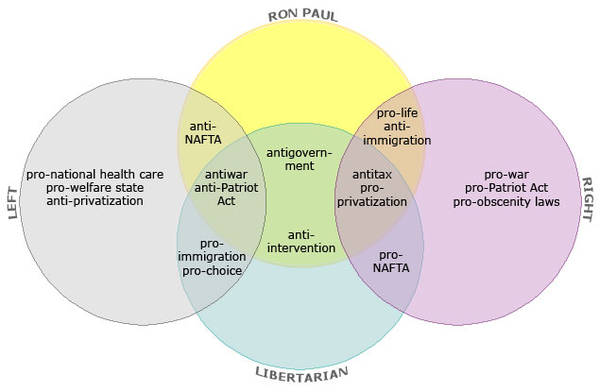 This Venn diagram illustrates not only how libertarians defy
conventional left-right dichotomies, but how Ron Paul differs from conventional
libertarians. His three main differences from more conventional libertarians are that he opposes abortion, immigration, and NAFTA (and perhaps other free
trade agreements), while conventional libertarians (including Johnson) favor
them.
This Venn diagram illustrates not only how libertarians defy
conventional left-right dichotomies, but how Ron Paul differs from conventional
libertarians. His three main differences from more conventional libertarians are that he opposes abortion, immigration, and NAFTA (and perhaps other free
trade agreements), while conventional libertarians (including Johnson) favor
them.
For one thing, as many people have commented, Ron Paul's followers are kind of scary. They have an almost cult-like devotion to their leader and the gold standard and turn out in droves whenever he is criticized. During the Republican primary, they were noted for manipulating the process, infiltrating caucuses to push through their candidate despite the wishes of the majority, and other unsettling behavior. Paul may be a libertarian, but his followers show disturbingly authoritarian tendencies. When a politician attracts a very authoritarian following, regardless of his nominal ideology, this is strong evidence that his followers see some sort of a kindred spirit. Johnson shows no such authoritarian followers. During his governorship of New Mexico, he did start out with a CEO-like tendency to disregard the separation of powers and certain checks and balances. But he learned and improved with time. Certainly I see no threat to democratic norms from Johnson. Paul makes me uneasy.
Next and most obvious -- the newsletters. Although the newsletters are really just a symptom of what Ron Paul was up to at the time. He had cast his lot with a faction of the libertarian movement that had decided to move in the direction of right-wing populism. This amounted to seeking an alliance with Pat Buchanan, the John Birch Society, neo-confederates, white supremacists, anti-government militias, vigilantes, Holocaust deniers, and anyone else who would back a gold standard. The newsletters simply pandered to their worst instincts. Johnson has no such distasteful baggage.
Nor can the newsletters be dismissed as a not-so-youthful indiscretion. For one thing, they completely give the lie to Paul's claims that other politicians pander, but he is a fearless truth-teller who is not afraid to tell people what they don’t want to hear. The letters were a shameless act of pandering to some very disturbing people. Paul’s attempts to disclaim them and deny any association with what went out under his name show that he is as willing to lie as any other politician. Johnson, by contrast, is remarkably candid in admitting mistakes he made in the past and things he has changed his mind about.*
For another thing, the newsletters reflect a very dangerous
psychology. As wise observer put it,
they are not really anti-state, but anti-other masquerading as anti-state. The newsletters appealed to a wide range of
xenophobes – racists, anti-semites, isolationists, and people who simply fear
all change. This is, of course, exactly
the same psychology that underlies fears that any practice of Islam in the U.S.
is a creeping shariah takeover, or that is terrified of releasing any terrorism
suspects, even if proven innocent beyond reasonable doubt, or favors torture of
terrorism suspects, just to be on the safe side. The scapegoats have changed, but not the desire for scapegoats. And if Ron Paul is the scapegoat seeking type, what is to stop him from seeking some new ones.
Finally, there is at least some evidence that Ron Paul has
not left his anti-other past altogether behind.
His opposition to abortion is the most defensible. If you believe that life begins
at conception (and there is no way to disprove it, after all), then abortion is
truly morally indistinguishable from infanticide, and being a libertarian would
no more mean condoning abortion than infanticide. So I think his opposition to abortion does
not disqualify Ron Paul from begin a libertarian. It might also reflect his experiences as an obstetrician,
delivering babies and doing his best to save a pregnancy in danger. But at the very least, it also suggests that
Paul is casting his lot with religious conservatives who are not notably
libertarian. (Gary Johnson favors
repealing Roe v. Wade and returning
the issue of abortion to the states. But
he opposes legislation against abortion before viability).
Opposition to immigration is harder to defend in libertarian
terms. Labor, after all, follows the
same free market rules as everything else – it tends to migrate from areas of
lower price to areas of higher price, and so to equal out prices over the long
run. And, as in other cases where
government tries to block the workings of the free market, immigration
restrictions lead to evasions and increasing repressive policies. Paul wants to "do whatever it takes" to secure our borders, track and deport anyone who overstays a visa, and end birthright citizenship. None of this sounds very libertarian. In fact, it sounds like extremely intrusive
and meddlesome government. Once again, this is more anti-other than anti-state. Johnson, by contrast, favors enlarging and streamlining the work visa
system to bring supply and demand more or less in to balance and give people currently here illegally two years to obtain such a visa. He would allow exclusions of immigrants for
health or safety reasons, but not much else.
But then
again, very few libertarians would go so far as to allow a total free market in
immigration. I thus find Ron Paul’s
opposition to immigration less alarming than his opposition to NAFTA. Why should that seemingly abstract issue be
more alarming than something concrete like abortion or immigration? Because all mainstream, right-thinking
conservatives and libertarians favor free trade. Gary Johnson, for instance, says that he
favors free trade, period, and believes that any currency manipulations and so
forth are minor matters compared to the benefits free trade offers. People on the left may oppose free trade out
of concern for saving U.S. jobs, or poor working conditions in Third World
countries. But on the right, opposition
to free trade is found only in the made fever swamps that Ron Paul inhabited in
the 1980’s and ‘90’s. The people on the
right who oppose NAFTA are ones who oppose any sort of international
cooperation at all as a threat to our sovereignty, who think it is a prelude to
turning North America into something like the European Union, with the United
States annexed to Canada and Mexico and the amero replacing the dollar. Rand Paul is one who holds such views. It makes one wonder about his father.
And, of course, Paul is a goldbug and Johnson
is not. Johnson favors tighter monetary
policy and may favor ending the Fed, but his real focus is on fiscal policy and
balancing the budget. Reading Johnson’s
website, one gets the impression he does not know much about monetary policy,
is not much interested in it, and treats it as little more than an adjunct of
fiscal policy. Ron Paul wants a gold
standard. It seems to be his primary
obsession. A gold standard would be even
more disastrous economically than Johnson’s fiscal and monetary
tightening. Johnson appears to be a
flexible, non-ideological kind of libertarian who is willing to admit when he
is wrong and change his mind. Paul is a
rigid ideologue. Furthermore, although I
know of no logical reason that support for the gold standard should correlate
strongly with support for the John Birch Society, the Confederacy, Glenn Beck,
and other forms of right wing madness.
But as an empirical matter, these views do, in fact, appear to correlate.
All of these
are absolute deal breakers for me with Ron Paul. None of them apply to Johnson. And besides, Johnson is a likeable sort of
guy who can win people over with his sunny personality. Paul is not.
My only real problem with Johnson is that I think his economic policies
would throw us into a major tailspin.
Given that he has not chance of winning, should this be a deal
breaker? That is what I will get to in
my third post.
____________________________________________________________
*Most notably, he was once a strong advocate of capital punishment who
even mused aloud about lowering the age of executions to 14! He has since decided that execution is the
ultimate state intrusion on liberty and therefore something libertarians should
oppose.
Sunday, November 4, 2012
Should I Throw Away my Vote on Gary Johnson?
I voted on Saturday. With a heavy heart and some hesitation, I voted for Obama. In 2008, I walked sidewalks and pounded doors for Obama, hoping that he would reverse the rampant abuses of executive power committed by George Bush.* He didn't. Beyond ending torture, he left those abuses in place, and strengthened them by making them bipartisan. How much that was by choice, and how much it was forced on him by a still hysterical Congress and public is debatable, but those policies have remained. Certainly voting for Romney was out of the question; Romney gives all appearance of wanting to continue the abuses, and perhaps even restore torture.
But what about a third party candidate? I live in New Mexico, which is considered solid for Obama, so we can afford to throw away a few votes. Our former governor, Gary Johnson, is running as the Libertarian Party candidate. Johnson favors ending the PATRIOT Act, maintaining proper judicial oversight over all searches, requiring all terrorism suspects to be charged, and making airport security less intrusive and more risk-based. He wants to avoid foreign wars. He would even allow people wronged by the War on Terror to sue for damages. In all this, he is definitely my kind of guy.
Unfortunately, he also wants to balance the budget in a single year. He would eliminate federal support for Fannie and Freddie, which currently securitize up to 80% of all home mortgage, with the remaining one being held by the bank making the loan. He apparently opposed raising the debt ceiling in order to force an immediate balanced budget. He also favors much tighter monetary policy. His website vaguely says, "Get the Federal Reserve out of the business of creating money, quantitative easing and other efforts to override the free market." It also makes clear that he wants the Fed to focus on price stability only and not unemployment. He has also said in an interview that he opposes "printing money,"** favors abolishing the Federal Reserve, and wants a "strong dollar." All of these, I believe, would be disastrous for the economy (though not as bad as the gold standard Ron Paul proposes). It is further evidence that success in business does not necessarily translate into understanding of a national economy.
So in some ways I am right back where I was when the issue was Ron Paul. Am I willing to vote for a candidate I expect to blow up the domestic economy because I support him on the War on Terror? And, if not, why not? Except that ultimately the decision was much easier with Paul. There were reasons to dislike him beyond his economic policy.
To be continued.
________________________________________________________
*The War in Iraq was less of an issue, because we were already in the process of withdrawal.
**To be fair to Johnson, I do not think he means that remark literally. Taken in context, it is clear that he means we should stop printing money to finance government expenditures, in other words, that we should balance the budget, not that we should adopt the gold standard or some other commodity-based money system.
But what about a third party candidate? I live in New Mexico, which is considered solid for Obama, so we can afford to throw away a few votes. Our former governor, Gary Johnson, is running as the Libertarian Party candidate. Johnson favors ending the PATRIOT Act, maintaining proper judicial oversight over all searches, requiring all terrorism suspects to be charged, and making airport security less intrusive and more risk-based. He wants to avoid foreign wars. He would even allow people wronged by the War on Terror to sue for damages. In all this, he is definitely my kind of guy.
Unfortunately, he also wants to balance the budget in a single year. He would eliminate federal support for Fannie and Freddie, which currently securitize up to 80% of all home mortgage, with the remaining one being held by the bank making the loan. He apparently opposed raising the debt ceiling in order to force an immediate balanced budget. He also favors much tighter monetary policy. His website vaguely says, "Get the Federal Reserve out of the business of creating money, quantitative easing and other efforts to override the free market." It also makes clear that he wants the Fed to focus on price stability only and not unemployment. He has also said in an interview that he opposes "printing money,"** favors abolishing the Federal Reserve, and wants a "strong dollar." All of these, I believe, would be disastrous for the economy (though not as bad as the gold standard Ron Paul proposes). It is further evidence that success in business does not necessarily translate into understanding of a national economy.
So in some ways I am right back where I was when the issue was Ron Paul. Am I willing to vote for a candidate I expect to blow up the domestic economy because I support him on the War on Terror? And, if not, why not? Except that ultimately the decision was much easier with Paul. There were reasons to dislike him beyond his economic policy.
To be continued.
________________________________________________________
*The War in Iraq was less of an issue, because we were already in the process of withdrawal.
**To be fair to Johnson, I do not think he means that remark literally. Taken in context, it is clear that he means we should stop printing money to finance government expenditures, in other words, that we should balance the budget, not that we should adopt the gold standard or some other commodity-based money system.
Subscribe to:
Posts (Atom)