Sunday, November 11, 2012

A Few Final Reflections on the Election

We are now hearing a lot of reports on how badly the Romney ground game was run, compared to Obama's highly efficient one.  Comments one:
While the Romney campaign waited for Orca to function as planned, the Obama campaign had placed signs outside every one of the city's thirty-three polling places, and was fully staffed with two volunteers outside each polling place, and a strike list volunteer inside, all day long from 6 a.m. to 7 p.m. 
 Apparently, there are some things community organizers are better at running than CEO's.  A get-out-the vote effort is one of them.  That was what convinced me during the last election that Obama had the executive ability to be President.  Of course, just as being able to run a corporation well does not necessarily translate into running a campaign well, being able to run a campaign well does not necessarily translate into running a government well.  I have been underwhelmed by Obama's governing style.  But it it yet one more point of evidence that running a company well is no proof of the ability to run a government well.

I will also say that at the time Obama announced the contraceptive mandate it seemed like a huge mistake.  He had exempted churches from the mandate, why not exempt church-affiliated organizations (like schools and hospitals) as well?  Obamacare is controversial enough already.  Why court more controversy unnecessarily?  But actually the decision seems to be working well for him.  Taking one controversial action has served as a lightening rod, attracting all opposition to this one, fairly minor portion of the law.  Opposition to the rest of it has been largely forgotten.

Saturday, November 10, 2012

Why I Didn't Throw Away my Vote on Johnson

Well, I had hoped to finish up on Johnson before the election, but life intervened, so here we are.

Conor Friedersdorf regards Obama's drone strikes (whose power to terrorize and disrupt lives means that their effect go far beyond the people killed), his willingness to include a U.S. citizen among the targets, his war in Libya without congressional authorization, his crackdown on whistle blowers, and his continuation and normalization of Bush's worst civil liberties violations as absolute deal breakers.  At the same time, he certainly has no illusion that Romney would be any better.  And I basically agree.  These are not trivial issues.  These are the primary reason I so fiercely opposed George Bush.  And Obama has continued them. Johnson opposes all of these. He has none of Ron Paul's alarming baggage.  And I thought (at least during the Bush Presidency) that these were the most important issues to me.  So I should vote for Johnson.  And yet . . .

And yet Johnson is yet another businessman who thinks that the principles of running a business translate into a national economy.  He is mistaken.  He favors balancing the budget overnight and keeping the Federal Reserve from fighting economic downturns by monetary expansion.  He may even favor a precious metal standard.  I disagree with Josh Barro, who appears to dismiss the War on Terror and civil liberties concerns as trivial compared to the economy, but neither am I prepared to dismiss the economy as trivial either.  And I agree with Barro that the economy is a moral issue, that it is not moral to crucify mankind on a cross of gold, and (above all) that these things are not entirely separate, that policies that throw an economy into crisis encourage an angry, scapegoating mindset that is dangerous to freedom.  And I agree with him that "'[D]on't worry, Congress will stop him' is not an argument you should have to make about your candidate for president."

Daniel Larison disagrees.  He says that since obviously Johnson will not win, it is pointless to worry about what a hypothetical Johnson Administration would do.  In fact, he is "puzzled" that anyone would worry about such a thing.  A vote for Johnson is a protest vote, intended to send a signal that one rejects the bipartisan consensus in favor of perpetual war and unrestrained executive power.  Who care about an economic agenda that would never be implemented.  And besides the President has much more unilateral power over foreign policy and civil liberties than over domestic and economic policy.  Then again, Larison appears to favor Johnson's fiscal policy as well.  And I agree with Larison's debate partner that the problem with a third party protest vote is that, while it clearly signals some sort of protest, it is not always clear what you are protesting.  Larison assumed that a vote for Johnson is a foreign policy protest vote, when Millman thought of it as a protest against the bipartisan consensus in favor of unlimited executive power and dismissal of civil liberties.  But the establishment might just as well read it as a protest against the bipartisan consensus in favor of paper money and a call for a gold standard.  (Larison appears to favor a Johnson protest vote both on foreign policy and fiscal policy).

And in the end I agree.  Protest votes are useless unless they send a clear signal what you are protesting.  So in the end, my view on Johnson is much the same as my view on Ron Paul.  I am too craven to accept the wreckage of our domestic economy as the price to be paid for ending the madness in the War on Terror.

Friday, November 9, 2012

Reflections on the Election

First of all, in the words of Andrew Sullivan, meep, meep!

Next, I would be fine with either Obama making a narrow win in the popular vote and a decisive victory in the electoral college, or a narrow win in each.  What I dreaded (besides a Republican victory, of course) was either a split with Obama winning the electoral college but not the popular vote.  I expected the Republican reaction to such an outcome would be Donald Trumpian. And a prolonged stalemate while the votes in Ohio or (God forbid) Florida were endlessly recounted was more than I could bear.  Fortunately, we seem to have been spared either eventuality.

Third, I hope that Republicans emerge with the narrative that they were just about to win when Hurricane Sandy delivered the October surprise that swung the election to Obama.  It still won't seem fair, but claiming that Obama caused the hurricane sounds a little too crazy even for the Republican party faithful. I would much rather hear the party faithful blaming the unlucky timing of the hurricane for their defeat than accuse ACORN of rigging the election.*

If we are thinking about getting rid of the Electoral College, our voting system needs a lot of improvement.

It would be a mistake, I think, to read this election as a major realignment, rather than just another swing of the pendulum.   People read the 2008 election as a major realignment and proclaimed that the  end of the Republican Party was at hand.  Republicans regrouped and rode a wave of alarm over Obama's perceived excesses (as well as a still languishing economy) to victory in 2010.  Once again, people read the election as a major realignment and proclaimed that the end of the Democrats was at hand.  Instead, people reacted against the perceived excesses of the Republicans.  No doubt the pendulum will swing back again.

And finally, let's talk about Nate Silver, since everyone else is.  Certainly during the dark days following the first debate, Nate Silver was my main source of comfort.  And conservatives hated him because he told them what they did not want to hear.  To counter Silver and the other wonks, conservatives came up with Unskewed Polls, which was supposed to remove the liberal bias from mainstream polling.

Republicans, from Romney on down, appear to have fallen for their own propaganda.  At least, we are told, Romney had prepared a victory speech, but no concession speech.  He had a website ready for the transition.  And he was prepared to celebrate with a fireworks display. 

But when the rubber hit the road, it turned out that Unskewed Polls was to Nate Silver what Fox News is to real news, what the Washington Times is to the Washington Post, what the Conservapedia is to the Wikipedia, and perhaps even what Qubetv aspired to be to You Tube.  This has led some people to wonder whether the right wing will finally wake up to the realization that unpleasant realities don't go away just because you deny them; that when the math disagrees with your gut, it's because your gut is wrong.  But let's face it.  Human nature doesn't work that way.

The way I see it is this.  The more remote, the more complex, and the more abstract the matter under dispute, the easier it is to be persuasive in denying unwelcome facts.  Evolution, after all, took place over hundreds of millions of years and is not casually observable.**  Global warming is frightfully complex and beyond most people's powers of observation.  What most people know, after all, is their own local weather, which invariably has its ups and downs.  Everything else is too remote to seem real.  Claims that tax cuts reduce deficits may be disproven by the evidence, but the amount of the deficit is something abstract and unreal to most people, and so easy to disregard.  But elections leave no such ambiguities.  They happen in the near future, and the question of which candidate won is obvious enough to leave no room for debate.  So ultimately calling an election wrong is impossible to miss.  These others are easy to obfuscate, so Republicans will continue to do just that.

I will also make a comment on when Nate Silver gets it wrong.  In 2008 he predicted Obama would win by 6.1 percentage points.  He won by 7.2.  He predicted every state except Indiana, which he predicted would go for McCain, but which narrowly went for Obama.  In 2010, he predicted 34 of 36 Senate elections correctly.  He incorrectly predicted that the Republican would win in Colorado.  In fact, the Democrat won by a narrow margin.  And he incorrectly called the Nevada election for Republican Sharon Angle by 3 percentage points, when in fact Harry Reid won by 5.5.  Thus he predicted a 7 seat pickup for Republicans in the Senate, when it turned out to be only 6.  He correctly predicted 36 out of 37 gubernatorial elections.  The sole exception was in Illinois, where the Democrat  defied his predictions by winning by half a percentage point.  In the Senate, he called 31 out of 33 elections correctly.  The exceptions were North Dakota, where the Democrat defied expectations by winning by one percentage point, and Montana, where the Democratic incumbent also defied Silver's predictions and won.

Do you see a pattern here?  Silver's predictions are usually highly accurate.  (1) He usually only gets it wrong in very close elections.  (2) When he is wrong, it is usually in favor of the Republican.***  I can imagine three reasons why this might be.  One is that the polls are slightly skewed in favor of Republicans.  One is that his calculations slightly favor Republicans in close elections.  And the third is that, when it is too close to call, he goes for the Republican.  After all, so long as Silver incorrectly predicts Republicans will win close elections, the mistake can be dismissed as no one is perfect.  If he ever incorrectly calls a race for the Democrat, that will be seized upon as proof of liberal bias.

___________________________________________________
*Difficult theological question for Republicans:  If Obama's election was caused by an act of God, then who does that suggest God favored in this election?
**Except in the evolution of antibiotic-resistant bacteria, pesticide-resistant insects and so forth.
***An exception is in the House elections in 2010.  Silver predicted a Republican gain of 53 seats.  The actual figure was 63.

Monday, November 5, 2012

Ron Paul and Gary Johnson

Ron Paul has refused to endorse Gary Johnson for President, and that refusal is not surprising.  Despite their similar views on many subjects, there are deep-seated differences between the two that make them incompatible.  All their differences, it should be added, favor Johnson and make the decision whether to vote for him more difficult than the decision whether to vote for Paul.

For one thing, as many people have commented, Ron Paul's followers are kind of scary.  They have an almost cult-like devotion to their leader and the gold standard and turn out in droves whenever he is criticized.  During the Republican primary, they were noted for manipulating the process, infiltrating caucuses to push through their candidate despite the wishes of the majority, and other unsettling behavior.  Paul may be a libertarian, but his followers show disturbingly authoritarian tendencies.  When a politician attracts a very authoritarian following, regardless of his nominal ideology, this is strong evidence that his followers see some sort of a kindred spirit.  Johnson shows no such authoritarian followers.  During his governorship of New Mexico, he did start out with a CEO-like tendency to disregard the separation of powers and certain checks and balances.  But he learned and improved with time.  Certainly I see no threat to democratic norms from Johnson.  Paul makes me uneasy.

Next and most obvious -- the newsletters.  Although the newsletters are really just a symptom of what Ron Paul was up to at the time.  He had cast his lot with a faction of the libertarian movement that had decided to move in the direction of right-wing populism. This amounted to seeking an alliance with Pat Buchanan, the John Birch Society, neo-confederates, white supremacists, anti-government militias, vigilantes, Holocaust deniers, and anyone else who would back a gold standard.  The newsletters simply pandered to their worst instincts.  Johnson has no such distasteful baggage.

Nor can the newsletters be dismissed as a not-so-youthful indiscretion.  For one thing, they completely give the lie to Paul's claims that other politicians pander, but he is a fearless truth-teller who is not afraid to tell people what they don’t want to hear.  The letters were a shameless act of pandering to some very disturbing people.  Paul’s attempts to disclaim them and deny any association with what went out under his name show that he is as willing to lie as any other politician.  Johnson, by contrast, is remarkably candid in admitting mistakes he made in the past and things he has changed his mind about.*


For another thing, the newsletters reflect a very dangerous psychology.  As wise observer put it, they are not really anti-state, but anti-other masquerading as anti-state.  The newsletters appealed to a wide range of xenophobes – racists, anti-semites, isolationists, and people who simply fear all change.  This is, of course, exactly the same psychology that underlies fears that any practice of Islam in the U.S. is a creeping shariah takeover, or that is terrified of releasing any terrorism suspects, even if proven innocent beyond reasonable doubt, or favors torture of terrorism suspects, just to be on the safe side.  The scapegoats have changed, but not the desire for scapegoats.  And if Ron Paul is the scapegoat seeking type, what is to stop him from seeking some new ones.

Finally, there is at least some evidence that Ron Paul has not left his anti-other past altogether behind.  

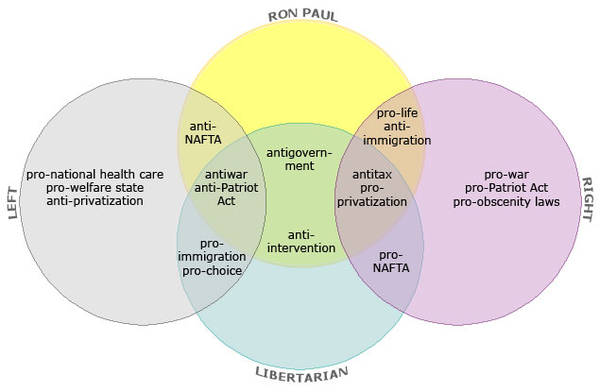
This Venn diagram illustrates not only how libertarians defy conventional left-right dichotomies, but how Ron Paul differs from conventional libertarians.  His three main differences from more conventional libertarians are that he opposes abortion, immigration, and NAFTA (and perhaps other free trade agreements), while conventional libertarians (including Johnson) favor them.

His opposition to abortion is the most defensible.  If you believe that life begins at conception (and there is no way to disprove it, after all), then abortion is truly morally indistinguishable from infanticide, and being a libertarian would no more mean condoning abortion than infanticide.  So I think his opposition to abortion does not disqualify Ron Paul from begin a libertarian.  It might also reflect his experiences as an obstetrician, delivering babies and doing his best to save a pregnancy in danger.  But at the very least, it also suggests that Paul is casting his lot with religious conservatives who are not notably libertarian.  (Gary Johnson favors repealing Roe v. Wade and returning the issue of abortion to the states.  But he opposes legislation against abortion before viability).

Opposition to immigration is harder to defend in libertarian terms.  Labor, after all, follows the same free market rules as everything else – it tends to migrate from areas of lower price to areas of higher price, and so to equal out prices over the long run.  And, as in other cases where government tries to block the workings of the free market, immigration restrictions lead to evasions and increasing repressive policies.  Paul wants to "do whatever it takes" to secure our borders, track and deport anyone who overstays a visa, and end birthright citizenship.  None of this sounds very libertarian.  In fact, it sounds like extremely intrusive and meddlesome government.  Once again, this is more anti-other than anti-state.  Johnson, by contrast, favors enlarging and streamlining the work visa system to bring supply and demand more or less in to balance and give people currently here illegally two years to obtain such a visa.  He would allow exclusions of immigrants for health or safety reasons, but not much else.

But then again, very few libertarians would go so far as to allow a total free market in immigration.  I thus find Ron Paul’s opposition to immigration less alarming than his opposition to NAFTA.  Why should that seemingly abstract issue be more alarming than something concrete like abortion or immigration?  Because all mainstream, right-thinking conservatives and libertarians favor free trade.  Gary Johnson, for instance, says that he favors free trade, period, and believes that any currency manipulations and so forth are minor matters compared to the benefits free trade offers.  People on the left may oppose free trade out of concern for saving U.S. jobs, or poor working conditions in Third World countries.  But on the right, opposition to free trade is found only in the made fever swamps that Ron Paul inhabited in the 1980’s and ‘90’s.  The people on the right who oppose NAFTA are ones who oppose any sort of international cooperation at all as a threat to our sovereignty, who think it is a prelude to turning North America into something like the European Union, with the United States annexed to Canada and Mexico and the amero replacing the dollar.  Rand Paul is one who holds such views.  It makes one wonder about his father.

And, of course, Paul is a goldbug and Johnson is not.  Johnson favors tighter monetary policy and may favor ending the Fed, but his real focus is on fiscal policy and balancing the budget.   Reading Johnson’s website, one gets the impression he does not know much about monetary policy, is not much interested in it, and treats it as little more than an adjunct of fiscal policy.  Ron Paul wants a gold standard.   It seems to be his primary obsession.  A gold standard would be even more disastrous economically than Johnson’s fiscal and monetary tightening.  Johnson appears to be a flexible, non-ideological kind of libertarian who is willing to admit when he is wrong and change his mind.   Paul is a rigid ideologue.  Furthermore, although I know of no logical reason that support for the gold standard should correlate strongly with support for the John Birch Society, the Confederacy, Glenn Beck, and other forms of right wing madness.  But as an empirical matter, these views do, in fact, appear to correlate.

All of these are absolute deal breakers for me with Ron Paul.  None of them apply to Johnson.  And besides, Johnson is a likeable sort of guy who can win people over with his sunny personality.  Paul is not.  My only real problem with Johnson is that I think his economic policies would throw us into a major tailspin.  Given that he has not chance of winning, should this be a deal breaker?  That is what I will get to in my third post.

____________________________________________________________
*Most notably, he was once a strong advocate of capital punishment who even mused aloud about lowering the age of executions to 14!  He has since decided that execution is the ultimate state intrusion on liberty and therefore something libertarians should oppose.

Sunday, November 4, 2012

Should I Throw Away my Vote on Gary Johnson?

I voted on Saturday.  With a heavy heart and some hesitation, I voted for Obama.  In 2008, I walked sidewalks and pounded doors for Obama, hoping that he would reverse the rampant abuses of executive power committed by George Bush.*  He didn't.  Beyond ending torture, he left those abuses  in place, and strengthened them by making them bipartisan.  How much that was by choice, and how much it was forced on him by a still hysterical Congress and public is debatable, but those policies have remained.  Certainly voting for Romney was out of the question; Romney gives all appearance of wanting to continue the abuses, and perhaps even restore torture.

But what about a third party candidate?  I live in New Mexico, which is considered solid for Obama, so we can afford to throw away a few votes.  Our former governor, Gary Johnson, is running as the Libertarian Party candidate.  Johnson favors ending the PATRIOT Act, maintaining proper judicial oversight over all searches, requiring all terrorism suspects to be charged, and making airport security less intrusive and more risk-based.  He wants to avoid foreign wars.  He would even allow people wronged by the War on Terror to sue for damages.  In all this, he is definitely my kind of guy.

Unfortunately, he also wants to balance the budget in a single year.  He would eliminate federal support for Fannie and Freddie, which currently securitize up to 80% of all home mortgage, with the remaining one being held by the bank making the loan.  He apparently opposed raising the debt ceiling in order to force an immediate balanced budget.  He also favors much tighter monetary policy.  His website vaguely says, "Get the Federal Reserve out of the business of creating money, quantitative easing and other efforts to override the free market."  It also makes clear that he wants the Fed to focus on price stability only and not unemployment.  He has also said in an interview that he opposes "printing money,"** favors abolishing the Federal Reserve, and wants a "strong dollar."  All of these, I believe, would be disastrous for the economy (though not as bad as the gold standard Ron Paul proposes).  It is further evidence that success in business does not necessarily translate into understanding of a national economy.  

So in some ways I am right back where I was when the issue was Ron Paul.  Am I willing to vote for a candidate I expect to blow up the domestic economy because I support him on the War on Terror?  And, if not, why not?  Except that ultimately the decision was much easier with Paul.  There were reasons to dislike him beyond his economic policy.

To be continued.

________________________________________________________
*The War in Iraq was less of an issue, because we were already in the process of withdrawal.
**To be fair to Johnson, I do not think he means that remark literally.  Taken in context, it is clear that he means we should stop printing money to finance government expenditures, in other words, that we should balance the budget, not that we should adopt the gold standard or some other commodity-based money system.

Follow Up

Jonathan Haidt says that people elect politicians and favor or oppose policies, not based so much on anticipated outcomes as on what appeals to their moral intuitions.  He concludes from that that liberals should stop focusing so much on outcomes and purely utilitarian calculus and worry more about how to appeal to people's moral intuitions.

I think this is about half right for politicians and about two-thirds right for policies.

I agree that people elect politicians based on moral intuition, not on anticipated outcomes.  But I think that people re-elect politicians based on actual outcomes.  If the actual outcome is bad, no amount of intuitive appeal will make the politician popular when the next election comes around. Suppose either Obama or McCain had decided to put political expediency ahead of the public good in 2008 and come out against the TARP.  Suppose he had led his party in the revolt against it and the TARP had failed.  This decision would have been wildly popular. The bank bailouts violated everyone's moral intuitions in the worst way possible.  The candidate who defeated them would probably have won by a landslide.  Then the financial system would have crashed and the country fallen into a much, much worse economic downturn than it did.  And the heroic candidate who defeated the bank bailouts would become increasingly unpopular and lose the next election.  Granted, people  might not recognize the cause and effect at work.  They might not realize that allowing the financial system to crash caused the economic downturn.  But the practical unpopularity of economic ruin would far outweigh the theoretical popularity of letting the banks fail.

This is not pure speculation.  Consider Franklin Delano Roosevelt.  Roosevelt ran in 1932 as a "Tea Party" candidate, denouncing Hoover for his deficits and pledging to make deep cuts in federal spending and balance the budget.  Clearly he thought this was a much more intuitively appealing approach than calling for a Keynesian stimulus.* And he was right.  Throughout his tenure, Americans surveyed continued to reject Keynesian logic and tell pollsters they favored spending cuts and a balanced budget.  But a funny thing happened.  When Roosevelt ran huge deficits and the economy made a strong recovery, he was wildly popular.  When he balanced the budget and the economy slumped, his popularity slumped along with it.  Clearly practical results trumped intuitive appeal, no matter what people told pollsters.

Policies are a bit more complex than politicians.  I do agree that people tend to favor or oppose policies based on what appeals to their moral intuitions rather than what the anticipated outcome is.  Then again, most people assume that if a policy is intuitively appealing, it will automatically get good results. What if people's intuitions turn out to be wrong?

Well, if an intuitively appealing policy results in immediate catastrophe, it is unlikely to be popular for long.  Raising the government debt ceiling goes against most people's moral intuition.  Most people, after all, have credit limits and can't unilaterally raise them.  It seems unfair that government does not have to play by the same rules the rest of us do.  And running up more debt during bad times always seems improvident.  So Republicans thought that refusing to raise the debt ceiling would be popular.  No doubt failure to raise the debt ceiling would have been popular, but the results would not.  The Republicans apparently assumed that people would consider the abstract principle that the debt ceiling should not be raised to be more important that concrete results. like, say, federal contractors not being paid, federal prisons not being guarded, border patrols ceasing, deposit insurance losing its federal backstop, no more air traffic controllers, and so forth.  But as the date loomed closer and closer and people became increasingly aware of what could happen if the debt ceiling were not raised, refusing to raise the debt ceiling started losing its appeal.  Moral intuition proved unequal to the challenge of the threat of catastrophic results.  Imagine how well it would have stood up to an actual catastrophe.

But immediate catastrophes are the exception and not the rule.  What of merely ordinary counter-intuitive policies with good results or intuitively appealing policies with bad results?  Well, I think that if politicians bite bullet and pass a policy that goes against most people's moral intuitions but yields good results, most people will find a way to modify their intuitions to accept the good outcome.  Certainly that is what supporters of Obamacare are hoping for.

But where I agree with Haidt is that unsuccessful policies that are intuitively appealing can be extremely difficult to get rid of.  That is why, for instance, so many drugs remain illegal, even though their illegal status does nothing to suppress use and merely leads to criminality and ever more intrusive police surveillance.  It is why there is such resistance to fighting AIDS by distributing condoms or needle exchange programs.  It is why religious conservatives resist vaccinating their daughters against cervical cancer or insist on abstinence-only education.  All of these things are about taking a stand against sin versus being complicit in it.  Effectiveness is really not the point.  Religious conservatives are well aware that sin isn't going away any time soon.  But so long as it exists, they are not willing to adopt policies that condone it.  Occasionally, the results of an intuitively appealing but practically disastrous policy can be so bad that even people who supported it end up admitting that their intuitions were wrong.  See Prohibition as an example.

In short, I believe that politicians who are intuitively appealing but practically harmful are often elected, but rarely reelected.  I believe that counter-intuitive but highly successful politicians and policies alike can overcome people's initial doubts.  But I believe that intuitively appealing but practically harmful policies can be extremely difficult to get rid of.  And I think Haidt should acknowledge the importance of outcomes as well as intuitions.

________________________________________
*Okay, so Keynes didn't come out with his theories until around 1936, so this is an anachronism.  But you know what I mean.

Saturday, November 3, 2012

The Moral Foundations of Ending FEMA

The whole question of whether Mitt Romney wants to end FEMA because of his remarks during the Republican Primary.  His words bear repeating;
Every time you have an occasion to take something from the federal government and send it back to the states, that's the right direction. And if you can go even further and send it back to the private sector, that's even better.  Instead of thinking in the federal budget, what we should cut – we should ask ourselves the opposite question.  What should we keep? We should take all of what we're doing at the federal level and say, what are the things we're doing that we don't have to do?
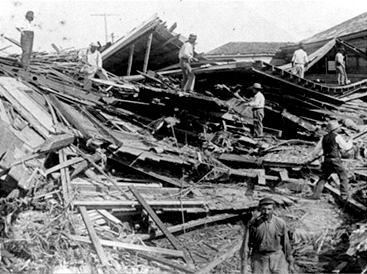
 Romney's position on FEMA is moderate compared to some people's.  Ron Paul wants to abolish FEMA altogether and makes clear that he approves of the good old days when a hurricane destroyed Galveston and the federal government did nothing.*  Other right wingers have discovered a new reason to hate Hoover.  Not only did he cause the Great Depression with his overly interventionist response to the stock market crash, he had already proven himself a socialist by leading federal disaster relief during the Great Mississippi Flood of 1927.  

Liberals are baffled by all this.  Is it really possible for anyone to think it is better for Galveston destroyed than for the federal government to lift a hand to help?  So I will do what I now make my habit when conservatives advocate something that baffles my liberal sensibilities -- run it through Jonathan Haidt's moral analysis.  Haidt argues that liberals have tunnel vision when they focus solely on harm avoidance, with some secondary concerns for justice and freedom.  Instead, he says, liberals should consider that full range of moral foundations that conservatives value -- besides harm avoidance, justice and freedom, we should consider the value of in-group loyalty, respect for authority, and reverence for the sacred.  So, how to these values apply to disaster relief, especially to abolishing FEMA.  And are such arguments likely to have much traction?

Harm avoidance:

Obviously, disaster relief, including by FEMA, is about harm avoidance.  Everyone (I trust) agrees that mitigating harm during a natural disaster is good.  Disaster relief is always a popular charitable cause.  FEMA, when competently managed, plays a major role in harm mitigation.  What values beyond harm mitigation are opposed to FEMA?

Fairness/Justice:

Liberals, Haidt says, tend to equate justice with harm mitigation while conservatives and libertarians see it more as just deserts -- as karma.  He has even expressed concerns that this could go too far -- treating the mere fact that people have suffered misfortune as proof that their misfortunes were deserved.  For the most part, I do not see these concerns applying to natural disasters.  Natural disasters are perhaps the most obvious case possible for bad things happening to good people.  

But there are exceptions.  In every natural disaster, there are people who put themselves in needless danger by taking unnecessary risks.  These are people who don't buy insurance and want FEMA to cover all their losses, people who build in flood plains because they can get federal flood insurance, people who live next to the forest and refuse to clear their land as a firebreak and expect the Forest Service to protect their houses, people who defy evacuation orders despite being healthy and wealthy enough to leave and then expect to be rescued, and (for that matter) people who go hiking during blizzards or take excessively dangerous rock climbs and then expect search and rescue to save them.  I have considerable sympathy for conservatives who lack sympathy for such people.  They not only put themselves in danger, they endanger rescue workers and waste resources that might go to rescuing  people who are genuinely just unfortunate.  But these simply means that we should modify disaster relief somewhat to penalize people who take unreasonable risks.  Getting rid of FEMA altogether is a classic case of throwing out the baby with the bathwater.

Furthermore, I see no evidence that there is wide popular belief that most people caught in natural disasters are to blame for their own misfortunes.  Quite the contrary, the overwhelming response to a natural disaster is one of sympathy and helpfulness, with resentment toward the minority of people who take unnecessary risks as decidedly secondary.

Freedom:

I do not doubt that certain hardcore libertarians or conservatives do see FEMA as in infringement on liberty. These are the ones who oppose all redistributionist taxation as a form of "enslavement."  These are the people who assure you that they will be happy to make voluntary donations to rebuild Galveston, to tax them for the benefit of the people of Galveston is morally indistinguishable from kidnapping them off the streets, carrying the off to Galveston, and forcing them "at gunpoint" to work on a chain gang rebuilding the city.  The fact that paying a tax is less intrusive does not make it less of an infringement on freedom, just more insidious.  Ensuring that the funding for rebuilding Galveston is entirely voluntary is infinitely more important than whether Galveston is actually rebuilt.  In fact, whether Galveston is ever rebuilt at all is not an appropriate public policy concern.  Let us be plain here.  The real argument here is that harm mitigation is not a legitimate public policy concern at all -- only freedom and justice are proper concerns of public policy.**  At least one libertarian has taken this to its illogical conclusion -- if an asteroid were on a collision course with earth and government had the technology to destroy it, it would be better to let all life on earth be wiped out than to spend taxpayer funds to prevent such an outcome.


I do not think this is a viewpoint that is likely to ever have much popular support.  If the liberal view that public policy should be solely about harm reduction is unbalanced, the ultra-libertarian view that harm reduction has no proper role in public policy  In its most extreme form, very few people are likely to see allowing the world to end in order to avoid paying higher taxes as freedom-enhancing.  After all, Patrick Henry notwithstanding, you have to be alive to be free.  In its less extreme form, most people are also unlikely to see the ruin accompanying natural disaster and the confusion apt to follow when recovery relies solely on voluntary donations as freedom-enhancing.

Furthermore, government routinely respond to natural disasters with much more intrusive infringements on freedom than just taxing people to pay for the recovery.  Governments order people to leave their homes; they set of roadblocks keeping people from going home; they order all traffic except emergency responders off the street; they declare martial law and send in the National Guard.  And furthermore, these measures are generally accepted as necessary given the emergency.  People expect government to restrict their freedom during natural disasters in ways that would never be tolerated under more normal conditions.  People accept these restrictions as necessary for their protection. In short, during natural disasters, most people are willing to temporarily let harm minimization trump freedom.  And, what is more, I think most people tend to see more intrusive governmental actions are more freedom-limiting than less intrusive measures, like taxes, offensive as this may be to some libertarians.

Finally, this is just guesswork on my part, but I suspect that most people's objections to redistributionist taxation is more likely to take a conservative/justice perspective than a libertarian/ freedom perspective.  In other words, most people do not object so much to their taxes going to benefit someone else as to their taxes going to benefit someone they don't think deserves the benefit.  Just as a guess, I would say that if you asked most people what they would be willing to voluntarily donate to and what they would be willing to see their taxes pay for, the lists would be very similar.  And disaster relief ranks right up their with cancer research among causes that people like donating to.

Group Loyalty:

This is more fruitful ground.  People argue against FEMA not so much on the grounds of freedom, but of federalism.  Government has a legitimate role in disaster relief, just not the federal government. This is often expressed in terms of freedom -- federal government is seen as much more dangerous and oppressive than state government.  Or freedom is equated with strict constitutionalism -- confining the federal government strictly within the bounds set by Article I, Section 8 of the U.S. Constitution, and any expansion beyond that undermines the rule of law and puts freedom in danger.

I am skeptical that this argument will get very far.  Most people do not draw as sharp a distinction between levels of government as many hard-core federalists might wish.  The idea that an act that is perfectly acceptable and popular if a state does it becomes a monstrous act of oppression if the federal government is involved is simply to rarified to have much popular currency.  

More promising is the argument that close-knit communities should pull together and rebuild out of their own resources.  This is an appealing idea.  And I will say that natural disasters seem to bring out all the best features of group loyalty -- bringing a community together, neighbors helping each other out, close cooperation for the good of the whole, the desire to be helpful and so forth.  And natural disasters seem to suppress the darker side of in-group loyalty -- an us-and-them outlook, and a narrowing of one's moral vision.  Natural disasters simultaneously strengthen in-group ties within a community and widen the circle of most people's sympathy.  They are the only instance I can think of in which those two tendencies are not opposed to each other.

But natural disasters also run up against the limits of group loyalty.  A large-scale disaster often overwhelms the resources of a local community to deal with it.  Are there communities so tight-knit and so distrustful of outsiders that they would turn down outside help under the circumstances?  Probably some Amish or Hasidic communities would (while drawing on help from other groups of Amish or Hasids), and perhaps some far-from-lovable cults.  But I doubt any mainstream community would turn down FEMA if its own resources were overwhelmed.

And local communities are not necessarily all that good at disaster relief, or inherently less oppressive than the federal government.  Certainly New Orleans was not during Katrina.  It should also be noted that the reason Hoover was put in charge of disaster relief in the 1927 flood, and why disaster relief began being seen as a federal responsibility was that local authorities were doing a terrible job.  Communities lacked resources to deal with the damage.  Black people were forced to work on the levees at gunpoint, left in flooded areas while white people were evacuated, imprisoned in refugee camps, and denied access to relief.  New Orleans officials deliberately blew up the levees protecting the poorer parts of town in order to spare the richer parts.  (No doubt this contributed to the widespread belief among black people that something similar happened during Katrina).

In short, I think that appeals to community loyalty as an argument against FEMA may very well have mainstream resonance, but are unlikely to survive the harsh reality of actually attempting the experiment.

Authority:

This might seem like an odd question even to raise.  After all, the government's authority is at its height in the wake of a natural disaster, and notably receives respect.  Government authority is only one kind, though.  Conservatives also value the authority of parents, clergy, employers, civic organizations, and so forth.  Indeed, I suspect one reason they distrust government is the fear that it will seize all authority to itself and undermine these other authorities.  During natural disasters, though, most people are willing to defer to the authority of government and accept the temporary subordination of these other possible sources of authority.

Purity and sanctity:

Haidt likes pointing out that many things liberals favor as harm mitigation strategies are deeply offensive to conservatives because they are seen as not merely passively allowing, but requiring active participation, in sin.  Examples include offering free birth control, drug legalization, needle exchange programs, and so forth.  Needless to say, disaster relief does not fit into this category.

Another party of purity/sanctity that Haidt does not explore as much is seeing certain things, or people, as defiling.  In this case, the source of defilement would be the federal government itself.  The federal government would be seen as a sort of toxic chemical, necessary in some cases, but to be confined so as to prevent its contamination of our otherwise pure society.  I suspect that certain libertarians or hard-core federalists really do see it in these terms.  By contrast, the United States as a country, is clearly seen as sacred, hence the outrage over what liberals dismiss as trivial symbolic issues, like flag burning.  Furthermore, there is ample evidence that the United States is seen as more sacred than any state or municipality.  School children pledge allegiance to the U.S. flag, not to their state flags.  Sports events begin with the Star Spangled Banner.  How many people even know their state song?  Many states fly a large U.S. flag with a smaller state flag below it, on a single flag pole.

Granted, the country is not the same as the government.  But the existence of a country more or less implies that it has a government.  And if people truly see their government as a desecration polluting everything it touches, even something so popular and uncontroversial as disaster relief, then that government has a serious legitimacy crisis at hand.  I do not see such a crisis with us.

CONCLUSION:

Some extreme libertarians or federalists may see federal disaster relief as an outrage against freedom, or as a desecration of the purity of sacred federalism.  I doubt very much, though, that either of these ideas has much potential to go mainstream.  Two criticisms of FEMA may have some mainstream currency.  One is that is subsidizes people who put themselves in danger by taking excessive risks.  This, though, sounds more like  a call to reform FEMA to penalize the irresponsible than reason to abolish it.  The other is that it infringes on the self-sufficiency of communities and discourages them from rebuilding with their own resources.  This argument may, indeed, have mainstream appeal.  It is unlikely, though, to survive for long in the face of the harsh realities of communities whose resources are overwhelmed.  In short, I believe that abolishing FEMA is one of the ideas that appeals to portions of the Republican party faithful, but is unlikely to be popular to anyone else.  And the Republican party faithful seriously overestimate their numbers compared to the general population.

PS:  And right on cue, here we have just that:  An expression of fear that if government does too much in terms of disaster relief, people will lose their resilience and self-reliance and be unable to come to the aid of their neighbors.  I file that under group loyalty, and consider it the best critique of FEMA.  But I don't see it as a plausible argument for abolishing it.

_________________________________________________
*To be fair to Ron Paul, even in the absence of any government intervention whatever, Galveston would not be as badly devastated now as it was in 1900.  The technology did not exist then to know in advance when a hurricane would strike.  
**This view does allow for harm mitigation in the form of law enforcement and national defense.  But these can be defended in terms of justice -- punishing the guilty as well as protecting the innocent.