Wednesday, June 13, 2012

False Memory: pp. 304-326

As Ahriman leads Martie into his inner sanctum and shuts the sound proof door, we can expect some serious exposition.  As we suspected, Ahriman is using his mind control powers to make Dusty and Martie feel strangely, even suspiciously, calm in his presence.  We see demonstrated what was at most faintly hinted at before.  Ahriman gained control over Martie by spiking her coffee in the waiting room.  He sound proofs his office so no one will know what he is doing to his patients inside.  He has a private waiting room outside his office so no one else, like the receptionist or other patients or family members, will see him come out and take control of the person waiting.  And I will have to admit that if Dean Koontz had taken my advice and postponed revealing Ahriman as the villain until his characters found out, all of this would be more difficult to reveal.  But the exposition leaves some important things unanswered.  It fails to explain Martie's mysterious phone call. In fact, it directly contradicts what we have been told before by saying that it was not until Martie's visit to the office yesterday that Ahriman implanted in her an intense fear of her own violent potential.  Yet Martie clearly started showing such fear before going to Ahriman's office, and even before his never-explained phone call.  None of this is ever addressed.

Once Ahriman has Martie alone in his office, he takes control.  He doesn't ask for voyeuristic details of her phobia thus far, but merely works on worsening it.  He shows her pictures of mutilated bodies and tells her to  memorize them and see them in her next panic attack.  He tells her that sadism is our true human nature, but even under his deepest spell, he cannot keep her from having compassion for the mutilated victims he shows her.

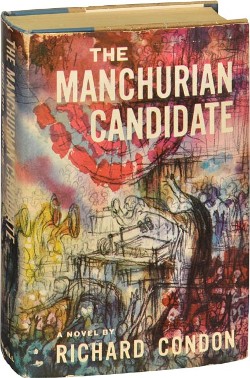
Dusty, in the meantime, is in the waiting room with the mysterious book that Martie thinks she has been reading, but really has not.  It is pristine and has never been opened.  But up till now our focus has been solely on the creep factor that she thinks she has been reading the book without really reading it.  Up till now that has distracted us from the actual contents of the book.  In fact, the contents have been entirely besides the point, so far as we know so far.  It is The Manchurian Candidate.   It seems incredible that Dusty would never have heard of this classic, but maybe I am just showing my age.  It is, of course, about brain washing and mind control.  (It is also a fantasy.  The sort of mind control the novel portrays is not possible).  And, much to Dusty's astonishment, it even features a character named Dr. Yen Lo.  As Dusty reads in fascination, looking for clues as to Skeet's condition, he hears the click of the inner office door opening.  He leaps to his feet and throws the book aside, fearing being caught with it.  This would appear to suggest that he already suspects Ahriman at some level, or why would he be afraid of being seen with the book?  Be that as it may, Ahriman now reveals what has long been screamingly obvious -- Dusty is under his control.
At this point, Ahriman offers a bit of exposition.  After assuming control of Martie, he had her drug Dusty's desert and conducted the programming sessions at their house.  Martie, under his control, could easily be put to the side.  He hooked Dusty up to an IV bottle which is apparently necessary to achieving proper control.  Valet the dog was much to sweet natured to be a good guard dog, so Ahriman just shut him up in the study with a yellow squeaking Booda duck.  This is a good bit of exposition.  It very nicely explains Valet's alarm whenever anyone starts to be under mind control.

It does leave a minor question open.  Apparently programming sessions call for hooking the victim up to an IV bottle.  That necessarily calls for some extended privacy without danger of interruption.  That was easy to do in Ahriman's office with Susan under mind control and out of the way, or in Dusty and Martie's house, with Martie under mind control and out of the way.  But how did Ahriman get sufficient privacy to go through three programming sessions with Susan?  His first session with Susan took place at his own house after she completed the sale, when he toasted the sale with champagne, spiking hers.  But how did he get close enough to conduct the other two programming sessions?   We don’t find out.

Ahriman also reveals that he knows how Dusty stopped Skeet’s suicide, but hasn’t given up wanting to make Skeet kill himself.  How does he know?  Presumably he asked about it during that other mysterious phone call when Dusty Caught the Dog Napping.  But we never find out.  It would only have taken a line or two, but Koontz doesn’t bother.  For that matter, how did Ahriman know he would find Dusty home alone at that particular time?  Presumably he wouldn’t want to exercise telephonic control when both spouses were home, or the one who didn’t answer would notice the other one was acting very strangely.  Maybe he ordered Dusty to be home at a certain time, and Martie to stay with Susan until after that time.  But we aren’t told.  Maybe I shouldn't complain that Koontz gave away the game too soon.  If he had only revealed Ahriman as the villain when Dusty and Martie found out, think how much more exposition he would have had to pack into even less pages.

Then Ahriman makes another blunder.  After telling Dusty not to interfere with Skeet’s next suicide attempt, and to get Martie to his office on Friday, he then tells him, “You will return to the outgoing waiting room, Dusty.  Pick up the book that you were reading and sit where you were sitting before.  Find the point in the text where you were interrupted . . . all recollection from the moment I stepped out of m office, just after you heard the click of the latch, will have been erased.”  He should have erased Dusty’s memory until just before he heard the click of the latch, not until just after.  To hear the click of the latch about to open and then not see the door open is a bit odd.  To hear the click of the latch, throw aside the book and leap to your feet, and then be sitting with the book in your hand, the door solidly closed, is a good deal stranger.  Didn't Ahriman notice that Dusty was throwing away the book and leaping to his feet when the door opened?  

So, Dusty hears a click, throws away the book and leaps to his feet -- and then finds himself again sitting with the book in his hands.  It greatly alarms him.  Clearly, he is missing more time, as if a celestial editor erased some moments from the videotape of his life.  “Apparently, an apprentice editor with a lot to learn.”  But Ahriman is no apprentice.  How could he make such a rookie mistake.  And why doesn’t the sudden lapse of memory in Ahriman’s office direct Dusty’s suspicion to Ahriman?  I know, because Ahriman programmed him not to suspect.  But really!

In any event, Dusty read that the brainwashed soldier in The Manchurian Candidate goes into a trance when someone tells him, “Why don’t you pass the time by playing a little solitaire?”  He plays until he sees the queen of diamonds, and then becomes controllable.  Dusty supposes that the same thing is happening, except with a name from the novel and a haiku.  He calls his foreman and tells him to pick up Martie’s prescription for Valium and a book of haiku.  He is also convinced that the appearance of the book is no coincidence.  Someone must have given it to her to clue her in to what is happening. 

Martie emerges from Ahriman's office feeling better.  Ahriman has told her to feel no more than a vague uneasiness, with brief spells of sharper fear about every hour.  But at 9:00, she is to have the worst panic attack yet.  Martie, of course, is unaware of any of this.  She and Dusty leave with great admiration of Ahriman, and only vague forebodings about why.

Tuesday, June 12, 2012

What Romney Will Not Say in His Inaugural Address


We have a long-standing tradition in this country.  No matter how bitter or hard-fought an election, once it is over, the contestants must endorse the results.  This is an important ritual because democracy calls for two very hard skills – being a good loser, and being a gracious winner.  Neither comes naturally to most people, but both are essential if democracy is to survive.  The is why, no matter how loudly the loser trashed the winner, and no matter what disasters the loser predicted if the election went the other way, the loser must always call to congratulate the winner and must give a gracious concession speech making clear to even the most zealous followers that the people have spoken and we must abide by their decision.  It is why the winner, no matter how much mud he or she has slung, must always strike a conciliatory note in acknowledging victory.  It is why a losing incumbent for President always attends his successor’s inaugural and why the winner who ousted the incumbent nonetheless thanks the incumbent during the inaugural address.

Nasty and hard-fought as this election is and will be, unwilling though the Republicans are to accept any Democrat as legitimate, I do not think we are ready to abandon those rituals, at least not yet.  That is why, much as the Republican base will want to hear it, I do not expect Mitt Romney’s victory speech, or his inaugural address to go anything like this:

My fellow authentic real Americans:  The nightmare is over.  Legitimacy has been restored.  This country has endured the indignity of a Democrat in the White House for the last time.  Ronald Reagan made clear as long ago as 1980 that the Presidency is an office for Republicans only.  Newt Gingrich made clear in 1994 that a Congressional majority is also one that only Republicans may legitimately hold.  And yet Democrats continually contest elections, run candidates, and act as if they had the same right to lead the country that we do.  Indeed, since Ronald Reagan’s time, they have twice usurped the White House, and from 2006 until 2010, they usurped control of Congress as well.  Well, those days are over.  From now on the message is clear.  If you can’t win the Republican primary, you have no business holding office.  Today, Karl Rove’s permanent Republican majority at last assumes the place it has long been due.  And make no mistake, we will NEVER yield it.  

Mitt Romney will not give this message because it is contrary to all accepted etiquette in American politics.  Indeed, this message is so contrary to our political tradition that I doubt the even most people who believe it dare think it in so many words.  But make no mistake.  Mitt Romney is very smart.  He may not come right out and say as much, but I have no doubt he will manage to get the message across.

Sunday, June 10, 2012

False Memory: pp. 263-303

We are now to page 263 of False Memory, which is also the beginning of the second day.  (The whole story takes place in a remarkably short time).  Somewhat hung over from too many sleep caplets, Martie cannot muster a full blown panic, but remains uneasy, fearful that she might to something violent to Dusty.  She says, "I feel like birdshit."  Dusty is very interested in her choice of words. Why bird?

The novel does not address the issue much further, but we are left to suspect that the reason Dusty is so interested in Martie's choice of words because he believes her breakdown is related to Skeet's an is looking for commonalities.  When Skeet was standing on the roof, preparing to jump, a crow dive bombed his shoe, and he said, "This is my life."  If Martie is using the same metaphor, this is a commonality suggesting they got it from a common source.  Alas, like so many other clues in the book, this one goes nowhere.  It would be a simple matter to have Ahriman refer to bird shit at some point, but he does not.

Dusty tries to keep Martie going with a mixture of coaxing, cajoling, jollying, bullying, threatening, taunts, insults and sarcasm that sounds annoyingly similar to what Martie was doing to get Susan going. In fairness to Koontz, he recognizes the similarity, and even has Martie comment on it, saying that Dusty is treating her exactly the way she has been treating Susan. I'm glad that Koontz has noticed he has written two essentially identical batches of dialogue, but not quite happy with the implications. I can only assume that Koontz has Dusty and Martie react in the same way to a troubled person they love because he assumes this is how everyone would react if someone they loved developed a serious phobic disorder. My own guess is that different people would tend to react quite differently under the circumstances.

Then we get an episode of people reacting the same way that is clearly not intended to be normal.  Just as they are about to leave for Martie's appointment with her doctor, Dusty and Martie say in the same breath that if nothing turns out be be physically wrong with her, she should be treated by a psychotherapist for anxiety disorders.  They use different words to express this thought, but at exactly the same time name who they had in mind -- Ahriman.  So just in case Dusty's previous lapse of memory hasn't clued you in that he is under Ahriman's control, this should make it obvious.  Of course, Dusty and Martie see nothing obvious here and simply put it down to being married so long they are starting to think alike.  They call Ahriman's office and leave a message about wanting an appointment.

On the way to Dr. Closterman (the family doctor), Dusty stops by Skeet's apartment looking for evidence he belongs to a brain washing cult.  He doesn't find any, of course.  The only literature Skeet has are fantasy novels about wizards and dragons.  But Dusty is forced to reveal that Skeet jumped off the roof and has been acting strangely, even by drug addict standards.  Martie has another major panic attack on the way to the doctor's office, seeing hideous images of death and violence, but it ultimately passes.

Closterman finds nothing physically wrong with her.  He duly orders tests, but is basically unconcerned until Martie has a miniature panic attack at the sight of his reflex hammer and ballpoint pen.  She tells him the violent fantasies she had just from looking at them, and he agrees she could use psychotherapy.  Dusty mentions that they are already seeking help from Dr. Ahriman, and Closterman reacts strangely.  He makes no criticism, but his face goes strangely expressionless, and he tries to steer them to someone else.  Dusty spots his reaction and wonders why he so dislikes Ahriman.  But he doesn't ask, nor does he mention that they have already called Ahriman's office to make an appointment.  He wonders at this odd reaction in himself.  Furthermore, when Martie is having the tests done, Ahriman's receptionist calls to tell them that he can get them in that afternoon.  Dusty is greatly relieved and wonders why he feels so relieved.  Normally he has an intense distrust of experts, the result of having been raised by too many of them.  He decides that he must be as gullible as anyone else, when someone he really cares about is at stake.

All right, already!  We get it!  Unlike the vague clues earlier on, these ones are coming on hard and fast as hammer blows.  Obviously Dusty is under Ahriman's control.  Lighten up already!  The fact that Ahriman was able to get them in that afternoon should be enough to set off alarm bells in anyone not under his spell.  Has Koontz every tried making an appointment with a specialist?  You don't get in the same afternoon.  There is a maddening waiting period.  And keep in mind that Dr. Ahriman is not just any specialist; he is a celebrity psychiatrist with a best selling book.  Normally you would expect someone like that to have a waiting list six months long.

When Dusty arrives in Ahriman's office, the strangeness continues.  Looking at the storm brewing outside Ahriman's picture window, Dusty has an overwhelming sense of menace and unease.  But when he looks around the office and especially at Ahriman, a strange, downright ominous, calm comes over him.  Dusty thinks, "This was a safe place. Dr. Ahriman was a great psychiatrist.  Everything would be all right now that Martie was in Dr. Ahriman's care.  Dr. Ahriman was deeply committed to his patients.  Dr. Ahriman would make this trouble go away." This would not in itself be sinister, except that it is just like Martie's insistence that the book writing was good; the plot was entertaining; the characters were colorful; she enjoyed it.  In other words, the same phrases keep running through his head over and over, like a mantra.  Dr. Ahriman calls Martie's disorder autophobia (fear of self).  He suggests that it arose out of a sense of guilt that she could not do more for Susan.  Dusty smiles, nods along, asks all the right questions on cue, and has a vague feeling that there is something wrong with his reaction.

Ahriman leads Martie into his inner office and closes the sound proof door.  First, though, he offers Dusty some coffee or another beverage.  Dusty turns him down.  Smart move, Dusty, but it's too late!  We are about to learn what is really going on in these mysterious sessions at Ahriman's office.

Monday, June 4, 2012

On the Lighter Side

On the lighter side, I should note the top options that come up when type "Romney" into Google:

Seamus Romney
Romney dog on roof
Romney religion
Romney dog
Romney vs. Obama
Romney for President
Romney tax plan
Romney delegate count
Romney running mate
Romneycare

As some wit commented, apparently the Seamus story had legs (four of them).

PS:  I should add that when I enter Obama into google, the results are:

Obama
Obamacare
Obama approval rating
Obama birth certificate

Romney's Cynical, Dangerous and Successful Strategy

As if the news in general were not depressing enough, here is an article on Mitt Romney's cynical, dangerous, and successful approach.  Romney has a problem with the base.  They have major differences on the issues.  He wants a fiscal expansion.  They want austerity.  They hate universal healthcare with a passion.  He achieved it in Massachusetts.  But Romney has now discovered that the base doesn't really care where he stands on the issues.  They just want no-holds-barred hatred of Obama.


They also appear to have decided that McCain threw the campaign by refusing to stoop to personal attacks.  That is a distinct bit of revisionist history.  McCain made plenty of personal attacks.  He accused Obama of "pallin' around with terrorists," played up his relations to Bill Ayers, he ran the celebrity ad.  He even ran "The One" ad, at best an attack that Obama was full of himself, and at worst, a hint that he had a messiah complex and might be the anti-Christ.  Indeed, during one of the debates, McCain even said that ACORN "is now on the verge of maybe perpetrating one of the greatest frauds in voter history in this country, maybe destroying the fabric of democracy."  That sounds very much as though McCain was implying that if Obama won, it would be "one of the greatest frauds in voter history" and might "destroy the fabric of democracy."


But he had his limits.  Although he kept accusing Obama of "pallin' around with terrorists," he did not let followers take that to its logical conclusion, but kept reminding people that he meant Ayers, "a washed up old terrorist from the '60's."  When angry crowds shouted, "Arab!" "Terrorist!" and "Traitor!" McCain rebuked them.  He said that they had policy differences, but he had no doubt that Obama was a loyal American.  Conservative activists saw this as weakness.  The article does not discuss why they saw this as weakness.  Some of them no doubt genuinely believe that Obama was in league with Islamic terrorists to destroy America.  But I can only assume that a good many know perfectly well that this was not true, but thought that McCain should have encouraged false beliefs if it would fire up the base.  They also no doubt believe that if the base had been fired up enough, McCain would have won.  Given the overall situation -- a war-weary public and the worst economic crisis since the Great Depression -- it seems unlikely that the Republicans could have won no matter how much they fired up the base.


It seems likely that McCain knew that.  It also seems likely that he saw more at stake than the outcome of one election, like the health of our general democracy.  Simply put, I think McCain was an old-fashioned sort of guy who believed in the loyal opposition.  He thought that encouraging false beliefs, especially the false belief that the man likely to be the next President is a traitor in league with his country's enemies, poses a serious threat to the health of democracy, which requires participants to be good losers.  It may even have entered into his mind that the last time the losing party refused to accept the outcome of an election as legitimate, it was Democrats refusing to accept a Republican victory, and the year was 1860.


Romney, by contrast, has no such scruples.  He refuses to repudiate the birther, Donald Trump.  When a supporter called for Obama to be tried for treason (to loud applause of the crowd), Romney did not endorse the remark, but he took care not to question it.  


Given the state of the economy, I fully expect Romney to win.  Republicans will then take that as vindication of treating the Democrat (any Democrat) as a traitor and false American.  But suppose by some miracle the economy improves and Obama wins?  Large portions of the Republican base will believe their leadership had endorse their belief that President Obama is a Kenyan-born traitor.


This sort of attitude bodes very ill for the health of democracy.

Sunday, June 3, 2012

False Memory: The Problem of Evil/Ahriman

As we have seen, the first 25 chapters of the book shifted perspective between Dusty and Martie as they went about their separate daily activities.  The technique is highly effective.  The increasingly creepy and alarming things happening to Martie alternate with Dusty's seemingly straightforward story about his drug addicted brother's self-destructive behavior.  Not until Chapter 20 (or so) do we begin to suspect that Skeet's off behavior may be more than just a drug addiction, let alone that they may be related to what is happening to Martie.

Once Dusty and Martie come together in Chapter 25, we can no longer alternate between them, but Koontz liked the shifting perspectives so much that he wants to keep doing it.  At first he shifts perspective between Dusty/Martie and Susan.  That is effective at first, as Susan hits on the idea of using the camcorder to catch her phantom rapist, but as soon as the villain is revealed to be Ahriman, something is lost.  Dusty is working hard to figure out what is going on, but the audience no longer has to work at all, because Koontz just showed us the back of the book so we longer have to figure it out.  No fair!

Now Susan is dead, so Koontz needs another perspective to alternate with.  The only candidate he can think of is -- Ahriman.  The book would be better off if this part were vastly reduced.

I agree that at least some Ahriman passages are essential for the sake of exposition.  Dusty is doing a fine job of figuring out how the mind control works from the viewpoint of the operator.  What he does not ever figure out or even attempt to figure out was how that control was established in the first place. We therefore need Ahriman to explain that to us, and indeed, he does.  He gains control by three times drugging his victims with his own special combination of drugs and engaging in three programming sessions with them in their drugged condition.  In Susan's case, she was a real estate broker who sold him his present house.  He invited her to toast the sale with champagne and secretly drugged hers for the  first session.  (The book does not explain how he got to her the second time).  Martie was drugged while accompanying Susan to his office.  This is useful information we need Ahriman to give us.  In addition, although Dusty gradually figures out how to operate a person under mind control, he is naturally somewhat clumsy and amateurish at it.  We need Ahriman at some time to give us a demonstration of how a pro works.  This exposition would also be useful to clear up some of those unexplained clues Koontz keeps planting.  Unfortunately, although some of the clues do get explained, a great many do not.

Other than providing exposition, Ahriman is mostly a nuisance.  Consider what we already know about him.  Ahriman is a psychiatrist who uses his training to exercise brainwashing and mind control over people.  He creates phobias and anxiety disorders and, under the guise of treating them, makes them worse and worse, tormenting his patients with terrible psychological maladies.  He also uses his mind control to rape female patients and subject them to unspeakable depravities.  He also uses his powers to make patients commit suicide or (it is beginning to be hinted) commit murder and spectacular crimes.

All of these are integral to the plot.  Any one of them should be sufficient to mark him as evil.  All of them combined mark him as really, really evil.  But apparently that is not enough for Koontz.  He has to add all sorts of pointless embellishments.  Besides all that, Ahriman relishes nothing so much as a woman's tears.  In his youth he dissected live cats and dogs and even a boy.  He killed both his parents.  He cut his father's eyes out and saves them in formaldihyde.  He drove a power drill through his step mother's heart.  And all sorts of other details that serve no purpose except to show off how thoroughly evil he is.  We get the point already!

Showing off gratuitous and pointless evil has no real appeal.  There are various reasons to dwell upon the villain.  One, mentioned above, is to provide exposition that no one else in the story can offer.  Koontz does a fair job with this, although a good deal remains unexplained.  A similar but not identical purpose is to show off the villain's fantastically intricate plot that, despite its evilness, has a certain artistic beauty in its complexity.  Koontz indicates that Ahriman does sometimes develop such plots, but in this particular case, he appears to be winging it.

Another possible reason to dwell on the villain is that he is not wholly evil, but has doubts and  misgivings.  Koontz, however, apparently has little tolerance for moral ambiguity and prefers his villains completely and utterly evil.  Of course, a villain can be completely and unambiguously evil and still be attractive.  But Koontz doesn't want his villains to be attractive.  He thinks that making evil attractive is immoral.  Or, as he puts it:
My villains are pathetic. I never glorify a villain. I couldn’t write something like Hannibal because there’s something there that makes the villain the most glamorous person in the piece. I can’t write that. I don’t find evil glamorous. You’ll never find it that way in my books.
 But evil can, after all, have a certain seductive appeal.  Much of great literature is devoted to exploring that seductive appeal and why it exists.  Of course, much of great literature is not.  If Koontz does not want to explore the seductive appeal of evil for fear of seducing his readers, that is certainly reasonable.  But to judge from the effort he expends establishing just how pointlessly and gratuitously evil Ahriman is, whether relevant to the plot or not, one can only conclude that evil has a definite fascination to Koontz.  Why?  Koontz explains:
 I need to portray the true struggle of this world, so there are bad characters in my books. We need to be honest about the violence that we face, including that which we became aware of on 9/11 — an evil that denies the legitimacy of the civilization that we know and an evil that doesn’t value human life. A lot of people want to turn away from it. We’re going to be defeated by it if we can’t recognize the depth of that evil.
Evil walks among us. We don’t always see it. Each of us, in our daily lives, encounters evil; we are tempted to evil every day of our lives. If we don’t want to read about it or think about it, I don’t think that’s a truly Christian point of view. We have to acknowledge it, face it and defeat it. That’s what each of my books is about.
But let's face it.   Evil is real, all right, and that fact has to be faced.  But characters like Ahriman -- dissects live puppies, killed both parents, pickled his father's eyes, causes innocent people to go on murderous sprees, etc. etc -- may exist, but they are extremely rare.  Koontz' readers are most unlikely to encounter anyone even remotely like Ahriman in their lives.  To suggest that people like Ahriman are lurking around every corner is a sure-fire recipe for paranoia.  To suggest that evil is Ahriman is an invitation to ignore or dismiss the countless petty misdeeds that are the form of evil most people encounter most often -- an are most likely to be tempted by.  Indeed, if the point of your novel is to encourage people to fight the ordinary evil and temptation of their everyday lives, defining evil as someone like Ahriman is the easy way out.  It makes it easy to say, "Well, I'm nothing like Ahriman, so I must be Good."

Just to be clear here, I am not saying that the villain has to be attractive, or morally ambiguous, or represent the sort of evil ordinary people are likely to encounter in their everyday lives.  All I am really saying is that if the novel is going to focus on the villain a lot, he should at least be entertaining and fun to read.  Ahriman's preening and posturing about how evil he is, is not entertaining or fun to read.

Ah, but there is one other kind of villain who can provide entertainment.  That is the comic villain, whose evil is not very effectual, and who is mostly put in for laughs.  Remarkable as it may seem, Ahriman actually does begin assuming that role around Chapter 65, page 466 (the book has short chapters).  By this time, events have spiraled out of Ahriman's control, Dusty and Martie are having more traditional action-packed adventure, and Ahriman is left to serve mostly as comic relief.  He is actually surprisingly effective and entertaining in that role, and fun to read.  (And he is already established as so thoroughly evil that showing him in a comic light in no way detracts from his evilness).

But until then, Ahriman's only real value is a source of exposition; otherwise he is an annoyance.  I will therefore gloss over the Ahriman sections except to the extent they offer exposition.

Friday, June 1, 2012

Despair All Around

I have never faced an election with such despair as this one.  Conventional wisdom has it that the House will stay in Republican hands, although Democrats may pick up a few seats; the Senate will probably (but not necessarily) flip to Republican control, and the Presidential election is too close to call.

I canvassed for Obama believing that he would reverse the worst abuses of the Bush War on Terror.  Aside from ending the official practice of torture, all he has done is consolidate them.  I applauded Obamacare and Frank-Dodd, thinking that even if he lost in 2012, these would remain as legacy (rather was Bush’s worst abuses remained as his).  But Republicans are taking a far more root-and-branch approach  that Democrats ever did, and the Supreme Court may very well do their work for them.

So, what are the possible outcomes?

 Obama wins, Congress remains Republican.  The result will be all-out war.  Republicans will see their mission as destroying the Obama presidency to assure that no Democrat is ever elected again.  They may even refuse to raise the debt ceiling and force a default.  Any damage the larger country may suffer will be acceptable collateral damage so long as Obama is blamed.

 Romney wins, the Republican right prevails in Congress.  Granted, it is considered unlikely that Republicans will get a filibuster-proof majority in the Senate, but that little obstacle is easily overcome by eliminating the filibuster.  Root-and-branch repeal of Obamacare and Frank-Dodd will be their top priority.  Passing the Ryan budget, making huge cuts in Medicaid, Food Stamps, and other programs for the poor, cutting off funding for family planning, and slowly privatizing Medicare will be passed.  It is estimated that Ryan’s cuts will raise the number of uninsured by 14 to 27 million.  Since the cuts will be made under the guise of turning Medicaid into a bloc grant to states so they can make it more efficient, states will get the blame for the increase in number of uninsured.  Also, as I understand it, Ryan will also cut off the federal assistance that made Romneycare possible, and thereby ensure that no state can reduce the number of uninsured.  Of course, these will be offset by a huge tax cut, so the deficit will balloon.  I suppose this could be the Keynesian stimulus the economy needs.  But at least according to conventional liberal wisdom, injecting money at the bottom is more effective than injecting it at the top because people at the bottom are more likely to spend it.  What I cannot tell is whether the ballooning deficit will be ignored on the grounds that deficits only  matter when Democrats are in power, or will provide the perfect excuse to cut Medicaid, Food Stamps, and other programs for the poor even more, if not eliminate them outright.  I would like to think that all of this will be unpopular and provoke a backlash against Republicans, but even if it does, the damage will remain.  Oh, and of course, the official practice of torture will be revived.

 Romney turns out to be Eisenhower  (or, perhaps, Obama).  What do I mean by this?  The Truman presidency was a time of bitter partisan strife because the U.S. was going through a transition.  Ever since George Washington’s Farewell Address in which he warned against “entangling alliances,” U.S. policy had been not to get mixed up in Europe’s conflicts.  Obviously we made two big exceptions during WWI and WWII, but these were seen as exceptional circumstances.  With the Cold War, Truman was asking Americans to set this tradition aside and become permanently “entangled” in Europe.  Yet even as Truman was calling for the US to take a world-wide stand against Communism, he was also in the process of shifting the New Deal from an emergency measure to deal with the Great Depression into permanent policy and trying (unsuccessfully) to expand it.  These actions struck many conservatives a socialistic.  Then he sent in troops to fight Communist aggression in Korea.  This was represented another major shift in policy.  It was our first large-scale limited overseas engagement.  Until then our overseas commitments had been either quite small in scale, or world wars.  Many people at the time assumed that the Korean War was the opening salvo in WWIII.  General McArthur famously wanted to invade China and start WWIII.  Plenty of people were so frustrated with a large-scale, intractable, limited war with no victory in sight that they regarded WWIII as an improvement.

The Republican reaction to all this was McCarthyism.  A lot of it seemed more like reflexive opposition to anything Truman did than anything else.  McCarthyists simultaneously sought to block Truman’s attempts to fight Communism in Europe while accusing him of being soft on Communism and madly hurling accusations of Communism against anyone who told them what they didn’t want to hear.  The denounced Truman for squandering blood and treasure in Korea and simultaneously wanted to escalate into WWIII.  And, most famously, they started investigating anything and everything for Communist infiltration, even as they ignored the Communist threat abroad.  Truman left office wildly unpopular.

Eisenhower was a moderate Republican, but seeking the nomination meant pandering to the right wing of the party.  In particular, McCarthy has been making accusations against George C. Marshall, the chief of staff during WWII, Truman’s secretary of state who developed the Marshall Plan, and later secretary of defense.  To Truman, attacks against himself were politics as usual, but attacks on Marshall were an outrage not to be tolerated.  He expected Eisenhower, who as field commander during WWII had worked closely with Marshall and knew his character, to come to his defense.  Bowing to the McCarthy wing, Eisenhower failed to do so.  Truman never forgave him for that.

But once Eisenhower came to office, things began to change.  McCarthyists discovered that Communist infiltration was only an issue when a Democrat was in the White House, and that with a Republican, all the Communists mysteriously went away.  Eisenhower also accepted the New Deal as a fait accompli and dismissed any attempt to undo it as political suicide.  He ended the war in Korea and resisted the temptation of starting another one in Vietnam.  Partisan acrimony faded.  Eisenhower effectively solidified Truman’s general legacy.  Truman looks a lot better in retrospect than he did when he was in power.

So, what does it mean to say Romney might be Eisenhower?  Well, undoubtedly he would still bring torture back, since (as Obama quickly learned) upholding the rights of scary brown people is a political loser anyhow.  And he would throw terrorist suspects into Guantanamo and hold them indefinitely without a trial for much the same reason.  But he has gone on record saying suspiciously Keynesian things, that he does not want his tax cuts matched by immediate spending cuts because they would shrink the economy.  Certain conservatives have advocated introducing a new healthcare plan that ends the fee-for-service approach to Medicare (just what Obama did, and was denounced for establishing “death panels”), would give everyone a refundable tax credit that can only be spent on health insurance (nothing but the mandate under another name), make available comparative information about effectiveness of different medical approaches (again, something denounced as death panels when Democrats did it) and have insurance companies promote healthy behavior (as opposed to that tyrant Michelle Obama).  Hell, some conservative have even hinted at breaking up Too Big To Fail banks, something they would have denounced as a Communist dictatorship if Obama had done it.

So how would I feel if Romney played Eisenhower?  On the one hand, we could see these things as vindication, much as the right saw Obama's adoption of most of Bush's War on Terror policies as vindication.  Or, more optimistically, as Nixon going to China.  It would, after all, give us what we wanted -- a Keynesian stimulus to revive the economy, and universal health care.  But it would mean that Republicans get the credit.  And worse, Republicans would be able to argue that they were able to deliver when Democrats were not and therefore should be the only ones entrusted with political power.

This will, once again, but submitting to blackmail.  It will, in effect, be granting Republicans a monopoly on power because they will make the country ungovernable unless given it.

That being said, there is an obvious obstacle to the Eisenhower route.  If Romney were to propose a Keynesian stimulus and some form of universal healthcare, Democrats would have to either favor or oppose it.  If they oppose it, all fine and good, Republicans can accuse them of mindless partisanship and boast how much more effective they are than Democrats.  But if Democrats agree to support either of these proposals, the effect will be to kill them.  Republicans will not dare vote yes for fear of a Tea Party primary challenge.

So we circle back to the beginning.  All alternatives fill me with despair.

PS:  Most of this post was written several days ago.  That was just before we got today's very bad economic news.  I think we can now rule out Outcome 1.  Obama is toast.  We are having a Lehman Brothers moment.  Barring a miracle, this election will be a Republican blow out.